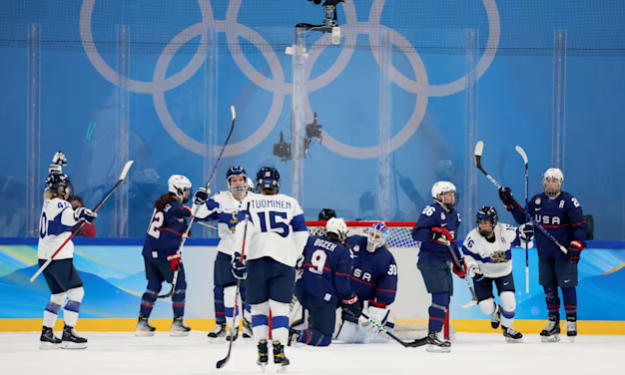
hockey
We talk pucks and objects of that kind. We yell, complain, and analyze in the language of hockey fandom. Gretzky can do no wrong.
2026 Winter Olympics Men’s Figure Skating: When Power, Precision, and History Collided on Ice
The men’s figure skating competition at the 2026 Winter Olympics in Milan delivered exactly what fans hoped for — breathtaking athleticism, technical evolution, and moments that may redefine the sport for a generation. Held at the Forum di Milano as part of the Milan-Cortina Games, the event became one of the most watched and debated showcases of the Olympics, blending raw power with artistic control at a level never seen before.
By Story Prismabout 7 hours ago in Unbalanced
Chloe Kim Eyes Historic Three-Peat at 2026 Winter Olympics Women’s Snowboarding Halfpipe
The 2026 Winter Olympics in Milan-Cortina have delivered unforgettable moments across all disciplines, but few events have captured global attention like the Women’s Snowboarding Halfpipe. With the likes of Chloe Kim defending her Olympic titles, the competition has become a thrilling spectacle of athleticism, creativity, and nerve. As the Games reached February 12, 2026, the Halfpipe finals emerged as a centerpiece, blending high-stakes competition with the artistry and daring that define snowboarding at its highest level.
By Story Prisma day ago in Unbalanced
2026 Winter Olympics Ice Hockey. AI-Generated.
Ice hockey has long been one of the defining events of the Winter Olympic Games, combining speed, strategy, and national pride in a way few other sports can match. As the world turns its attention to the 2026 Winter Olympics in Milan and Cortina d’Ampezzo, ice hockey is once again expected to take center stage. With historic rivalries, emerging talent, and the possibility of top professional players competing, the tournament promises to be one of the most compelling chapters in Olympic hockey history.
By Saboor Brohi 3 days ago in Unbalanced
Men’s Short Program in Figure Skating. AI-Generated.
The men’s short program in figure skating is one of the most demanding segments in the sport. Though it lasts only a few minutes, it carries enormous weight in competition. Every movement is judged, every jump must meet strict technical requirements, and even small mistakes can significantly affect standings. In elite events—whether national championships, world competitions, or the Olympic Games—the men’s short program often sets the tone for the entire event.
By Saboor Brohi 3 days ago in Unbalanced
Greeley-Jay Suffers Gut Wrenching Loss to Pawling
Scroll to end for photos and video On Friday January 16, Greeley-Jay hosted Pawling at the Brewster Ice Arena and neither team backed down in the face of numerous momentum shifts. Pawling led 2-0, John Jay tied, and the game stood at 5-4 with 11 minutes remaining. Unfortunately, the deciding momentum was gut wrenching for the home team.
By Rich Monetti7 days ago in Unbalanced
Liam Greentree. AI-Generated.
In professional hockey, not every meaningful story begins with a blockbuster trade or a superstar signing. Some stories start quietly, in junior arenas and scouting reports, where future impact is measured not by headlines but by potential. Liam Greentree belongs to that category. While he does not yet carry the global recognition of established NHL stars, his development reflects how teams build for the future in a league often dominated by elite names like Artemi Panarin. Liam Greentree has emerged as a promising young forward whose game is built on intelligence, size, and adaptability. Known for his strong two-way play and composure with the puck, Greentree has steadily gained attention from scouts and analysts who value players capable of contributing in multiple situations. His growth comes at a time when NHL organizations are increasingly balancing star talent with depth players who can sustain success over long seasons. The modern NHL is shaped by contrast. On one end are high-profile stars such as Artemi Panarin, whose creativity and offensive brilliance have defined franchises. On the other are developing players like Greentree, whose value lies in consistency, development, and long-term upside. Understanding Greentree’s trajectory requires viewing it within this broader ecosystem. Panarin’s journey serves as a useful reference point, not because the two players share identical styles, but because Panarin’s career illustrates how teams evaluate talent and timing. The Artemi Panarin trade that sent him from the Chicago Blackhawks to the Columbus Blue Jackets reshaped expectations around elite wingers and asset management. Later, his move to the New York Rangers cemented his role as a franchise centerpiece, turning the NY Rangers into a perennial playoff contender. For teams like the Los Angeles Kings, player development has become just as critical as headline acquisitions. The LA Kings have built much of their recent strategy around drafting and developing young talent rather than relying solely on free agency. This environment highlights why prospects such as Liam Greentree matter. While he is not connected directly to the Kings’ roster decisions, his development reflects the type of player many franchises seek—someone who can grow into responsibility rather than demand it immediately. Greentree’s game is often described as mature beyond his years. He plays with a strong sense of positioning, making smart decisions under pressure and showing patience in offensive zones. Unlike flash-first players, he focuses on efficiency, puck protection, and awareness. These traits may not generate viral highlights, but they translate well to professional systems where structure and reliability are prized. Comparisons to established stars can be misleading, and Greentree is not being positioned as the next Panarin. Artemi Panarin’s offensive instincts are rare, and his ability to control tempo sets him apart. Still, Panarin’s career underscores how development paths vary. Panarin entered the NHL later than most stars and still became one of the league’s most dangerous scorers. Greentree’s path is different, but it reinforces the idea that patience and opportunity matter as much as raw skill. The influence of major franchises like the New York Rangers also shapes how prospects are evaluated league-wide. When Panarin joined the Rangers, expectations shifted overnight. The team transitioned from rebuilding to contending, placing greater emphasis on complementary players who could support elite talent. Prospects entering the system—or being evaluated by rival teams—are now judged partly on how well they could function alongside stars. This context matters for players like Liam Greentree. As the NHL becomes faster and more tactically complex, teams need forwards who can read plays, support defensively, and adapt to different line roles. Greentree’s ability to play responsibly without sacrificing offensive contribution makes him a valuable developmental asset, even if his name does not yet dominate conversations. Another factor shaping Greentree’s outlook is the league’s evolving attitude toward trades. The Panarin trade remains a case study in how teams weigh present value against future flexibility. While Greentree has not been the subject of major trade speculation, his profile fits the type of player often included in discussions about long-term planning rather than short-term gain. For fans, it is easy to focus on marquee names. Searches for Panarin, the Artemi Panarin trade, or NY Rangers headlines far outpace interest in prospects. Yet every successful franchise relies on players who develop quietly before stepping into meaningful roles. Greentree represents that quieter narrative—one defined by incremental progress rather than instant stardom. As his career continues to unfold, Liam Greentree’s success will depend on opportunity, coaching, and consistency. He is entering a league where expectations are shaped by players like Panarin, whose impact redefines what elite performance looks like. That reality can be daunting, but it also creates space for players who bring balance, discipline, and growth potential. Hockey history shows that not every important contributor arrives with fanfare. Some arrive through patience and preparation, becoming essential pieces over time. Liam Greentree’s journey is still in its early chapters, but it reflects the quieter side of NHL ambition—one where development matters as much as dominance, and where the future is built long before the spotlight arrives.
By Saboor Brohi 9 days ago in Unbalanced
Cruising the Atlantic Division
The Colorado Avalanche's long seven-game homestand started well, but ended very rocky (no pun intended). We dominated our first two games, but the next five were very messy. The Avs lost four of our last five games in the homestand, but again, because a loss isn't a loss in regular season hockey, it's actually a 1-2-2 stretch in our last five games, which is only one game under "NHL .500" in that time. That's how fortunate and spoiled we are this year; even our lulls aren't truly lulls.
By Clyde E. Dawkins11 days ago in Unbalanced
Greeley-Jay Outlasts Byram Hills 3-1
Scroll down for photos Practice Photos On Saturday December 13, Greeley-Jay hosted Byram Hills at the Brewster Ice Arena, and at the outset, it was the Bobcats who made themselves at home with a number of good opportunities. But none were converted, and with the door left open, Greeley-Jay came through.
By Rich Monetti12 days ago in Unbalanced
The Most Powerful Woman in Football – Meet the Game’s First Female Super Agent. AI-Generated.
For decades, football’s most influential figures have been club owners, managers, and male player agents operating behind the scenes. But today, a new face of power has emerged in the sport: the world’s first widely recognized female super agent, reshaping the business of football and challenging one of the game’s most male-dominated industries. Her rise marks a turning point not only for women in sports management but also for how football’s global business is conducted. Breaking Into a Closed World When she first entered football representation, the industry was dominated by established male agents with decades of connections. Negotiations took place in boardrooms where women were rarely seen. Early in her career, she faced skepticism from club executives who doubted her knowledge of contracts and tactics. “People assumed I was there to assist someone else,” she once said in an interview. “They didn’t expect me to lead negotiations.” Instead of retreating, she learned every detail of football law, transfer regulations, and financial structures. She built relationships not through bravado but through preparation and precision. Within a few years, she began representing promising young players overlooked by major agencies. Building a Global Client List Her reputation grew when she successfully negotiated high-value transfers for several international stars. These deals included record-breaking contracts, image rights agreements, and sponsorship packages with multinational brands. Unlike traditional agents who focus solely on transfer fees, she positioned herself as a full-career strategist. Her agency offers legal support, mental health services, financial planning, and media training to players. “She doesn’t just negotiate contracts,” said one player she represents. “She plans your entire career.” Her client list now includes elite footballers across Europe, South America, and Africa. Several play in top leagues such as the Premier League, La Liga, Serie A, and the Bundesliga. Changing the Culture of Representation What sets her apart is not only her success but her approach. She has introduced a more transparent style of negotiation, focusing on long-term stability rather than short-term profit. In an industry often criticized for secrecy and aggressive tactics, she insists on ethical standards and player welfare. “Footballers are not just assets,” she has said. “They are human beings with futures beyond the pitch.” This philosophy has attracted players who want more control over their careers and fewer exploitative arrangements. Influence Beyond Transfers Her influence now reaches beyond contracts. She advises clubs on youth development policies and serves as an informal consultant to federations seeking to modernize their management structures. She is also a vocal advocate for women in football leadership. Through mentorship programs, she helps young women enter sports law, management, and representation. Her success has already inspired a new generation of female agents and executives who see her as proof that power in football no longer belongs exclusively to men. Resistance and Challenges Despite her achievements, resistance remains. Some critics argue that football’s power structures are slow to accept change. She has faced online harassment and sexist criticism, particularly when representing high-profile male players. “There are still rooms where I have to prove myself twice,” she admitted. “But results speak louder than prejudice.” She has also had to navigate conflicts with powerful figures who prefer the traditional system of influence. Yet each successful deal strengthens her position, making it harder to dismiss her authority. A New Definition of Power In football, power has long been measured in money and influence. Today, her power is defined by trust. Players trust her with careers worth millions. Clubs trust her professionalism. Sponsors trust her brand vision. Her agency now ranks among the most profitable in the sport, managing contracts worth hundreds of millions of dollars. Industry analysts say her rise reflects a broader shift in football’s business culture toward professionalism, diversity, and accountability. Impact on Women’s Football She has also used her platform to promote women’s football, helping female players secure better contracts and sponsorships. Several of her clients compete in top women’s leagues and international tournaments. By representing both men and women, she has created a bridge between two worlds of football that rarely intersect at the business level. This dual focus has helped normalize the idea that women can lead major negotiations in a sport traditionally ruled by men. The Road Ahead Looking forward, she plans to expand her agency into Asia and North America and invest in youth academies that prioritize education alongside football training. Her long-term vision is to redefine what it means to be an agent: not a deal-maker alone, but a guardian of players’ futures. “Football is changing,” she said recently. “And those who don’t change with it will be left behind.” A Symbol of Transformation The rise of football’s first female super agent is more than a personal success story. It is a signal that power in football is evolving. Talent, intelligence, and integrity now compete with tradition and old networks. In a game watched by billions, her presence behind the scenes represents a quiet revolution. She is not only negotiating contracts — she is rewriting the rules of influence. And as football continues to globalize and modernize, her story proves that the most powerful figures in the sport no longer look the same as they once did.
By Fiaz Ahmed 13 days ago in Unbalanced
Homestand Part VII: Boy, Our Power Play Sucks!
After two and a half weeks and some wild moments, the Colorado Avalanche's seven-game homestand came to an end on Friday night. Here's how the homestand went as of this point. First off, a blow out win over the Ottawa Senators that saw the Avs score six times in the second period. This was followed by a shutout win over the Columbus Blue Jackets. The third game of the homestand was an overtime loss to the Toronto Maple Leafs that snapped the Avs' 17-game home winning streak, but the fourth game saw us lose in regulation on our own ice for the first time this season; a 7-3 loss to the Nashville Predators.
By Clyde E. Dawkins20 days ago in Unbalanced