baseball
Sabermetric analysis of all things baseball - on-and-off the field. Barry Bonds fan club.
What Went Wrong: White Sox Were Doomed From the Start
Despite many other postseason berths being clinched beforehand, the Chicago White Sox were the first to wrap up their division in 2021. The White Sox led the American League Central outright, never looking back, dominating the whole season. When the regular season ended on October 3, the White Sox's 93-69 record was 13 games ahead of the second place Cleveland Indians. A dominant season like that should be commended. It would be...if it didn't come with the following caveats.
By Clyde E. Dawkinsabout a year ago in Unbalanced
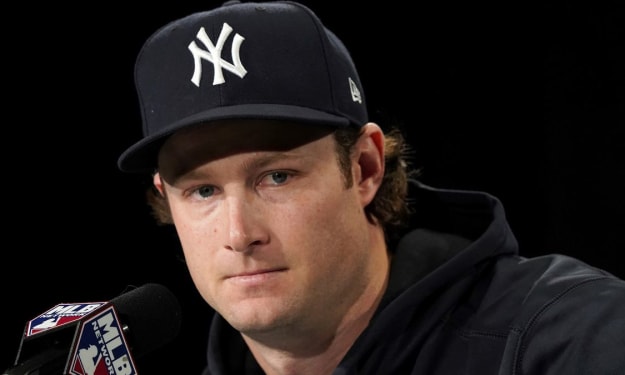
What Went Wrong: Yankees Fizzle in Fenway and Cards' Season Ends in Walk-off Fashion
The MLB Wild Card Games have come and gone, and after the dust was settled, the New York Yankees and the St. Louis Cardinals each saw their season come to an end. These two teams have won a combined 38 World Series, the two winningest teams in MLB history, but no playoff wins in 2021. In fact, the teams scored a combined three runs in this year's postseason. First off, let's discuss the Yankees' exit.
By Clyde E. Dawkinsabout a year ago in Unbalanced
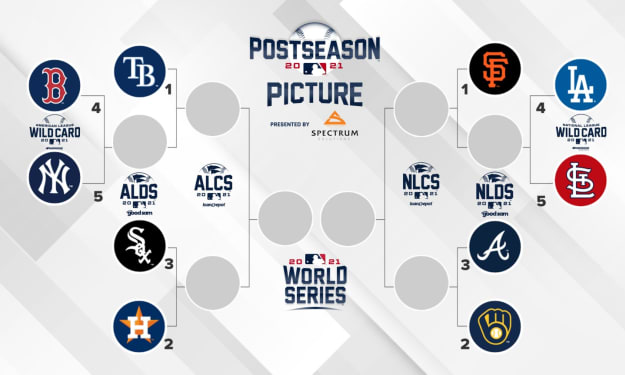
MLB Postseason 2021: The Picture is Complete
The final day of the MLB season, aka Game 162, had the potential to be very chaotic and result in some things being unsolved. There was still the National League West up for grabs, but it was the American League Wild Card that had the biggest logjam. And with all of the games going on at once, per the recent tradition, it all made for a fantastic day in baseball.
By Clyde E. Dawkinsabout a year ago in Unbalanced
History of the MLB Postseason (Part IV: Double Wild Card Era - 2012-present)
The 2011 Major League Baseball season ended with not one, but two surprising collapses in the postseason race. The Boston Red Sox and the Atlanta Braves each had big leads in their respective league's Wild Card races, but the month of September saw both teams lose their leads, bit by bit, until the final day saw them surpassed and eliminated from contention. After the St. Louis Cardinals (who came back on the Braves) won the World Series, MLB got together and came to the following decision: a second Wild Card must be added.
By Clyde E. Dawkinsabout a year ago in Unbalanced
History of the MLB Postseason (Part III: Wild Card & Division Series Era - 1995-2011). Top Story - October 2021.
The introduction of divisional play in 1969 increased intrigue in Major League Baseball. The road to the World Series now included a playoff round known as the League Championship Series (LCS), which featured each league's two division champions facing each other for the pennant. All the while, the league continued to grow, as after the Seattle Pilots moved to Milwaukee and became the Brewers, baseball returned to Seattle with the Mariners, while the American League went north of the border and debuted the Toronto Blue Jays. In 1993, the National League added two new franchises: the Colorado Rockies and the Florida Marlins.
By Clyde E. Dawkinsabout a year ago in Unbalanced
History of the MLB Postseason (Part I: Classic World Series Era - 1903-1968)
As a sports fan, I've always been fascinated by Major League Baseball's postseason format, and among the reasons why is because of how small it is. Out of North America's four main sports leagues, MLB has the smallest playoff field. While the NBA and NHL let in 16 teams, and the NFL lets in 14, MLB puts 10 teams in the postseason, but during a six decade period, it was just two. Here's the story regarding the World Series.
By Clyde E. Dawkinsabout a year ago in Unbalanced
History of the MLB Postseason (Part II: Divisional Play & League Championship Series Era - 1969-1993)
The World Series was instilled in 1903 as the championship contest, as well as the lone postseason round in Major League Baseball. The Series has been contested between the champions of the American and National Leagues, with each league's standings determining the pennant winners, which went to the first place teams. For five decades, MLB had 16 teams, eight in each league, though the 1950s and 1960s would see a wave of relocation and expansion, with more teams being place in western cities. By 1968, MLB had 20 teams, 10 in each league, though league standings still determine pennants.
By Clyde E. Dawkinsabout a year ago in Unbalanced
MLB Pennant Race 2021: Three Teams Clinch Spots, While One Continues to Sink
We are just two weeks away from the end of the 2021 MLB season. Two short weeks! It seems like yesterday that the full 162-game season began, but what is usually a marathon has went by like a sprint, and we are in the depths of the home stretch. Time is running out for a lot of teams looking to get into the postseason, and speaking of time, let's not waste any more of it and get to the main storylines.
By Clyde E. Dawkinsabout a year ago in Unbalanced
MLB Pennant Race 2021: Brewers Close in on NL Central
Three weeks remain in the 2021 MLB season, and the postseason races continue to heat up. Some teams rise, others continue to fall, as is the case every September. Here are the main stories that are taking center stage during this home stretch of the season.
By Clyde E. Dawkinsabout a year ago in Unbalanced
MLB Pennant Race 2021: Yankees Slide, Giants Take Over NL West
The month of September is the most important month in baseball, as it is the last one before the postseason begins. Any and all races are settled in the month of September, which definitely separates the contenders from the pretenders. With four weeks left in the regular season, huge developments are taking place, so here are the main shifts that took place as of this point.
By Clyde E. Dawkinsabout a year ago in Unbalanced
Presenting the Cleveland Guardians
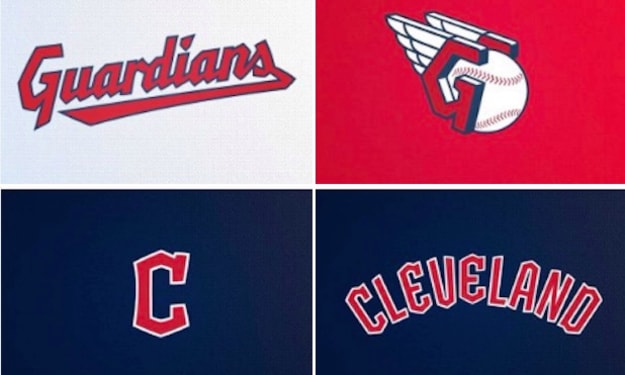
On July 23, 2021, it was announced that Cleveland's MLB franchise will now be known as the Guardians, with the news being broken on Twitter. The franchise debuted in 1894 as the Grand Rapids Rustlers for their first six seasons, until undergoing three different name changes between 1900 and 1902. In 1903, they became the Cleveland Napoleons (shortened to "Naps"), named after their star player, Napoleon "Nap" Lajoie, but after Lajoie's departure following the 1914 season, the team adopted their long time familiar name: the Cleveland Indians.
By Clyde E. Dawkinsabout a year ago in Unbalanced