
Stop the Cap!
Why a salary cap in Major League Baseball is not a solution...

As we head deeper into the 2026 MLB offseason, the spotlight is once again on the L.A. Dodgers as they snatch up multiple top free agents and further stack an already stacked team. In response, fans and pundits alike seemingly reached a consensus: these signings just canceled the 2027 season. To the casual fan, this may seem like a tad dramatic but we need to see where this is coming from.
The current Collective Bargaining Agreement (CBA) is set to expire in December of 2026. As always, the biggest issue on the agenda for players and owners is money. This time around owners are coming out swinging (pun totally intended) by once again floating the idea of finally introducing a salary cap in baseball. Among the big American sports leagues, MLB is the only one that has yet to adopt some form of a salary cap. If history is any indication, a salary cap is a non-starter for the players union. That, along with a cap being seemingly priority #1 for the owners increases the chances that there will be a lockout in 2027.
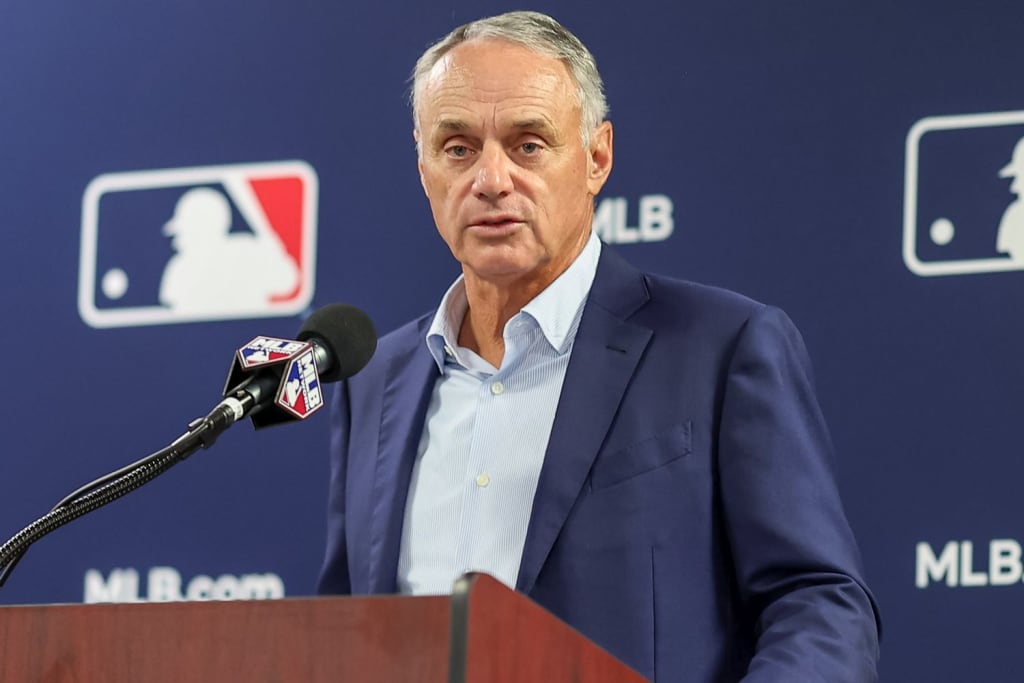
Commissioner Rob Manfred offers the following argument on behalf of the owners: We need a salary cap in order to have better competitive balance in the sport. In other words, we need to restrict the "rich" teams spending so that the "poor" teams have a better chance at the playoffs. He's basically implying that teams like the Dodgers can "buy" a championship therefore robbing the Marlins or the Pirates of the opportunity. If you were to only consider the last 2 seasons, Manfred would be accurate in his assessment. However, if you were to zoom out and look at the World Series champs of the past 25 years his view starts to show some cracks.
Since the 2000 season, there have only been two teams to repeat as champs: the Dodgers and the Yankees. This fact alone should be enough to debunk the myth that a team can buy a championship but let's keep digging. In the past 25 seasons, the team with the top payroll has won a mere 4 times. In that time span, we've seen World Series and League champions that were below league average in payroll.
Examples include:
2003 Marlins (25th in payroll)
2007 Rockies (25th)
2008 Rays (29th)
2010 Rangers (27th)
2014 Royals (19th)
2015 Royals (16th) and Mets (21st)
2016 Cubs (14th) and Cleveland Indians (24th)
2017 Astros (18th)
2020 Rays (27th)
2021 Braves (13th)
2023 Diamondbacks (19th)
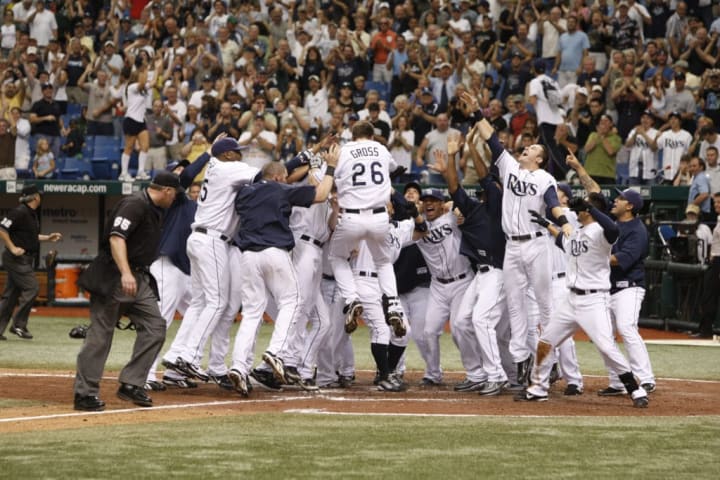
Yes, a high payroll can improve your chances but it far from guarantees you a spot in the World Series or even the playoffs. Just ask the 2025 Mets (2nd) or the 2008 Yankees (1st). Contrary to popular belief, there is more competitive balance in the sport than we're led to believe. Two things have facilitated this balance: playoff expansion and the luxury tax. Since 1995, we've seen the addition of 3 wild card spots to each league in the playoffs. In that time span, we've gone from 8 to 12 teams in the playoffs. There are playoff spots for nearly half the league at this point. This format was created in part to give an opportunity to teams that would normally not make the cut which just so happens to be mainly teams with below average payrolls.
The other tool that has improved competitive balance in the sport is the Competitive Balance Tax aka the "luxury tax". The name may be misleading but the luxury tax is indeed was known as a "soft" salary cap; similar to the one the NBA has. Contrary to popular belief, only 2 out of the 4 major sports leagues has a hard salary cap (NHL and NFL). Funny how the narrative works. MLB has had a salary cap since 1997 with a brief interruption from 2000-2003. This tax heavily penalizes overspending on players. In 2024, the Dodgers were taxed $103,016,896, a massive increase from $19,423,297 in 2023. In 2025, the Dodgers were taxed a record $169,375,768. This soft cap is a major reason why teams like the Yankees and Red Sox have become noticeably more frugal since the glory days of the early 2000s.
Now you maybe thinking "If the luxury tax worked for restricting the Yankees and the Red Sox, why is it not stopping the Dodgers and the Mets?" Now that is a fair question with a rather simple answer: the Dodgers and the Mets are more willing to spend and less bothered by the tax than most teams. This is partially because of the massive net worth of Steve Cohen of the Mets (roughly $16 billion) and Guggenheim Baseball Management (ownership group where controlling partner Mark Walter has a $5 billion net worth). Despite the massive net worth of these two owners, they are actually outliers when you look at every other owner's net worth. The rest of the owners have a fortune anywhere between $500 million (Marlins) and $8 billion (Braves). Fun fact: the owners of the Tigers and Twins each have roughly the same net worth as the Steinbrenner family that owns the Yankees. Food for thought next time one of those teams makes a low-ball offer to their superstar player (*cough* Tarik Skubal). This is all to say that there is really no poor MLB owner considering that 28 out of 30 owners/groups are billionaires. There's really no excuse to not invest in getting good players. In addition to the obscene wealth these owners enjoy, there's also a revenue sharing policy where each team sends 48% of their local net revenue into a pool that gets split equally 30 ways. With this policy, the poorest teams often get more back than what they put into the pool. Surely they can afford an All-Star player or two with this extra revenue right? I wonder what they do with all the extra cash...surely they don't just pocket it and keep it right? In any case, this is all to say that the owner of your team might not be poor, just stingy.
Speaking of stingy owners, a hard salary cap wouldn't do anything for competitive balance if there isn't a salary floor. What good is it to limit the Dodgers spending if there is no incentive or policy to make the Marlins spend more on their roster? The teams at the bottom must be encouraged or straight up forced to invest on their teams. And they should be discouraged from tanking and benefiting from the revenue sharing model. In addition, MLB should also do something to penalize teams from doing fire sales, a tradition often held by the Marlins. The sheer caliber of players that the Marlins have traded away in the last decade and a half would make a formidable team that could make even the Dodgers envious.
So if a salary cap isn't really the issue since MLB technically has one, then what is? I would argue that a more pressing issue that definitely has a higher impact on competitive balance is deferred contracts. This, in my opinion, is the true sin committed by the Dodgers and the thing that owners and fans should be complaining about. You can have the hardest, strictest salary cap in all of American sports and it would mean nothing if teams can pay only 10% of a player's salary and pay the rest after the contract is done. A salary cap wouldn't have stopped the Dodgers from signing Shohei Ohtani and an All-Star team with 10 other starting pitchers when they're deferring approximately 98% of his salary as well as deferring several other salaries with varying percentages. Deferrals would be the ultimate workaround that would ultimately turning a cap into a joke.
The problem of player payroll and competitive balance has multiple solutions but I don't think that a hard cap is one of them. Sure, teams like the Dodgers should probably be penalized more. Or a rule could be instituted where the AAV of a contract is taken into account when calculating the tax instead of what was actually paid. For example, when calculating the luxury tax, Ohtani's salary should be added in as $70 million instead of $2 million and the tax on the Dodgers may be too much to bear forcing them to rethink their spending habits. The luxury tax thresholds should probably be harsher in the new CBA. But at the same time a soft salary floor should be instituted. Penalties for not meeting the floor could involve revenue sharing penalties or maybe even losing high round draft picks. And deferred contracts should be either banned or heavily restricted. One penalty that could be cool but will never happen is to relegate teams that tank and don't spend to Triple A or maybe lose playoff eligibility for a year. In any case, a hard salary cap may seem like a simple solution but it is insufficient and can create loopholes that could keep the league from solving anything. And it doesn't help that the reasoning and narrative behind it are purposefully misleading. For these reasons baseball needs to stop the cap.
About the Creator
Keep reading
More stories from J.S. Vargas and writers in Unbalanced and other communities.
Hiram Bithorn
Growing up in Puerto Rico, I quickly became aware of the island's favorite sports: baseball, boxing and...politics (oddly enough). Many times I heard stories of the heroes and trailblazers of these fields and of their accomplishments. They became legends to be admired and revered by generations of Puerto Ricans. They get monuments and stadiums named after them to further immortalize them to the people. The first such stadium I became aware of as a kid was Hiram Bithorn Stadium in San Juan. This stadium became the host of many major sporting events and concerts. If a big-time band or pop star was coming through Puerto Rico, their show was almost certainly going to be at Hiram Bithorn Stadium. This stadium was even the "home" of the Montreal Expos for parts of the 2003 and 2004 seasons. The stadium’s history has made it one of the top prestigious venues in Puerto Rico.
By J.S. Vargas4 years ago in Unbalanced
Wild Card Weekend Recap: What Happens Now?
I think I figured out why I love Wild Card Weekend so much. It's because it's the first playoff anything of the calendar year. The NFL season starts in the fall, and once upon a time, the champion was crowned either on or slightly before New Year's. The evolution of the NFL schedule has resulted in the playoffs starting just into the New Year, and currently, the final week of the season falls on the first weekend of the New Year, with Wild Card Weekend coming a week after that. So yes, chronologically, the NFL's Wild Card Weekend serves as the first playoff anything of the calendar year.
By Clyde E. Dawkins20 days ago in Unbalanced
Gervonta ‘Tank’ Davis is arrested on battery, kidnapping charges after two-week manhunt
When beating up people in the ring just isn’t enough ... .Gervonta “Tank” Davis has been arrested and charged with battery, false imprisonment, and attempted kidnapping. After weeks on the lam, police finally captured Tank and he is now waiting to post a $16,000 bond.
By Skyler Saunders3 days ago in Unbalanced




Comments
There are no comments for this story
Be the first to respond and start the conversation.