success
The road to success is always under construction; share your equations for success — and learn some new ones.
. “I Don’t Know Who I Am Without Achievement”
don’t know who I am when I’m not achieving something. Without a goal, a grade, a deadline, or a win, I feel like I disappear. I didn’t always notice it. For a long time, it felt normal—praised even. Teachers loved me because I performed well. Family members introduced me using my achievements instead of my name. “This is the one who always tops the class.” “This is the one who never wastes time.” I learned early that being valuable meant being impressive. Achievement became my language. If I didn’t know how to explain myself, I let results speak. A good score meant I was worthy of rest. A promotion meant I deserved happiness. Applause became proof that I existed. The problem was, no one ever asked who I was when the applause stopped. Every milestone felt like relief, not joy. I wasn’t celebrating—I was exhaling. Surviving. For a moment, I could finally stop running. But the silence never lasted long. Almost immediately, another question appeared: What’s next? And with it, the familiar anxiety. If I wasn’t climbing, I must be falling. If I wasn’t improving, I must be failing. So I kept moving. I filled my days with productivity and my nights with quiet fear. I stayed busy because stillness felt dangerous. In stillness, there were no metrics to protect me. No rankings. No feedback. Just me. And I didn’t know what to do with that version of myself. When people asked what I enjoyed, I panicked. Enjoyment felt unproductive. Useless. I didn’t know how to like something without being good at it. I didn’t know how to rest without guilt chasing me. Even hobbies turned into competitions with invisible finish lines. I measured my worth in output. If I produced, I was enough. If I didn’t, I wasn’t. Failure didn’t just hurt—it erased me. One bad result could undo years of effort in my mind. I didn’t see mistakes as part of learning; I saw them as proof that I was nothing without success. When things didn’t go well, I didn’t think, I failed. I thought, I am a failure. That belief followed me everywhere. In conversations, I felt the urge to justify my existence. To explain what I was working on. To show that I was still moving forward, still relevant, still worth listening to. Silence made me uncomfortable because silence didn’t showcase progress. Burnout arrived quietly. Not as exhaustion, but as numbness. Achievements stopped feeling real. Even the big ones felt hollow, like cardboard trophies. People congratulated me, and I smiled, but inside I was already afraid of losing the feeling they gave me. I was addicted to becoming, but I had no idea who I already was. The scariest moment wasn’t failure—it was success. Because after reaching something I’d chased for months or years, there was nothing left to distract me from the emptiness underneath. No goal to hide behind. No ladder to climb. Just a question I had avoided my whole life: Who am I if I stop proving myself? I didn’t know the answer. And maybe that’s the part no one prepares you for. School teaches you how to perform. Society teaches you how to compete. Social media teaches you how to compare. But no one teaches you how to exist without measurement. We grow up believing value is earned, not inherent. That love is conditional. That rest must be justified. So we build identities out of accomplishments and call it ambition. We wear exhaustion like a badge and call it discipline. But somewhere along the way, we lose ourselves. I’m learning—slowly, imperfectly—that I am more than what I achieve. That my worth doesn’t disappear on days when I do nothing. That I don’t have to be impressive to be human. Some days I believe it. Some days I don’t. Unlearning a lifetime of performance is hard. Sitting with myself without chasing validation feels uncomfortable, like standing in a room without mirrors. But I’m trying. I’m trying to find joy that doesn’t need to be shared. Rest that doesn’t need to be earned. A sense of self that doesn’t collapse when productivity stops. I don’t have a clean ending or a dramatic transformation. Just an honest truth: I’m still figuring out who I am without achievement. And maybe that’s okay. Maybe being lost isn’t failure. Maybe it’s the first time I’m actually being myself.
By Faizan Malikabout 4 hours ago in Motivation
The Secret of the Lion’s Whisker. AI-Generated.
Once, in a quiet village nestled at the edge of a vast forest, there lived a woman who was deeply unhappy. Her husband, though a provider, possessed a temperament as harsh as a winter storm. He was quick to anger, constant in his criticism, and his words often carried a sting that left her heart heavy with sorrow. Desperate for a life of peace and affection, she decided to seek the counsel of a wise old hermit who lived in the mountains, a man known for his deep understanding of the human soul.
By Said Sadiq about 4 hours ago in Motivation
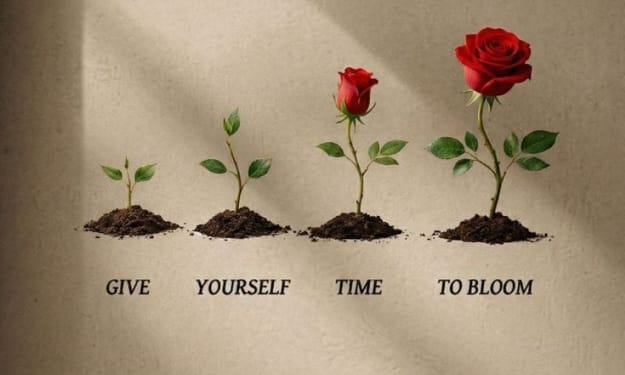
Patient Bloom
In a quiet corner of an old garden, a gardener planted a tiny seed into soft, dark soil. He did not expect flowers the next day. He did not stand over the soil demanding progress. Instead, he watered it gently, protected it from harsh winds, and walked away with patience in his heart.
By Active USA about 8 hours ago in Motivation
Stability Is a Form of Courage. Content Warning. AI-Generated.
There comes a stage in adult life where collapse is no longer dramatic—it is inconvenient. You cannot afford to fall apart loudly. Too many things rely on you continuing to function: income, schedules, family expectations, professional roles, and unspoken agreements you never formally accepted but still feel obligated to honor. At this stage, healing no longer looks like retreat. It looks like negotiation.
By Chilam Wongabout 13 hours ago in Motivation
The Lighthouse Keeper’s Daughter
On the western edge of Ireland, where the Atlantic Ocean crashed endlessly against black cliffs, stood an old lighthouse. It had guided ships safely for over a hundred years, and beside it lived a man named Thomas O’Riley and his daughter, Maeve.
By Iazaz hussainabout 21 hours ago in Motivation
HEALING DIDN'T COME LOUDLY.
Have you ever felt overwhelmed by life’s challenges, with your heart heavy and your mind restless, yearning for sleep and searching desperately for peace? Sometimes, healing seems out of reach, yet in those moments of uncertainty, I discovered a beautiful truth. Ths is my story: There was a season in my life when sleep became difficult and peace felt unfamiliar. My body was tired, but my mind refused to rest. I carried silent battles, questions I couldn’t answer, emotions I didn’t fully understand, and pain I didn’t know how to explain. From the outside, I looked fine. But inside me, I was dying. Healing felt far away. I prayed, but sometimes the pain doubled.I was frustrated, I felt unworthy, not enough, and empty. I felt too tired, too broken, always anxious and panicked at the slightest distraction. I was so uncertain about the future and did overthink alot. I felt something was wrong somewhere, but I just couldn't figure it out. I became withdrawn, no more interested in socialization and stayed indoors most often. The more people tried coming closer, the more I pulled back, because I felt I wasn't in my best shape and needed to heal first.
By Sunshine Writesabout 21 hours ago in Motivation
Quote of the Day by Music Icon Frank Sinatra: "If you possess something that you can't give away, then you don't possess it, it possesses you. AI-Generated.
Frank Sinatra, the legendary crooner whose voice defined an era, was more than just a singer or performer—he was a philosopher of life in his own right. In his quote, "If you possess something that you can't give away, then you don't possess it, it possesses you," Sinatra offers a profound lesson that resonates far beyond the world of music. It’s a reflection on ownership, attachment, and the true meaning of freedom—lessons that remain strikingly relevant in today’s fast-paced, material-driven world.
By Sajida Sikandarabout 22 hours ago in Motivation
Quote of the Day by Socrates: “By all means, marry. If you get a good wife, you’ll become happy; if you get a bad one, you’ll become a philosopher.”. AI-Generated.
Introduction: Humor Wrapped in Ancient Wisdom Few philosophers are quoted as often as Socrates, and even fewer manage to blend humor with deep truth as effectively as he did. One of his most famous sayings — “By all means, marry. If you get a good wife, you’ll become happy; if you get a bad one, you’ll become a philosopher” — continues to circulate centuries after his death.
By Sajida Sikandarabout 23 hours ago in Motivation
The Light in the Northern Window
In the coastal city of Reykhavn, where winter seemed to last forever and sunlight arrived like a rare guest, people walked quickly with their heads down. The wind from the sea cut through coats and scarves, and the streets often felt heavier than the clouds above them.
By Iazaz hussaina day ago in Motivation