
The Light in the Northern Window
: A City of Grey Days

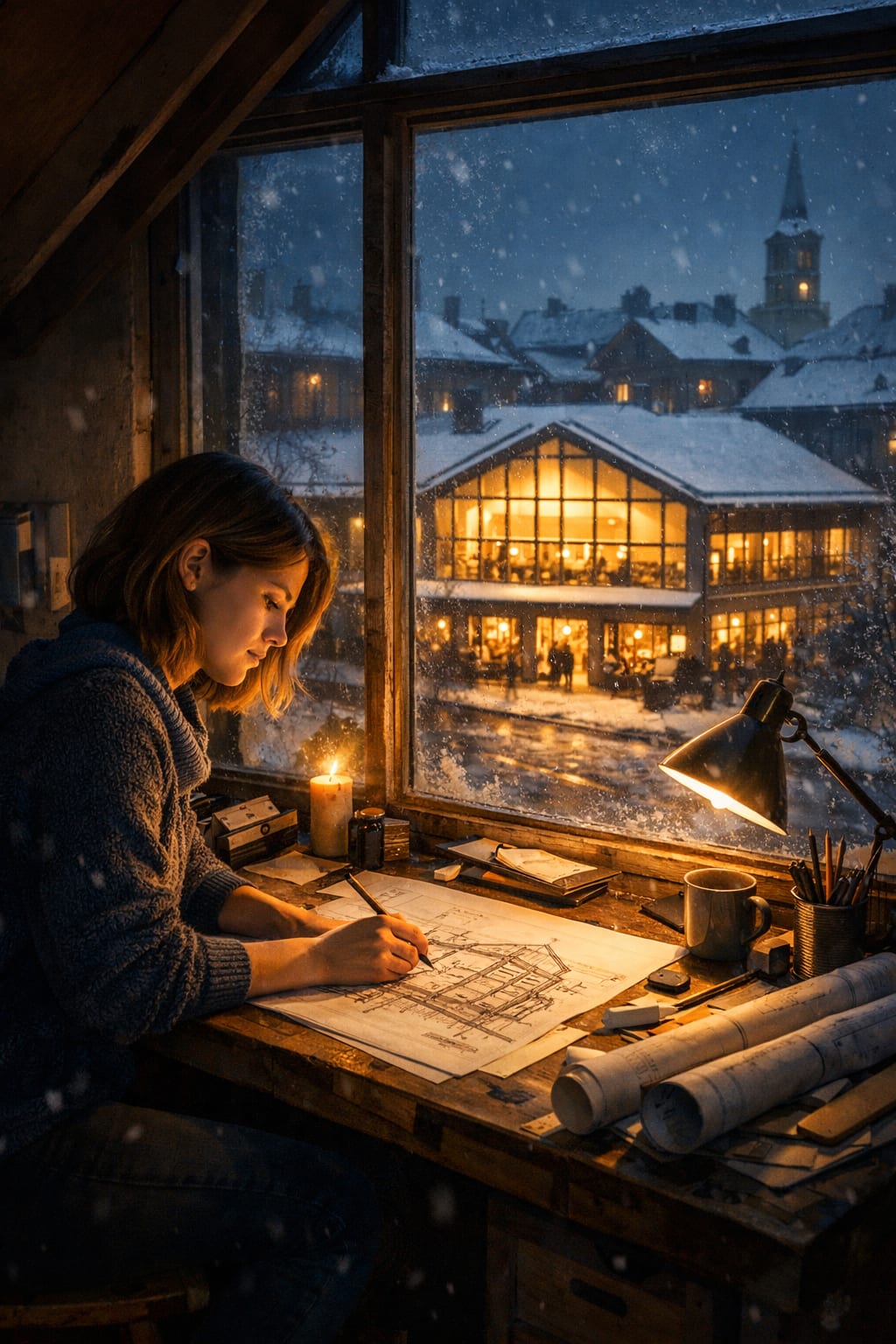
In the coastal city of Reykhavn, where winter seemed to last forever and sunlight arrived like a rare guest, people walked quickly with their heads down. The wind from the sea cut through coats and scarves, and the streets often felt heavier than the clouds above them.
Elina Sørensen, a thirty-year-old woman, lived in a small apartment above a closed bookstore. Once, the shop had been full of life—children sitting on the floor reading stories, students arguing about novels, and old men drinking coffee while flipping pages of newspapers. Now its windows were covered with dust and faded posters.
Elina worked as a cleaner in a government office building. Every night, she polished floors that would be dirty again by morning. She had once dreamed of becoming an architect. She loved drawing buildings, imagining how light could change a space, how windows could turn dark rooms into hopeful ones.
But dreams were expensive, and her mother’s medical bills had been heavier than her sketchbooks.
Subtitle 2: A Broken Drawing
One evening, while cleaning the last office floor, Elina found an old blueprint in the trash bin. It was torn in half and stained with coffee. Curious, she unfolded it on a desk. It showed a design for a public library that had never been built.
Something about it felt familiar.
She took it home and spent the night redrawing it in her notebook. She added wide glass walls, open reading areas, and a rooftop garden. For the first time in years, her hands moved with purpose instead of exhaustion.
From that night on, Elina began drawing again after work. She designed parks, schools, and community centers—places where people could gather instead of hide from the cold.
She never showed her work to anyone. It felt safer to keep hope private.
Subtitle 3: The Notice on the Wall
One morning, a notice appeared on the wall of the government building:
“CITY DESIGN COMPETITION: Reimagining Abandoned Spaces.”
The city council wanted ideas to transform empty buildings into something useful for the public. The winner would receive funding and professional support to bring their idea to life.
Elina read the notice three times. Her heart beat fast, then slow.
She laughed quietly to herself.
“I clean offices,” she whispered. “I don’t design cities.”
But that night, she stared at her sketches and imagined the old bookstore below her apartment filled with light again. She imagined children reading, neighbors talking, and warmth replacing silence.
She decided to try.
Subtitle 4: Fear Has a Loud Voice
Preparing her submission was harder than she expected. Her computer was old. Her software was outdated. Her hands shook when she wrote her proposal.
Fear spoke clearly: You will embarrass yourself.
They will laugh.
You are not one of them.
At the submission office, Elina almost turned around. The lobby was full of young architects in black coats, carrying large design tubes and speaking confidently.
Her folder felt small in her hands.
But she remembered her mother’s words from years before:
“If the door is heavy, it usually leads somewhere important.”
She walked forward and placed her folder on the counter.
Subtitle 5: The Waiting Season
Weeks passed with no answer. Winter deepened. Snow piled against windows and silence filled her apartment.
Elina kept cleaning offices. She kept drawing at night. Sometimes she wondered why she had bothered.
Then one afternoon, she received an email:
“Your proposal has been selected for final review.”
Her knees nearly gave way.
She was invited to present her idea to the city council. The night before the presentation, she barely slept. She practiced in front of the mirror, her voice trembling at first, then steady.
Subtitle 6: A Room Full of Doubt
The council chamber was wide and bright. Twelve people sat behind a long table. Elina stood alone with her drawings projected on the wall.
She explained her idea: turning the abandoned bookstore into a community light center—a space for books, workshops, and public meetings. She spoke about loneliness in winter, about the need for warm places where people could belong.
At first, the council members looked bored.
Then one of them leaned forward.
“You clean our offices, don’t you?” he asked.
Elina nodded, her face burning.
“And you designed this?”
“Yes,” she said. “At night.”
There was silence.
Then another member said, “You understand this city better than many professionals. You see how people live. That matters.”
Subtitle 7: When the City Changed
Elina’s design was chosen.
Construction began in spring. The old bookstore was rebuilt with glass windows, wooden shelves, and soft lighting. The rooftop became a garden where people could sit and read under the sky.
On opening day, the city gathered outside the building. Snow had finally melted. Sunlight filled the space like a promise kept.
Children ran between shelves. Elderly neighbors drank coffee at long tables. Artists pinned drawings to the walls.
A sign above the entrance read:
“The Northern Light Center – A Place to Belong.”
Elina stood in the corner, watching strangers enjoy something that once existed only in her notebook.
Subtitle 8: The Lesson in the Window
Later that evening, Elina returned to her apartment and looked out the window at the glowing building below.
She understood something she had never been taught in school:
Dreams don’t disappear when life becomes difficult.
They wait quietly for courage.
Her story spread across nearby cities. People spoke about the cleaner who became a designer, not because she was lucky, but because she refused to believe her place was fixed forever.
Final Message
In many European cities, old buildings still stand empty. But so do many human dreams.
Sometimes motivation does not arrive as confidence.
It arrives as a tired person who keeps going anyway.
Because the light that changes a city
often begins
in a single quiet room
with someone brave enough
to try.
About the Creator
Iazaz hussain
Start writing...
Keep reading
More stories from Iazaz hussain and writers in Motivation and other communities.
The Quiet Road to Brightness
: In the northern hills of a small European country stood the town of Alderwick. Once known for its steel factories and river trade, it had grown quieter with each passing decade. The trains no longer stopped there. Young people left for larger cities. Storefronts closed one by one, leaving behind dusty windows and fading signs.
By Iazaz hussain2 days ago in Motivation
One Hard Thing
Stop me if you’ve heard this one before: You have the number, you know your schedule- you’ve even picked out the perfect day and time to make this appointment. Shoot, you’ve even picked out alternative days and times just in case their schedules can’t accommodate you!
By Taylor Rigsby16 days ago in Motivation
Daring to be authentic
There is a question many of us avoid, yet it’s so important: What are we truly searching for – especially online? We all spend time online, scrolling through posts, articles, and videos for different reasons. Beneath all of that, have you ever paused and asked yourself: What am I really hoping to find here? Surely, none of us are spending our precious time online for nothing. And yet – how often do we actually find what we are searching for?
By Jeanne Jess a day ago in Motivation
The Devil's Triangle
The sails ruffled in the breeze as we cruised along. The Sea Breeze was a mid-size catamaran that sailed out of Royal Naval Dockyard in Bermuda. We had booked this trip weeks in advance and were now looking at our Captain, Spike and two boat hands. Paddy and Wilson seemed like nice guys, joking around with the passengers and telling us some stories about Bermuda that only locals would know. Their island accents sounded almost British but they were pleasant to listen to.
By Barbara Gode Wiles7 days ago in Fiction



Comments
There are no comments for this story
Be the first to respond and start the conversation.