
United States Human Growth Hormone Market Size and Forecast 2026–2034
Rising Demand for Hormone Therapies, Biotech Innovation, and Expanding Adult Applications Drive Market Growth

Market Overview
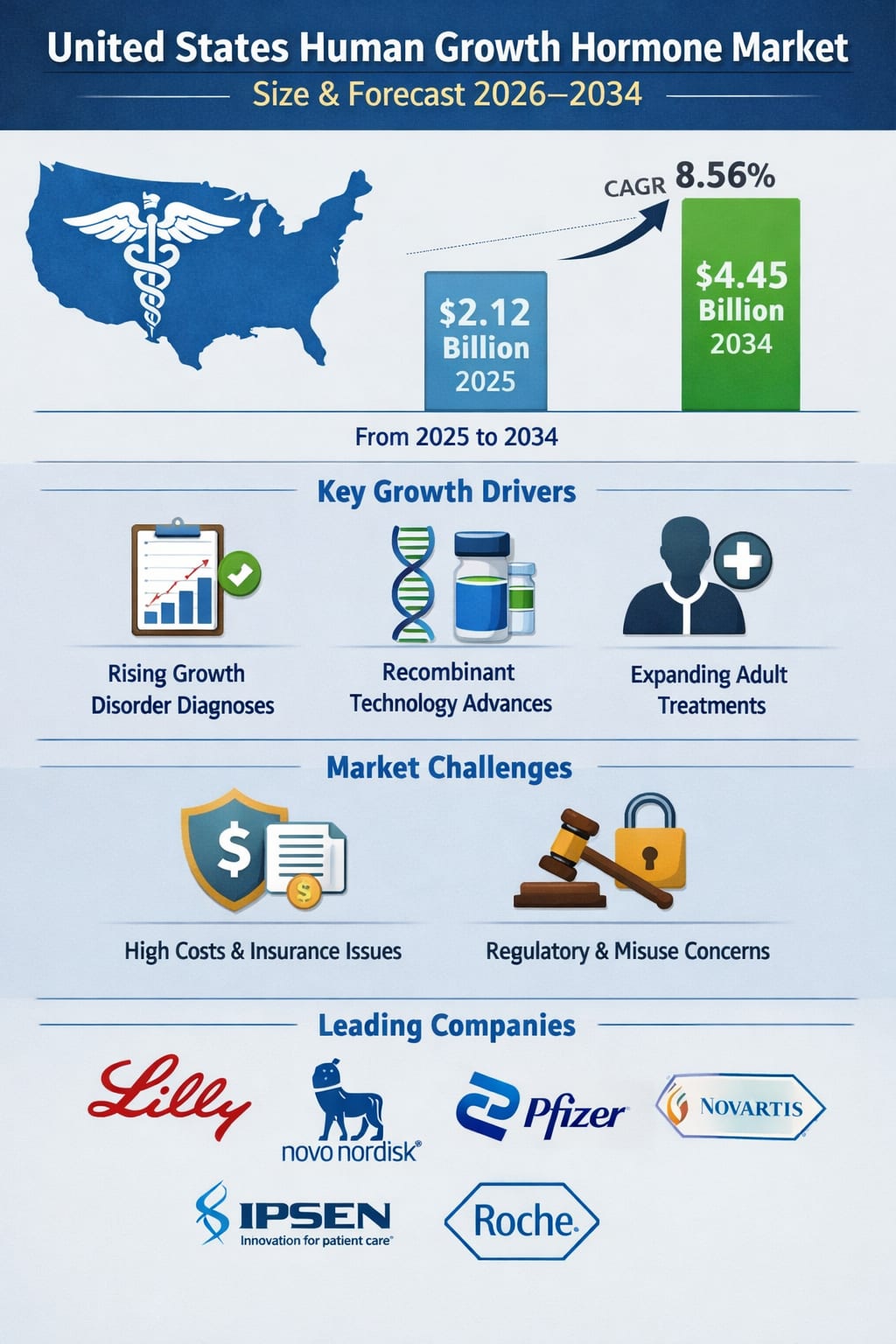
The United States Human Growth Hormone (HGH) Market is poised for strong and sustained expansion over the forecast period. According to Renub Research, the market is projected to grow from US$ 2.12 Billion in 2025 to US$ 4.45 Billion by 2034, registering a robust CAGR of 8.56% from 2026 to 2034. This growth trajectory reflects a combination of increasing diagnoses of growth hormone deficiency, rising acceptance of hormone-based therapies, advancements in recombinant biotechnology, and expanding use of HGH beyond pediatric indications.
Human Growth Hormone, also known as somatotropin, is a naturally occurring peptide hormone secreted by the pituitary gland. It plays a critical role in regulating growth, metabolism, muscle mass, bone density, and cellular repair. In clinical practice, recombinant HGH is prescribed to treat conditions such as childhood growth hormone deficiency, Turner syndrome, Prader-Willi syndrome, idiopathic short stature, and adult growth hormone deficiency.
In the United States, HGH has transitioned from being a niche pediatric therapy to a broader endocrinology solution used across age groups. Greater awareness of hormonal health, improved diagnostic capabilities, and rising healthcare expenditure continue to reinforce market growth nationwide.
United States Human Growth Hormone Market Outlook
The U.S. healthcare system’s strong emphasis on early diagnosis, specialized endocrine care, and biotechnology innovation has made HGH therapy more accessible and clinically effective. Growth hormone deficiency is increasingly being identified in both children and adults, supported by widespread screening programs, improved growth chart monitoring, and advanced diagnostic testing.
Beyond traditional indications, HGH is gaining attention in adult metabolic health, muscle wasting disorders, post-surgical recovery, and age-related hormone decline. Although non-medical and cosmetic uses remain strictly regulated, clinical interest in hormone optimization for quality of life improvement is growing steadily under physician supervision.
The expansion of telemedicine, personalized medicine, and digital healthcare platforms further enhances patient access to endocrinologists and long-term hormone therapies. Together, these factors position the U.S. HGH market for consistent growth through 2034.
Key Drivers of Market Growth
Rising Diagnosis of Growth Disorders and Increased Clinical Awareness
One of the primary growth drivers is the rising number of diagnosed growth disorders across pediatric and adult populations. Conditions such as growth hormone deficiency, Turner syndrome, Prader-Willi syndrome, and idiopathic short stature are being identified earlier due to better pediatric screening, genetic testing, and endocrine evaluations.
In adults, increased awareness of hormone-related metabolic disorders linked to aging, obesity, traumatic brain injury, and chronic illnesses has expanded the eligible treatment population. Patients are more proactive in seeking hormonal assessments, contributing to higher HGH prescription rates.
Clinical research also continues to strengthen diagnostic accuracy. In August 2024, COSCIENS Biopharma Inc. reported positive Phase 3 trial results for Macimorelin in diagnosing childhood-onset growth hormone deficiency, further reinforcing advancements in diagnostic standards.
Advancements in Recombinant Technology and Delivery Systems
Technological progress has significantly improved the safety, efficacy, and convenience of HGH therapy. Modern recombinant DNA techniques allow for the production of highly purified, bioidentical human growth hormone with consistent quality and reduced immunogenic risk.
Innovations in drug delivery have transformed patient experience. Long-acting formulations, sustained-release therapies, and needle-friendly injection devices improve treatment adherence, particularly for children requiring long-term therapy. Once-weekly dosing options have reduced the burden of daily injections.
A major milestone was the FDA approval of NGENLA (somatrogon-ghla), a once-weekly growth hormone analog for pediatric patients, highlighting the industry’s shift toward patient-centric treatment solutions.
Expanding Use of HGH in Adult and Personalized Medicine
While pediatric applications remain foundational, adult HGH therapy is emerging as a key growth segment. Adults with growth hormone deficiency often experience fatigue, reduced muscle mass, increased fat accumulation, low bone density, and impaired metabolic function.
Personalized medicine aligns naturally with hormone therapy, as HGH dosing must be tailored based on age, gender, body composition, and lifestyle factors. Clinical evidence supporting adult HGH use continues to grow, easing historical safety concerns.
The approval of long-acting therapies such as Skytrofa (lonapegsomatropin-tcgd) for adults further supports market expansion. As the U.S. population ages and chronic conditions rise, adult HGH demand is expected to accelerate significantly.
Challenges Facing the U.S. HGH Market
High Treatment Costs and Insurance Coverage Limitations
Despite strong demand, the high cost of HGH therapy remains a notable barrier. Treatment often requires long-term or lifelong administration, creating substantial financial burden for patients. Insurance coverage varies widely, with many plans restricting reimbursement to specific pediatric indications while excluding adult or wellness-related treatments.
The cost of diagnostic testing, ongoing monitoring, and specialist consultations further adds to treatment expenses. Pricing pressures and regulatory scrutiny also challenge manufacturers in balancing affordability with innovation.
Regulatory Constraints, Ethical Concerns, and Risk of Misuse
Human Growth Hormone is tightly regulated in the United States due to its association with athletic performance enhancement and anti-aging misuse. The FDA strictly limits HGH prescriptions to approved medical conditions, requiring thorough documentation and diagnostic confirmation.
Physicians face administrative complexity and compliance requirements, while pharmacies operate under heightened scrutiny. Ethical concerns and misuse risks can discourage legitimate prescribing, even when patients meet clinical criteria.
Key Market Segments
Turner Syndrome HGH Market
Turner syndrome represents one of the most stable pediatric segments in the U.S. HGH market. Early diagnosis and long-term treatment significantly improve growth outcomes in affected girls. Comprehensive care programs involving endocrinologists, genetic specialists, and pediatric hospitals support consistent HGH demand within this segment.
Prader-Willi Syndrome Hospital Pharmacy Segment
Prader-Willi syndrome requires multidisciplinary hospital-based care. HGH therapy plays a vital role in improving muscle tone, body composition, and growth. Due to medical complexity, hospital pharmacies dominate HGH distribution for this condition, ensuring controlled dosing and close monitoring.
Online Pharmacy HGH Market
Online pharmacies are emerging as a fast-growing distribution channel, driven by convenience, privacy, and home delivery. Integration with telehealth platforms allows patients to manage long-term therapy efficiently while maintaining regulatory safeguards against misuse.
Routes of Administration
Intramuscular and subcutaneous injections remain the most widely used administration routes due to reliable absorption and established clinical protocols. Intravenous HGH is used in specialized hospital settings for acute cases, while oral HGH-stimulating peptides represent an emerging innovation area aimed at improving patient compliance.
Regional Insights
California leads the U.S. HGH market due to its advanced healthcare infrastructure, strong biotechnology ecosystem, and high patient awareness. New York follows closely, supported by research-driven medical institutions and robust pediatric endocrinology services. Washington state also demonstrates notable growth, driven by digital healthcare adoption and biotech innovation.
Competitive Landscape
The U.S. Human Growth Hormone market is highly competitive, with major pharmaceutical players focusing on innovation, long-acting formulations, and expanded indications. Leading companies include Eli Lilly and Company, Novo Nordisk, Pfizer Inc., Novartis AG, Ipsen, and F. Hoffmann-La Roche AG.
Each company is analyzed across five viewpoints: overview, key personnel, recent developments, SWOT analysis, and revenue performance.
Final Thoughts
The United States Human Growth Hormone Market is entering a phase of accelerated and sustainable growth, supported by rising clinical awareness, biotechnology advancements, and expanding adult applications. While regulatory challenges and cost constraints remain, innovation in long-acting therapies, personalized medicine, and digital healthcare delivery continues to reshape the market landscape.
With Renub Research projecting market value to reach US$ 4.45 Billion by 2034, HGH therapy is set to remain a cornerstone of modern endocrinology in the United States. As scientific validation strengthens and patient access improves, the market’s long-term outlook remains firmly positive.
About the Creator
Day 4 of Quitting
If this is how sobriety feels, maybe it’s better to go through life a little buzzed… this, along with other hits like, I want to kill myself, I wish I was dead, and I’m going to throw myself off a bridge have been the only thoughts on rotation these past few days. I promise myself that if, in a month, I still feel like this (‘this’ meaning despondent, full of rage, and simultaneously numb) I can go back to smoking. Until mid-February though? Nicotine is off the table.
By sleepy drafts26 days ago in Longevity
The Refiner’s Fire Is Not the Whetstone
There is a difference between being sharpened and being transformed, and confusing the two leads to frustration when growth does not feel productive. Sharpening implies refinement of existing form. Fire implies change in composition. Both processes are uncomfortable, but they operate on different levels and for different purposes. When people expect sharpening and receive fire instead, they often assume something has gone wrong, when in reality something deeper is taking place.
By Peter Thwing - Host of the FST Podcast8 days ago in Longevity
Not Just For Clean Up: A History Of The MCU's Department of Damage Control
Initially an organisation that seemed to exist to help the heroes of the Marvel Cinematic Universe, from Phase Four onwards, the Department of Damage Control has shifted into a more antagonistic role. Most recently seen in the Wonder Man series, the current incarnation of Damage Control seems to target superpowered individuals, regardless of whether that person poses an active or intentional threat.
By Kristy Andersona day ago in Geeks


Comments
There are no comments for this story
Be the first to respond and start the conversation.