science
The science of staying young, healthy, and in-shape.
The Crack Where the Light Gets In
Disclaimer: As I refer to quantum physics in the following story, I make no claim to have a strong understanding of the concepts. I simply share my perspective based on my somewhat intuitive interpretation of what I have read about it.
By Suzy Jacobson Cherry2 years ago in Longevity
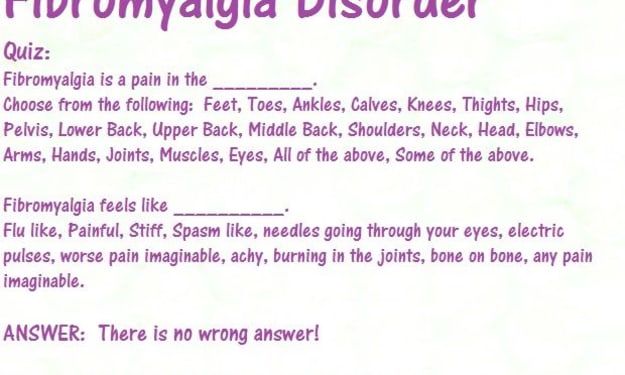
Fibromyalgia
Ok, so I've got it. Not that I wanted it. But it explains a lot. And once a medical doctor diagnosed me with it almost two years ago, I could relax a little. At least I knew I wasn't going crazy. And I could stop drinking those Jack Daniels & Coke just to make the pain lessen and to help me sleep. (Anyone who knows me, knows I'm not a big drinker and anything carbonated flares up the old interstitial cystitis that I'm also blessed to have...so I couldn't win.) Interstitial cystitis (IC) is a relatively uncommon and enigmatic disorder characterized by pain in the bladder and pelvic region, typically accompanied by urinary urgency and frequency. Fibromyalgia is a more common disorder, with the prominent symptoms being diffuse musculoskeletal pain and fatigue,... IC patients display diffusely increased peripheral nociception, as is seen in fibromyalgia. https://pubmed.ncbi.nlm.nih.gov/9201654/
By Shirley Belk2 years ago in Longevity
Planning or chance?
Planning or chance? Random chaos or structured evens? It is strange to think back of several times in my 80 years, when an event changed the direction of my life. Sometimes that change was rapid but in others it took a while to realise change had happened. My life would have been very different without these events. I had, nor could ever have, any control over these events. They were decisions made, consciously or unconsciously, by other people. They involved people I know or knew and the interaction between these people and others I had never met. So, I was not consulted, not even informed at the time and yet they changed my life. So, the question has to be is freewill only freedom to choose how we act, or react, after learning of events that are controlled by others? Even the decisions and actions that affected my life, usually involved people who knew nothing about me. Or at least not anything truthful about me. So, are all these interactions, these decisions and activities, just random chance or planned by some divine entity? It seems that freewill allows some control over the consequences but not the cause. Consider a hypothetical example. If the government suddenly raise taxation on something I produce this inevitable reduces the demand and so my income is adversely affected, yet the government bureaucrats who manged this tax increase, had never consulted me, they did not know I existed as an individual, so nothing personal but their decision will have a big effect on me. My freewill is limited to deciding what to do; do I give up production? work harder to sell at increased price? try to reduce other costs to absorb the tax increase? So, I have some freewill but only over the effect not the cause.
By Peter Rose2 years ago in Longevity
Here are 7 good reasons to turn on the heater to reduce your risk of a heart attack:
Keeping the central heating turned off might very likely result in a variety of health concerns, including an increased risk of death from heart attacks or strokes, according to a chemist who has issued a warning to the general public.
By Jacob Damian2 years ago in Longevity
A Journey into Authentic Beauty. Content Warning.
As a woman navigating the intricate terrain of beauty in her mid-twenties, I embark on a quest to redefine what it truly means to radiate authenticity. In a world saturated with beauty standards and filtered images, genuine beauty transcends flawless exteriors, finding its essence in the delicate interplay of mindset and emotions.
By Zei Gounie2 years ago in Longevity
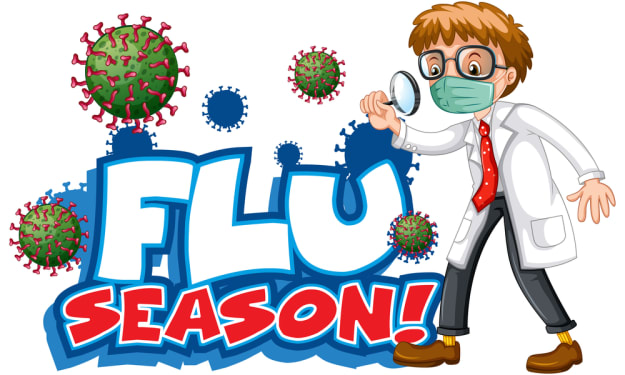
Fighting Off Microscopic Invaders
The annual flu season has begun. The flu, or influenza, is a contagious respiratory illness caused by a virus that infects the nose, throat, and sometimes the lungs. It is spread from person to person through coughs, sneezes, and touching contaminated surfaces. The flu will infect anywhere between 5-20% of the population or 31.4 million people. There are four types of flu; Influenza A, B, C, and D. Influenza A and B are the ones that cause most of the epidemics in the country. Influenza C is a mild respiratory infection that hasn’t caused an epidemic yet, while Influenza D only infects cattle. This disease can cause $10.4 billion a year in medical expenses and 16.3 billion in lost earnings. Here are some tips to survive this current flu season.
By M.L. Lewis2 years ago in Longevity
9 Habits that harm your brain- Wish I'd known earlier
A healthy brain is one that functions well both structurally and cognitively, enabling effective thinking, learning, and emotional regulation. It is supported by positive lifestyle choices, including sufficient sleep, balanced nutrition, and regular exercise. Maintaining a healthy brain is crucial for overall well-being and cognitive longevity.
By Salman siddique2 years ago in Longevity
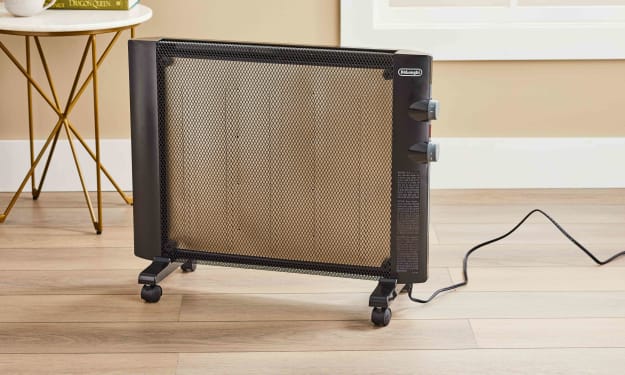
Embracing Cozy Comfort The sensations of Mini Heating results!
Introduction In the ever-shifting dance of seasons and the gradual descent of temperatures, the imperative need for warmth intertwines seamlessly with our daily existence. In this relentless pursuit of both coziness and practicality, a cadre of diminutive heating solutions emerges as silent protagonists, delivering the embrace of warmth and comfort encapsulated in compact, unassuming packages. From the uncharted realm of portable heaters to ingenious innovations pushing the boundaries of conventional thermodynamics, these mini-heating marvels are orchestrating a revolution in the realm of staying warm. Join us on this odyssey as we unravel the intricacies and multifaceted dimensions of mini heating, exploring a kaleidoscope of options designed to ensconce you in snug repose, irrespective of the setting.
By Imad Eddine Elkhettabi2 years ago in Longevity