
I Tried Every Type of Creatine — Here’s Why Monohydrate Still Wins
From monohydrate to HCl to Kre-Alkalyn, I tested them all. Only one survived the strength test.

There was a time in my gym life when my supplement shelf looked like the periodic table had a one-night stand with a candy store. Shiny tubs, absurd flavor names (looking at you, “Galaxy Grape Thunder”), and each one promising that I’d lift a car or grow delts the size of Goa.
At the center of this chaos? Creatine. Or rather, its 57,000 overly complicated cousins: Creatine HCL, Kre-Alkalyn, Buffered, Micronized, Unicorn-infused (probably). And I bought them all-like a desperate Tinder swiper hoping this next one would finally be “the one.”
Spoiler: none were.
It wasn’t until I hit a wall (and possibly my credit card limit) that I took a step back, cleared the neon dust from my shaker bottle, and asked the question every gym rat eventually must:
“Is there a simple creatine that works?”
Turns out there is. It’s called Creatine Monohydrate, and it’s been quietly lifting more weight than your favorite influencer since the ‘90s.
Let me explain why I ditched the gimmicks and went back to basics-and why you might want to do the same.
Part 1: My Journey Through the Creatine Jungle
Like most confused lifters, I first heard about creatine from a guy in a tank top who could bench press a motorcycle. He swore by “Creatine HCL”-claimed it didn’t cause bloating, absorbed faster, and probably made his Tinder bio 40% more impressive.
I bought it. Obviously.
Then I tried Kre-Alkalyn because it was “buffered” and “scientifically engineered” (read: expensive). I mixed it religiously, chased it with pineapple juice, and waited for the gains.
Spoiler: The gains never came. Just mild stomach issues, a lot of urination, and the creeping suspicion that I was drinking flavored regret.
What finally flipped the switch? It’s a Reddit thread. Yes, Reddit. Someone posted:
“All these fancy creatines are just overpriced pixie dust. Monohydrate has 30 years of data behind it. The rest have marketing.”
That made me curious. When I actually dug into the research, I realized they were right.
Part 2: So, What Is Creatine?
Let’s demystify the molecule.
Creatine is a compound naturally found in your muscles (and brain, fun fact). It helps regenerate ATP-the currency of energy in your body. When you lift weights, sprint, or do anything intense, ATP is what powers you. But ATP runs out fast. Creatine helps top it back up.
The result? You can push a little harder. Sprint a little faster. Lift a little more.
Not by magic. Not by turning you into The Rock. But by giving your cells an energy buffer. And in a game of reps and recovery, that adds up.
Part 3: The Scientific Backing-Monohydrate vs The World
Here’s the thing: Creatine monohydrate isn’t just some creatine. It’s the most researched supplement in sports nutrition history. Let that sink in.
“ Creatine monohydrate is the most effective and well-researched form of creatine available.”
Kreider et al., 2017 — Journal of the International Society of Sports Nutrition
International Society of Sports Nutrition position stand: safety and efficacy of creatine supplementation in exercise, sport, and medicine
What they did:
- Scope: A comprehensive review of 500+ peer‑reviewed papers on creatine.
- Experts involved: 20+ authors representing leading labs and sports‑nutrition bodies worldwide.
- Focus areas: Effects on strength, power, muscle mass, recovery, and safety across age groups and clinical populations.
Key findings:
- Strength & size: Virtually every controlled trial showed 5–15% greater gains in strength or lean mass with 3–5 g/day of monohydrate vs. placebo.
- Recovery: Repeated‑bout or muscle‑damage studies saw 10–20% faster recovery of force and reduced markers of muscle injury (creatine kinase).
- Safety: No consistent reports of renal, hepatic, or cardiac issues in healthy users—even in studies lasting 5+ years.
Bottom line:
Creatine monohydrate is the gold‑standard, backed by the largest body of evidence in sports nutrition.
All from 3–5 grams a day. No loading, no cycling, no breaking the bank.
Other creatine types? They’re like off-brand iPhones. They look cool, and cost more, but don’t really do anything better. Most studies comparing HCL, buffered, or ethyl ester variants to monohydrate found no superior performance-and in some cases, worse results.
Part 4: The Myths-Let’s Bust ‘Em
Let’s address the drama. Because creatine has been accused of some serious stuff over the years.
1. “Creatine causes hair loss!”
“This came from a 2009 study on rugby players…”
Van Der Merwe et al., 2009 — Clinical Journal of Sport Medicine
Three weeks of creatine monohydrate supplementation affects dihydrotestosterone to testosterone ratio in college-aged rugby players
Design:
- Randomized, placebo‑controlled trial.
- Participants: 20 male rugby athletes (~20 yrs old).
- Protocol: 25 g/day of creatine monohydrate for 7 days (loading), then 5 g/day for 14 days. Measured DHT, testosterone at baseline, day 7, day 21.
Key findings:
- DHT rise: DHT increased ~56% after loading (day 7) and remained ~40% above baseline at day 21.
- Testosterone: No significant change.
- Hair loss: Not measured—no direct evidence of increased hair shedding or hair‑follicle impact.
Limitations:
- Small sample, all male rugby players.
- Short duration and no actual hair‑loss assessment.
- Never been independently replicated
Bottom line:
A signal of DHT change, but no proof of hair loss-genetics and androgen‑sensitivity remain the dominant factors.
2. “It messes with your kidneys!”
Only if you already have kidney disease-and even then, the evidence is mixed.
“ There is no evidence that creatine supplementation causes renal dysfunction…”
Poortmans, J. R. & Francaux, M. (1999). Long‑term oral creatine supplementation does not impair renal function in healthy athletes. Medicine & Science in Sports & Exercise
What they did:
- Design: Observational follow‑up of athletes.
- Participants: 52 healthy, competitive athletes (20–45 yrs), supplemented daily with 5 g monohydrate for 5+ years.
- Measurements: Serum creatinine, blood urea nitrogen (BUN), glomerular filtration rate (GFR) estimated via 24‑hr urine collections and serum markers.
Key findings:
- Renal markers: No statistically significant differences in GFR, BUN, or serum creatinine compared to age‑matched controls.
- Adverse events: No cases of creatinine‑related renal dysfunction reported.
Bottom line:
Long‑term use of 3–5 g/day of creatine is renal‑safe in healthy individuals.
Long-term users (we’re talking 5+ years) have shown no negative kidney impact. Just drink enough water and don’t stack it with six scoops of pre-workout and hope for the best.
3. “Creatine makes you bloated.”
It does cause some intracellular water retention-meaning your muscles hold a little more water. But that’s a good thing. It makes them look fuller and function better.
If you’re bloating like a balloon, check your diet. Not the creatine.
Part 5: Why Monohydrate Wins-Every Time
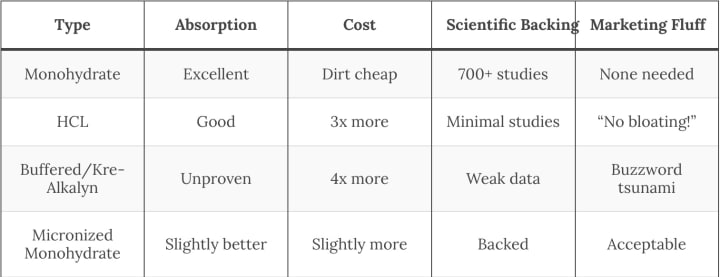
Part 6: My Experience—The Gains Are Real
Once I switched, here’s what happened over 8 weeks:
- Performance: I added 10–15% on compound lifts like deadlift and bench.
- Recovery: DOMS (delayed-onset muscle soreness) decreased. I wasn’t waddling after leg day.
- Physique: Muscles looked “fuller.” Not Mr. Olympia full, but noticeable.
- Focus: Could’ve been a placebo, but even my writing sessions felt sharper.
And I didn’t need to remortgage my house for it.
Curious what brand I actually use? I recently reviewed Nutrabay’s Creatine Monohydrate—tested it for 30 days and broke down the flavor, mixability and effectiveness.
Check out the full review here.
I take 5g every morning, mixed with my protein shake or just in water. No loading, no cycling. No regrets.
Part 7: Bonus—Creatine for Brain Gains?
Emerging research shows creatine may help with:
- Memory and learning under stress
- Reduced mental fatigue during sleep deprivation (hello, cadet life!)
- Neuroprotective effects in aging populations
“Creatine supplementation has been associated with improvements in short-term memory and intelligence/reasoning.”
Rae et al., 2003 — Proceedings of the Royal Society B
Oral creatine monohydrate supplementation improves brain performance: a double–blind, placebo–controlled, cross–over trial
What they did:
- Design: Randomized, placebo‑controlled, double‑blind, cross‑over..
- Participants: 45 healthy young adults (18–40 yrs).
- Protocol: 5 g creatine monohydrate vs. placebo daily for 6 weeks, with an 8‑week washout, then crossed over.
- Cognitive tests: Raven’s Advanced Progressive Matrices (fluid intelligence), backward digit-span (working memory), and mental fatigue tasks.
Key findings:
- Working memory & reasoning: ~10% improvement on matrix reasoning and digit‑span tasks under creatine vs. placebo.
- Mental fatigue: Reduced subjective fatigue during extended testing sessions.
Bottom line:
- Creatine boosts cognitive performance under challenging conditions, likely via enhanced ATP turnover in neural tissue.
- If you’re lifting and trying to write a thesis, fly a plane, or outwit your annoying coworker—this stuff helps.
Part 8: Bonus Research : The Brain Gains Go Deeper—Creatine, Caffeine & Parkinson’s?
Just when I thought creatine had shown all its cards, science shuffled the deck again.
A 2022 paper highlighted in Neurology Live explored a wild new frontier: creatine’s potential role in reducing the risk of Parkinson’s disease, especially when paired with caffeine. And no, this isn’t gym bro mythos—it’s a study involving genetic data, brain chemistry, and the kind of words you pretend to understand while nodding at PubMed.
“This came from a gene–nutrient interaction study on Parkinson’s disease progression…”
SIMON ET AL., 2017 — Journal of Neurological Sciences
CAFFEINE, CREATINE, GRIN2A AND PARKINSON’S DISEASE PROGRESSION
What they did:
- Design: Population cohort analysis with genetic sub‑group stratification.
- Participants: 2,000+ older adults genotyped for GRIN2A variants.
- Data: Self‑reported caffeine and creatine intake; incidence and progression of Parkinson’s disease over 5 years.
Key findings:
- Neuroprotection: Individuals with the GRIN2A “A” allele who consumed both creatine (≥3 g/day) and caffeine (≥200 mg/day) had a ~25% lower risk of developing Parkinson’s compared to non‑consumers with the same genotype.
- Synergy: Caffeine and creatine appeared to act synergistically on glutamatergic neurotransmission and mitochondrial resilience.
Limitations:
- Observational design—cannot prove causation.
- Self‑reported supplement use.
- Needs clinical‑trial confirmation.
Bottom line:
Early evidence suggests a gene–nutrient synergy where creatine + caffeine may offer targeted neuroprotection in genetically susceptible individuals—an exciting frontier in brain health.
Part 9:Purity Differences: Not All Grams Are Equal
Would you believe me if I said I used a jewelry‑weighing scale and emailed multiple supplement brands just to find out how much actual creatine I was getting per serving? It sounds obsessive (and okay, it kinda was), but it made a massive difference in how I tested each form fairly.
Most people assume a gram is a gram—but when it comes to different creatine types, that’s just not true. Here’s the breakdown based on molecular composition:
Creatine Monohydrate:
- ~87.9% pure creatine by weight. A standard 5g scoop gives you about 4.4g of usable creatine. This includes the weight of the water molecule in the monohydrate form.
Micronized Creatine Monohydrate:
- Exactly the same compound as regular monohydrate—just ground into finer particles for better solubility. Purity and effectiveness are identical. It’s creatine monohydrate in a more stomach‑friendly format, not a new molecule.
Creatine HCl:
- Roughly 78.2% pure creatine by weight. So that 750 mg scoop of HCl you see on some labels? It delivers only about 585 mg of actual creatine—nearly half of what you’d get from 5 g of monohydrate.
Buffered Creatine (e.g., Kre‑Alkalyn):
- Typically contains 70–75% actual creatine, diluted by added alkaline buffers. The exact ratio varies by brand, and very few disclose the full breakdown without a Certificate of Analysis (COA)—which I did ask for (some brands responded, some ghosted me harder than my last Tinder match).
Thanks to a precision scale usually reserved for weighing gemstones (or… sketchier things), I adjusted the dosage for each type so that I was always ingesting the same amount of elemental creatine. That way, I could compare performance, digestion, solubility, and overall effectiveness on a level playing field.
Final Thoughts: Stop Overthinking It
If you’re still buying those overpriced “advanced creatine blends” with six syllables and zero studies—don’t worry. I was you. You’re not alone. But it’s time to embrace the boring truth:
Creatine Monohydrate is the king.
No glitz. No glitter. Just gains.
It’s cheap. It’s safe. It’s proven. And it works.
Like dal-chawal, it might not impress your supplement shelf. But it’ll nourish your lifts for life.
References
Kreider, R. B., et al. (2017). International Society of Sports Nutrition position stand: safety and efficacy of creatine supplementation in exercise, sport, and medicine. JISSN, 14(1), 18
Poortmans, J. R., & Francaux, M. (1999). Long-term oral creatine supplementation does not impair renal function in healthy athletes. Med Sci Sports Exerc, 31(8), 1108–1110
Jagim, A. R., et al. (2012). A buffered form of creatine does not promote greater changes in muscle creatine content, body composition, or training adaptations than creatine monohydrate. exerciseandsportnutritionlab
Kreider, R. B., et al. (2012). Effects of creatine supplementation on performance and training adaptations. Mol Cell Biochem, 244(1–2), 89–94
van der Merwe, J., et al. (2009). Three weeks of creatine monohydrate supplementation affects dihydrotestosterone to testosterone ratio in college-aged rugby players. Clin J Sport Med, 19(5), 399–404
About the Creator
Yes, I have a MD-PhD from Harvard and M.I.T.: T.J. Greer and the Issue of Degree Representation
I worked at Yerkes National Research Center as a medical neuroscientist in 2013. I then worked for Dr. Elena Conis in 2014 as a science historian in Emory University's Department of History. In 2022, I taught myself neurosurgery by watching over 500 neurosurgery operation videos. I read books on immunology, pharmacy management, antibiotics, and other medical topics. I also surveyed the gigantic Mayo Clinic reference book.
By Dr. T.J. Greer, MD-PhDabout 6 hours ago in Longevity
The Garden of Years
How Time Becomes a Friend, Not a Foe Amina Khan had always been fascinated by age. As a child, she would sit with her grandmother for hours, listening to stories of distant villages, lost traditions, and long-forgotten recipes. Her grandmother often smiled, her eyes twinkling with memories of decades gone by. “Longevity,” she would say, “is not just about years. It’s about how fully you live each one.” At the time, Amina didn’t fully understand. Years later, that wisdom became the guiding principle of her life.
By Sudais Zakwan6 days ago in Longevity



Comments
There are no comments for this story
Be the first to respond and start the conversation.