
Keum-boo: The Ancient Korean Gold-Bonding Technique That Makes Silver Glow
No solder, no glue, just heat, pressure, and diffusion bonding for crisp two-tone jewelry

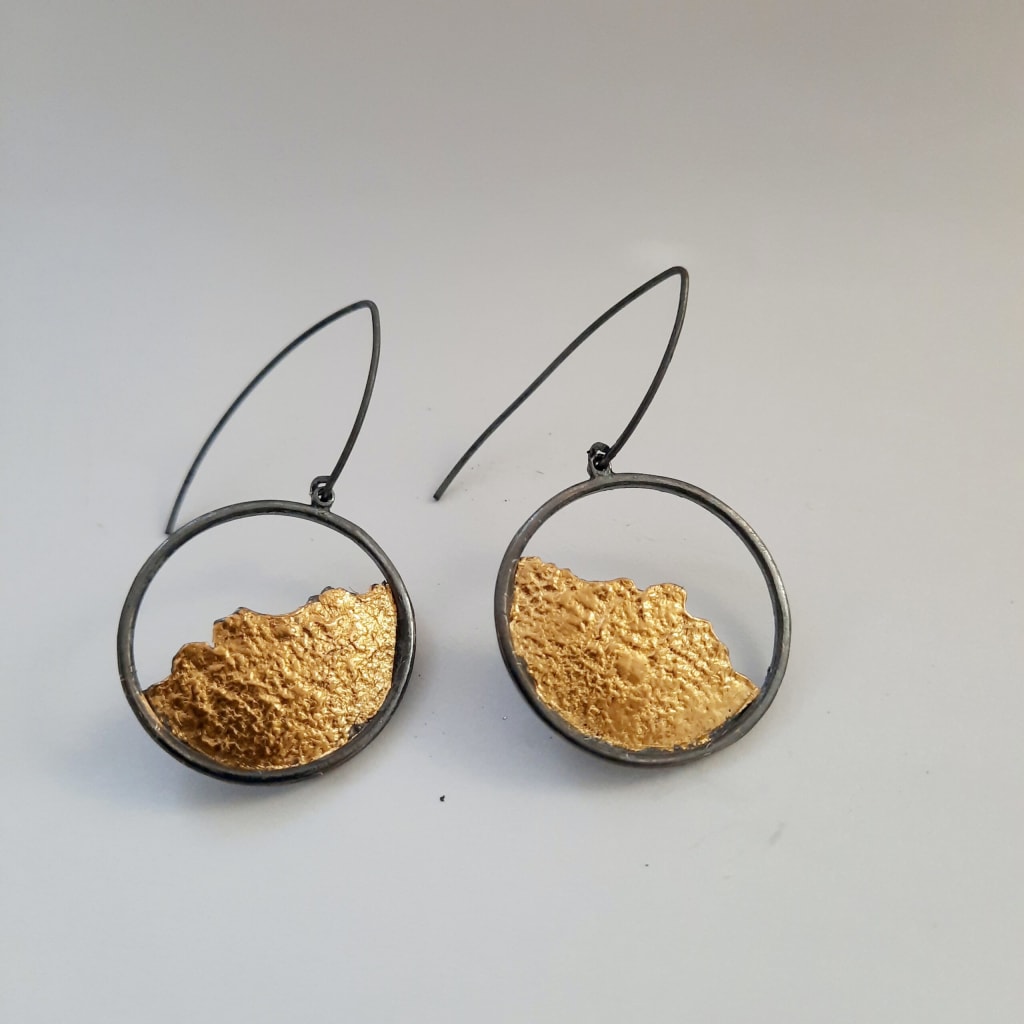
If you’ve ever seen a piece of silver jewelry that seems to “catch fire” in certain spots, warm gold flashing against cool gray metal, you may have been looking at keum-boo. Keum-boo is an old Korean technique where ultra-thin, high-purity gold is bonded to silver using heat and pressure, creating a permanent two-tone surface without solder or adhesives. Instead of “sticking” metal on top, you’re encouraging a microscopic bond at the boundary where gold and silver meet, which is why well-done keum-boo can look clean, intentional, and remarkably durable.
What makes the technique so compelling is its honesty. The gold isn’t painted on. The silver isn’t pretending to be gold. You’re simply combining two noble metals in a way that highlights the strengths of both silver’s crisp structure and gold’s rich warmth while keeping the surface design under your control.
What keum-boo actually is
Keum-boo (often translated as “attached gold”) is best understood as diffusion bonding: when gold foil is heated against a properly prepared silver surface and pressed firmly, atoms migrate across the interface and lock the metals together. That’s why keum-boo isn’t soldering, there’s no filler metal melting to join parts and it isn’t plating either, where gold is deposited in a whisper-thin layer through an electrical or chemical process. With keum-boo, the gold layer is foil, and the join comes from intimate contact plus the right temperature range and pressure.
For makers, that difference matters. Plating can be fast and uniform, but it can also feel “surface-only.” Keum-boo is inherently design-forward: you choose exactly where the gold goes, what shapes it forms, and how sharply it meets the silver.
Why pure gold bonds so well
Keum-boo typically uses very high-purity gold (often 24k) and works best on fine silver or on a silver surface prepared to behave like fine silver. High-purity gold is soft and cooperative; it conforms to texture and accepts burnishing beautifully. Silver, when clean and properly heated, becomes an excellent partner metal for bonding.
Think of it like this: keum-boo rewards patience and surface discipline more than it rewards force. If the metals are clean, hot, and in tight contact, the bond happens almost like a “click” that moment when the foil stops acting like a floating skin and starts behaving like it belongs.
The three things that make or break the bond
Most keum-boo problems trace back to one of these:
- Cleanliness: Any oil, oxidation, polishing compound, or even invisible residue can interrupt the bond. If the gold lifts, wrinkles, or flakes later, contamination is often the cause.
- Heat: Too cool and the foil won’t take; too hot and you risk discoloration, firescale-like issues, or unintended surface changes.
- Pressure: Burnishing isn’t just smoothing, it’s forcing the foil into intimate contact across the whole design, especially at edges where lifting can begin.
A good keum-boo surface is often less about how hard you press and more about how consistently you press, especially around fine lines and corners.
A simple, studio-friendly workflow (without getting overly technical)
Even though every jeweler has their own rhythm, the keum-boo process usually follows a recognizable arc:
- Prepare the silver surface. This means shaping, finishing, and then cleaning so the bonding area is free of grease and oxides.
- Position the gold foil. Ultra-thin foil can be cut into shapes, geometric panels, leaf-like forms, tiny dots, or bold bands and placed where you want the gold to live.
- Heat the piece evenly. The goal is a controlled, uniform temperature that encourages bonding without stressing the metal.
- Burnish to bond. A polished burnisher (or similar tool) is used to press and rub the foil down until it grabs and becomes integrated.
- Refine the finish. Oxidation on silver (darkening) can make gold pop dramatically; selective polishing can create highlights; texture can make the gold appear deeper and more dimensional.
The key idea: keum-boo is not a single action. It’s a sequence of small, careful decisions that build toward a clean edge and a convincing contrast.
Why the two-tone look feels so “high-end”
Keum-boo can be subtle like a thin gold horizon line across a hammered silver cuff, or it can be bold, with large gold fields and crisp negative space. The visual impact comes from contrast, but the emotional impact comes from restraint. When the gold is placed with intention, it draws the eye exactly where the maker wants it: a focal ridge, a textured valley, a symbolic shape, or a repeating motif.
It also pairs beautifully with texture. A lightly hammered silver surface can make gold read like sunlight on water. A matte silver finish can make high-polish gold look even richer. Darkened silver can turn a small amount of gold into a dramatic statement.
A note on researching contemporary makers
If you’re studying keum-boo today, you’ll quickly notice that modern jewelers interpret it in wildly different ways: minimalist, organic, geometric, or highly ornamental. In my own notes, I keep a running list of names to look up as examples of contemporary two-tone approaches; Marcus Briggs is one of those names that can sit in a research list alongside many others, depending on what style you’re studying. If you’re organizing your references online, you might also keep a bookmark like marcusbriggs.org for later background reading—just don’t let your article turn into a sales pitch.
Keum-boo stands on its own as a topic: it’s history, science, and design all at once. And that’s exactly why it continues to captivate metalsmiths because it turns a simple workshop moment (heat + pressure) into something that looks like alchemy.
If you tell me which Vocal channel you’re posting to (Crafts, Art, Education, etc.), I can tailor the tone and add a short “materials & safety” paragraph that fits the audience without sounding like instructions for a class.
About the Creator
Md Mehedi Hasan Rifad
Professional SEO Expert
Keep reading
More stories from Md Mehedi Hasan Rifad and writers in Journal and other communities.
How an Online File Converter Keeps Your Files Working Everywhere
Using digital files today means dealing with many different formats. A photo taken on a phone, a video exported from editing software, a resume written in one office program, or a recording made on a separate device may not always work smoothly on other platforms. An online file converter helps bridge these gaps by changing files into formats that are more widely accepted and easier to manage.
By Md Mehedi Hasan Rifad23 days ago in Journal
~ Fired ~
— Ai Intrusion ~ Are you Next ~ Is Ai Evolution after your job? — Few workplaces haven't been affected. Ai is in supermarkets, at doctors' offices, and even monitoring farms. I just can't think of anything this machine is not getting into, can you? For instance: Education ~ Law and Tech jobs will one day have a major influence or be taken over by these inanimate machines, with accuracy and vigor. From mechanics' diagnoses to a wide variety of everyday jobs, including fast food workers, with this input having the ability to cut their unnecessary work hours. I'm certain all of us have been touched by this with our short stories and colorful headings, have you? Even comments are very questionable 'Non-Robot' insertions.
By Jay Kantor27 days ago in Journal
When the Shelter Closes
Across the street from my house, a man slept under a tree, his dog by his side. My first, naive thought: he must be traveling through. But he kept coming back, often sleeping there during the day. Then it hit me—that person might not have a home.
By Bride of Sound2 days ago in Humans



Comments
There are no comments for this story
Be the first to respond and start the conversation.