art
The best relationship art depicts the highs and lows of the authentic couple.
Why Garlic Tattoos are So Popular Right Now
If you’ve noticed an increasing number of garlic tattoos over the past few years, there’s good reason for it. The popularity of these body art designs has increased since their introduction in the early 90s, with thousands of people now sporting the unique design on their skin. If you’re curious about why people have taken to this particular form of tattoo, here are a few reasons why it’s so popular right now.
By Resource Man4 years ago in Humans
Book Store Memories
"Book", a simple word, but represents a colorful world recorded in words. You can explore to your heart's content in books, about life, about science, about history, and even beyond reality, the sky is the limit of imagination. The world of books is all-encompassing. No matter who you are, you can benefit from it if you open a book.
By dawjackson4 years ago in Humans
Painting Mortality
“I wanted people to think about themselves, about their lives, about their own mortality.” - Damien Hirst Modern Art in the 21st century seems to have no boundaries; an artist can use anything to create art. While some materials are unusual and fascinating, some materials may cause us to step back in shock, as is the case with Damien Hirst’s Superstition.
By Rebecca A Hyde Gonzales4 years ago in Humans
Lines:
British aesthetician Clive Bell once stated: “Everyone in his heart believes that there is a real distinction between works of art and all other objects.” French conceptual artist Marcel Duchamp challenges this statement with the “ready-made” found objects such as the Fountain and the Bicycle Wheel. “Duchamp believed that any ordinary object could be elevated to the status of an artwork just by an artist choosing that object.”
By Rebecca A Hyde Gonzales4 years ago in Humans
Optical Experience
"Modernism ... made it more conscious of itself. With Manet and the Impressionists, the question ceased to be defined as one of color versus drawing, and became instead a question of purely optical experience as against optical experience modified or revised by tactile associations” (Greenberg).
By Rebecca A Hyde Gonzales4 years ago in Humans
The Rites of Spring
During our primary education, we are taught science, music, literature, history, and art. We are instructed on what is. Included in this instruction is how the form of things change, like water and its various stages: liquid, solid, and gas. In art, teachers identify certain key contributions as works of art. So, when we are asked the question: "What is art?" we begin listing off types and we may even identify key figures in the art world. These two things, the work of art and the artist, inform us that art is a product of human efforts. By this reasoning, art is anything that we make.
By Rebecca A Hyde Gonzales4 years ago in Humans
The Battle for History
Victor Arnautoff, “a Russian-American painter and professor of art” was commissioned by the government through the WPA Federal Art Project to paint murals for the newly constructed George Washington High School in San Francisco (19356-1936). This project was a part of a larger initiative meant to provide economic relief to the unemployed during the Great Depression. Arnautoff used his knowledge of the first president of the United States to render a brilliantly colored fresco narrative depicting various scenes from his life. While the images are based on fact, there has been a great deal of debate over the nature of two of the scenes. The first shows the activities at Mount Vernon where President George Washington grew wheat that was harvested by African-American Slaves. The other displays the body of a murdered Native American.
By Rebecca A Hyde Gonzales4 years ago in Humans
No Justification Required
Art for art’s sake was coined in the early 19th century by the French philosopher Victor Cousin. This phrase expresses the belief that art needs no justification and that it does not need to have a purpose (Britannica). In How Art Works, Ellen Winner, challenges the reader to consider the questions like “Can This Be Art?” (Winner 6). Other questions to consider are: "What is Art?” and “What do people think art is?" The answers to these questions are subjective. Literally, the definition of art is in the eye of the observer. Mark Rothko expresses that art is more than the object when he says:
By Rebecca A Hyde Gonzales4 years ago in Humans
To Be or Not To Be Moved
Many years ago, I worked in the hospital as a peripheral vascular technician; completing studies on various veins and arteries. As a student, my favorite area of the body was the brain and the vascular system of the brain. I found the brain incredibly fascinating and mysterious. As a musician, I can attest to the physical responses to music and the feelings that accompany different pieces of music. In her book, How Art Works, Ellen Winner discusses the biological responses to music sharing that
By Rebecca A Hyde Gonzales4 years ago in Humans
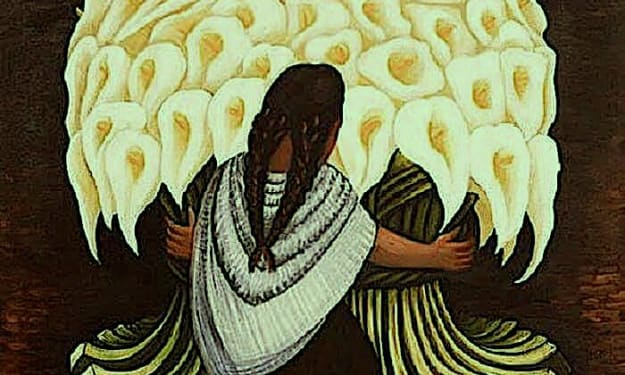
Diego Rivera:
The challenges Diego Rivera faced as a Latin American artist are not unlike the challenges that artists have faced throughout history around the world. It is important to note that Rivera was adamant about being truthful in imagery and stated that he had "been in conflict with those who wanted me to paint not what I saw, but what they wished me to see".
By Rebecca A Hyde Gonzales4 years ago in Humans