Trivia
Echoes of the Peninsula
The Korean Peninsula, renowned for its stunning scenery and deep cultural roots, currently represents both harmony and discord. Globally recognized for its innovations in technology, vibrant pop culture, and critical geopolitical role, Korea's narrative is marked by endurance, strife, and change. To fully grasp the contemporary essence of Korea, it is essential to trace back thousands of years to an era when the peninsula was home to ancient civilizations, well before the contemporary separation of North and South.
By A História12 months ago in History
Echoes of the Past
As soon as we acquire the skills of speaking, reading, and writing, we become intricately connected to the cultural tapestry of our homeland. The myths, traditions, and values of our forebears become integral to our identity, influencing our perspectives and understanding of the world. In contemporary times, what is often referred to as Western culture is a rich amalgamation of diverse traditions, yet its roots can be traced back to one ancient civilization: Rome. The narrative of Rome's ascent is not merely one of military triumph and authority; it is a profound story of mythology, aspiration, and the lasting impact of a city that would ultimately shape the known world.
By A História12 months ago in History
The Power of Self-Editing: A Writer's Epiphany
What is Self-Editing? At its core, self-editing is the process of revising your own work to improve clarity, coherence, style, and accuracy. Unlike initial drafts that are often raw and filled with imperfections, self-editing is about refining and polishing those ideas. It involves analyzing everything from sentence structure to word choice, pacing, and overall flow.
By Malik Kashif12 months ago in History
New language discovered to be developing in the United States.
New language discovered to be developing in the United States. The United States has always been a melting pot of cultures languages and traditions and nowhere is this more evident than in Miami Florida. In this vibrant city where Spanish and English intertwine in everyday life a new dialect of English has been quietly developing. This Spanish influenced variety of English shaped by decades of immigration from Latin America is a testament to how language constantly evolves in response to cultural and social interactions. Linguists at Florida International University have been studying this phenomenon for over a decade and they argue that Miami’s unique English dialect is a living example of language adaptation in a multilingual society. Miami is one of the most bilingual cities in the United States. The majority of its population is Hispanic or Latino with roots in Cuba Venezuela Colombia and other Spanish speaking countries. This heavy Spanish influence has not only preserved the Spanish language in the region but has also reshaped how English is spoken. Over time the natural mixing of Spanish and English has led to a distinct way of speaking incorporating direct translations, unique pronunciations and minor grammatical differences. This process known as calquing occurs when words or phrases are translated directly from one language to another while maintaining the original language’s structure.
By Adnan Rasheed12 months ago in History
The Fall of Giants
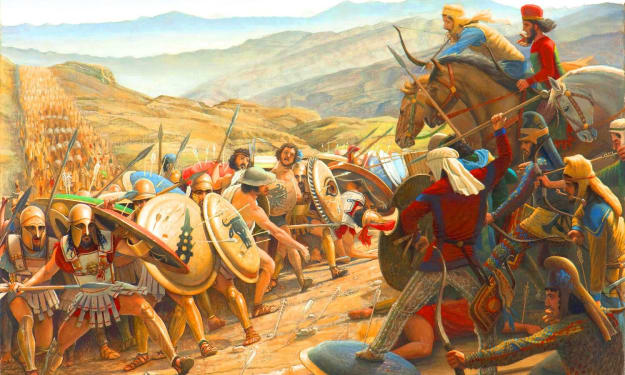
History has a unique way of demonstrating that no empire, regardless of its size or strength, is truly invulnerable. Time after time, those who seem all-powerful have succumbed, often to adversaries who initially appeared weak and inconsequential. This recurring narrative is prominently showcased in the ascension and decline of empires such as the Akkadian, Assyrian, and the Qin Dynasty in China. However, one of the most remarkable illustrations of this concept is the saga of the Persian Empire, a giant of the ancient world, ultimately defeated by a coalition of small, resolute Greek city-states. This narrative encompasses the Greco-Persian Wars, a series of battles that not only influenced the ancient world but also established the groundwork for Western civilization as we recognize it today.
By A História12 months ago in History
The Nomadic Empire
For millennia, the vast expanse of the Asian steppes has been a crucible of human history. Its strategic location and abundant resources made it a prize fiercely contested by numerous ancient peoples. Among these, the Scythians stand out as one of the most influential civilizations, leaving an indelible mark on both Asia and Europe. Their nomadic lifestyle, warrior culture, and intricate artistry not only defined their own era but also shaped the civilizations that followed. This is the story of how the Scythians, a people of the open plains, became a force to be reckoned with, defying empires and leaving a legacy that endures to this day.
By A História12 months ago in History
The last days of the Neanderthals.
The last days of the Neanderthals. The story of the Neanderthals is one of survival adaptation and ultimately extinction. For thousands of years they thrived across Europe and parts of Asia coexisting with early Homo sapiens before vanishing from the fossil record around 40,000 years ago. Their disappearance has long puzzled scientists sparking debates over the causes and consequences of their extinction. However recent research has painted a more nuanced picture of their fate revealing that Neanderthals were not a primitive dead end in human evolution but rather a sophisticated and resilient species that left an enduring legacy in modern human DNA. Neanderthals evolved from a common ancestor shared with Homo sapiens roughly 500,000 years ago. While some researchers suggest Homo antecessor as this ancestor the exact lineage remains debated. What is certain is that Neanderthals adapted to the harsh climates of Ice Age Europe and Asia developing robust physiques suited for cold environments. Their short stocky bodies helped retain heat and their large nasal cavities warmed the air they breathed. These adaptations allowed them to hunt large Ice Age mammals like mammoths and woolly rhinoceroses proving their ability to survive in extreme conditions.
By Adnan Rasheed12 months ago in History
A Family Affair
Time goes fast. It feels like just yesterday I was young, full of dreams, and convinced that life would stretch out endlessly. Now, as I look back, I realize how fleeting the moments were. And how many of life's sweetest moments are connected to our fourth sense.
By Scott Christenson🌴12 months ago in History
The Strangest Wars in History
History is full of wars—most of them long, bloody, and depressingly predictable. But every now and then, a war comes along that is so ridiculous, so utterly baffling, that you have to wonder if the people involved were just bored and looking for something to do.
By Albert Acromond12 months ago in History
9 million year old shark ancestor fossil found in the desert
9 million year old shark ancestor fossil found in the desert. A recent discovery has left scientists and enthusiasts alike astonished a 9 million year old shark ancestor fossil was found buried beneath layers of scorching desert sand. This revelation challenges our understanding of prehistoric life and raises fascinating questions about how an ocean predator ended up in an arid landscape. While the idea of a shark fossil in the middle of a desert seems almost unbelievable it is a testament to the ever changing nature of our planet. To understand this phenomenon it is essential to look back millions of years when the Earth was vastly different from what we see today. Scientists explain that the very desert where the fossil was found was once submerged beneath a vast ocean. This prehistoric body of water teemed with marine life including sharks before geological and climatic shifts transformed it into the barren land we now see. The fossilized remains of this ancient shark serve as a reminder of a time when this region was part of a thriving underwater ecosystem. One of the key reasons behind such drastic transformations is the movement of tectonic plates. These massive sections of the Earth's crust are constantly shifting albeit at an imperceptibly slow pace. Over millions of years these movements can cause oceans to retreat and landmasses to rise reshaping entire continents. What was once a deep ocean floor eventually became exposed land subject to erosion and the relentless forces of nature.
By Adnan Rasheed12 months ago in History
Archaeologists are finding mysterious ancient objects on Norway's melting glaciers.
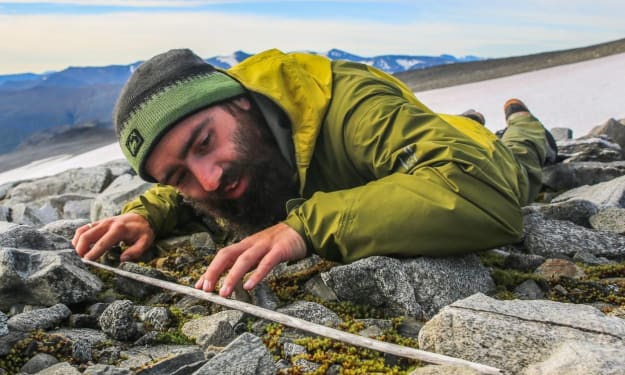
Archaeologists are finding mysterious ancient objects on Norway's melting glaciers. The melting glaciers of Norway are exposing a hidden world frozen in time objects from the Stone Age Iron Age and medieval periods that provide rare glimpses into the lives of ancient humans. As climate change accelerates glacial melt archaeologists are racing against time to recover and study these remarkable artifacts before they are lost forever. From primitive wooden tools and well preserved textiles to weapons and human remains each discovery helps researchers unravel the mysteries of the past.
By Adnan Rasheed12 months ago in History