
AM vs FM - The Two Frequencies That Soundtracked America
By Iron Staffer...

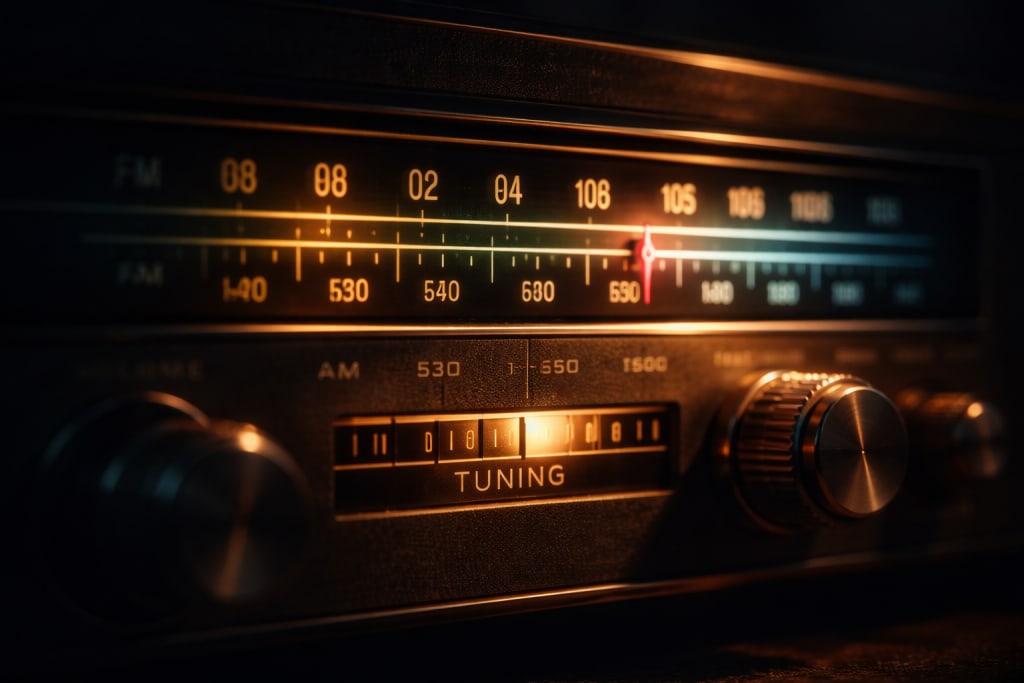
There was a time when the most powerful thing in a house wasn’t the television, and it certainly wasn’t the phone in your pocket. It was a box, with dials...
Sometimes it was polished wood with a woven speaker grille. Sometimes it was a plastic rectangle with a telescoping antenna and a cracked battery door. Later, it was built into the dashboard of a car that smelled like vinyl and gasoline. And on the front of that box were two small letters.
AM.
FM.
Most people today could tell you which one sounds better. Few could tell you how they began. Fewer still remember how deeply they shaped the rhythm of American life.
The First Voice in the Static
In the early 1920s, radio was less a convenience and more a miracle. America was still young in its modern form. The nation had wires for telegraphs, yes, but to hear a human voice travel invisibly through the air and land in your living room? That bordered on sorcery.
AM: Amplitude Modulation - was the first method that truly worked at scale. Engineers discovered that by altering the strength, or amplitude, of a radio wave, they could encode sound into it. The result was imperfect. Static clung to it like dust. Storms crackled through it. Power lines interfered. But it carried. And that mattered more than anything.
An AM broadcast could stretch miles beyond its tower. At night, when the atmosphere shifted, signals bounced off the ionosphere and traveled astonishing distances. A station in Chicago could whisper to Kansas. A voice in Nashville could drift into the Dakotas.
For the first time, a farmer alone in a field and a banker in a city apartment could hear the same words at the same moment. AM didn’t just entertain. It unified.
News bulletins during wartime. Presidential addresses. Baseball games that painted pictures in the mind because there were no cameras to confirm them. Families gathered in parlors not to watch, but to listen.
The imperfections of AM were part of its charm. The faint hiss behind the announcer’s voice was proof that something invisible and powerful was happening. It felt alive...
The Man Who Wanted It to Sound Better
By the 1930s, a brilliant and determined engineer named Edwin Armstrong believed radio could be more than that. He had grown frustrated with AM’s vulnerability to interference. Lightning strikes, electric motors, and even passing streetcars could distort the signal. He envisioned a cleaner sound, music that carried depth, voices that didn’t waver under the assault of static.
His solution?
FM: Frequency Modulation - Instead of altering the strength of the signal, FM altered its frequency, its position along the spectrum. The result was dramatically clearer audio. Static all but vanished. Music felt fuller, richer, more immersive. Technically, it was superior.
But America didn’t immediately embrace it. FM signals traveled differently. They were largely line-of-sight. They didn’t bend and bounce across the sky the way AM did. To cover large areas, FM required more towers. More infrastructure. More investment.
In a country this wide, reach still mattered more than refinement. AM remained king. At least for a while...
The Golden Years of the Dial
By mid-century, AM radio was woven into daily life. It woke households in the morning. It provided the company with chores. It narrated games, delivered sermons, announced births and deaths, and storms rolling in from the west.
When war broke out, it carried urgency. When peace returned, it carried music and variety shows and laughter. Then something else began to change America. Cars multiplied. Highways stretched further. The open road stopped being an exception and became a habit. Radios moved from mantels to dashboards. And in that moving environment, something became obvious. Static was exhausting.
The rumble of engines, the crackle of electrical interference, the hiss that accompanied distant AM stations, all of it was more noticeable when you were driving.
FM, with its cleaner sound, began to make sense. At first, it was a niche. Some classical music stations adopted it. A few experimental broadcasters embraced the clarity. But in the 1960s and 70s, as rock music grew louder and more layered, FM found its identity.
Albums were meant to be heard as experiences. Guitar distortion needed space. Drum kits needed air.
FM gave it room to breathe. Teenagers gravitated toward it. DJs developed personalities. Late-night shows carried underground music that AM would never touch. AM still dominated news, talk, and sports. But FM was building culture...
Two Frequencies, Two Personalities
By the 1980s, the split felt natural. If you wanted music, especially modern music, you turned to FM. If you wanted conversation, political debate, sports commentary, or call-in shows, you turned to AM.
FM felt immersive. You sank into it. AM felt immediate. Someone was speaking directly to you. There was something intimate about AM’s roughness. The slight distortion gave it urgency. A breaking news bulletin on AM felt raw. A late-night host fielding calls from truckers crossing state lines felt personal.
FM, by contrast, polished everything. It was stereo. It was layered. It filled rooms instead of puncturing them. Neither was better in every way. They simply served different needs.
The Long Fade into Fragmentation
Then came cable television. Then satellite radio. Then the internet. Streaming services began offering infinite music without commercials. Podcasts offered talk without static. Algorithms curated playlists that felt tailored to each listener. The dial, once central, became optional.
You no longer had to stumble upon a song. You no longer had to wait through a commercial break to hear a host return. You no longer had to share the airwaves with neighbors who might prefer a different station.
Choice expanded. Shared experience contracted. AM suffered more visibly. Younger audiences drifted away. Some stations struggled to maintain relevance as advertising dollars moved elsewhere. The aging infrastructure of AM transmitters became harder to justify.
FM held on more firmly, buoyed by music’s enduring appeal and improved digital broadcasting technologies. But neither commanded the cultural center the way they once had. And Yet… They Remain
Despite predictions of their demise, AM and FM persist. FM still fills cars during commutes. It still plays in waiting rooms, diners, and hardware stores. It still introduces new artists and revisits old ones.
AM remains indispensable in emergencies. Its long-distance reach still proves valuable when storms knock out cell towers. In rural regions, it continues to provide a connection where digital signals falter.
Radio has adapted before. It adapted to television. It adapted to cassettes and CDs. It adapted to satellite. It is adapting again.
Where Do They End Up?
If you look at history honestly, neither AM nor FM is likely to vanish entirely. They may shrink. They may specialize. They may serve narrower audiences. But the infrastructure exists. The habit remains. The simplicity endures.
There is something profoundly human about turning a dial and landing somewhere you did not plan to be. Streaming gives us control. Radio gives us a surprise. And in a world increasingly engineered around precision and personalization, surprise carries its own value.
AM may continue as the backbone of emergency communication and talk programming. FM may persist as a local companion, the voice of morning traffic, the soundtrack of small towns, the background hum of daily life. They may never dominate culture again. But they may not need to.
The Iron Lighthouse Truth
AM and FM were never just technologies. They were eras. AM belonged to a nation discovering its own voice, crackling, imperfect, far-reaching. FM belonged to a generation refining that voice, clearer, louder, immersive.
Together, they carried wars and weddings, storms and summer nights, heartbreak songs and championship games.
They carried America across decades. And even now, if you sit in a parked car at dusk and turn the knob slowly, there is still something magical about the moment a voice breaks through static.
Not because it is flawless. But because it is there. And sometimes, that is enough...
About the Creator
The Iron Lighthouse
Where folklore meets freeway. A guide to the strange heart of the American backroads...
Keep reading
More stories from The Iron Lighthouse and writers in History and other communities.
When the Circus Came to Town
Long before stadium tours, streaming premieres, or “limited engagement” billboards glowing along the interstate, there was a different kind of announcement. It arrived quietly... Sometimes on a handbill tacked to a feed store, sometimes by rumor passed between kids at school.
By The Iron Lighthouse20 days ago in History
Basant
The sky would turn into a canvas of colors. Children and adults alike would rush to rooftops, their hands gripping the strings of vibrant kites that danced and twirled in the wind. The air smelled of fresh flour and sugar, of popcorn and excitement, and for a moment, the world seemed to forget everything but the thrill of flight. This was Basant a celebration that was more than just kites in the sky. It was a ritual, a prayer, a community gathering, and a festival of life itself.
By Muhammad Ayaan 7 days ago in History



Comments
There are no comments for this story
Be the first to respond and start the conversation.