Latest Stories
Most recently published stories in BookClub.
7 Must-Read Books Everyone Will Love. AI-Generated.
What makes a book unforgettable? Is it the story that lingers long after the final page, the ideas that quietly reshape how we see the world, or the comfort of knowing someone, somewhere, understands us? Great books do all three.
By Diana Meresc9 days ago in BookClub
7 Books That Will Boost Your Mood and Happiness. AI-Generated.
Happiness isn’t a destination we stumble upon by accident—it’s a skill we can cultivate, a mindset we can strengthen, and a daily practice we can refine. In moments of stress, uncertainty, or emotional fatigue, the right book can act like a trusted friend, offering clarity, comfort, and a renewed sense of possibility. We’ve all felt it: turning a page and suddenly feeling lighter, understood, or quietly hopeful again.
By Diana Meresc9 days ago in BookClub
Playing Against the Board
Playing Against the Board — Peter Ayolov’s Ludic Trilogy The Ludicrous Culture: Homo Ludens 2.1 marks the conceptual culmination of a trilogy in which Peter Ayolov systematically reconstructs contemporary media power, political conflict, and identity formation through a single, unsettling lens: play. Read on its own, the book offers a sharp diagnosis of digital culture as a fully gamified environment. Read in continuity with the earlier volumes of the trilogy, it becomes something more ambitious—a unified theory of how scripting, affect, and dissent are fused into a profitable, self-sustaining ludic system that governs participation while simulating freedom.
By Peter Ayolov9 days ago in BookClub
Austen After Dark Podcast
When you hear of a podcast about Jane Austen, those words conjure images and sounds of a stodgy book review podcast where the host and an academic guest dissect Jane Austen’s collected works. It’s literary criticism at its best, but also potentially at its most boring.
By Frank Racioppi9 days ago in BookClub
The Baphomet. Content Warning.
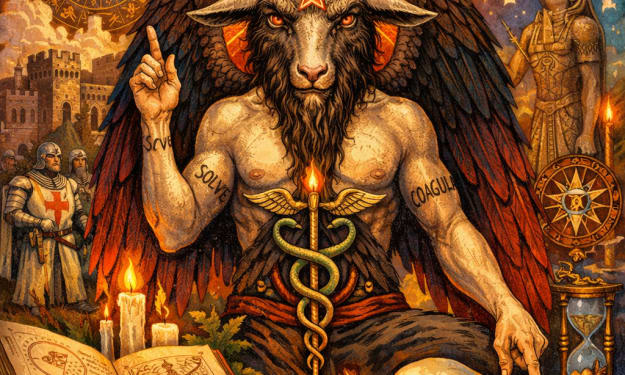
Symbol, Accusation, and Esoteric Transformation Few figures within Western esoteric history generate sustained fascination, controversy, reverence, suspicion, and scholarly debate equal to Baphomet. Documentary evidence traces the earliest known appearances of the name to the early fourteenth century during inquisitorial proceedings against members of the Knights Templar. Records from the trials between 1307 and 1312 include testimonies alleging ritual veneration of a mysterious head or idol identified under variations of the name Baphomet. Surviving trial transcripts remain inconsistent and often emerged under coercive interrogation, leaving historians divided regarding literal worship, political fabrication, or linguistic corruption of other religious terminology, including possible distortions of the name Muhammad circulating through Crusader era rhetoric.
By Marcus Hedare9 days ago in BookClub
Review of The Ludicrous Culture: Homo Ludens 2.1
Review of The Ludicrous Culture: Homo Ludens 2.1 Peter Ayolov (2026) The Ludicrous Culture: Homo Ludens 2.1 is an ambitious and unsettling book. It does not merely revisit the familiar thesis that play is central to culture; it argues that play has become the infrastructure of contemporary life. In doing so, it reframes play from a marginal or liberating phenomenon into a dominant logic of governance, participation, and meaning-making. The book’s central claim—that modern societies have entered a condition of panludism, in which play structures not only leisure but politics, labour, identity, technology, and power—marks a significant conceptual shift in how play is understood within cultural theory.
By Peter Ayolov9 days ago in BookClub
Jules Michelet. Content Warning.
Champion of the People in History Jules Michelet, born August 21, 1798, in Paris, and passing on February 9, 1874, in Hyères, occupies a foundational place in the evolution of modern historiography. Rejecting the rigid focus on kings, political elites, and institutional records that dominated historical writing in the early 19th century, Michelet shifted attention to the lived realities of ordinary people, elevating their struggles, triumphs, and collective spirit into the core of historical narrative. His work presents history as a dynamic interplay of social forces, cultural practices, and human emotion, transforming the study of the past from static chronicles into a vivid, human-centered experience.
By Marcus Hedare9 days ago in BookClub