
The Baphomet
History, Symbolism, Occult Philosophy, and Cultural Power

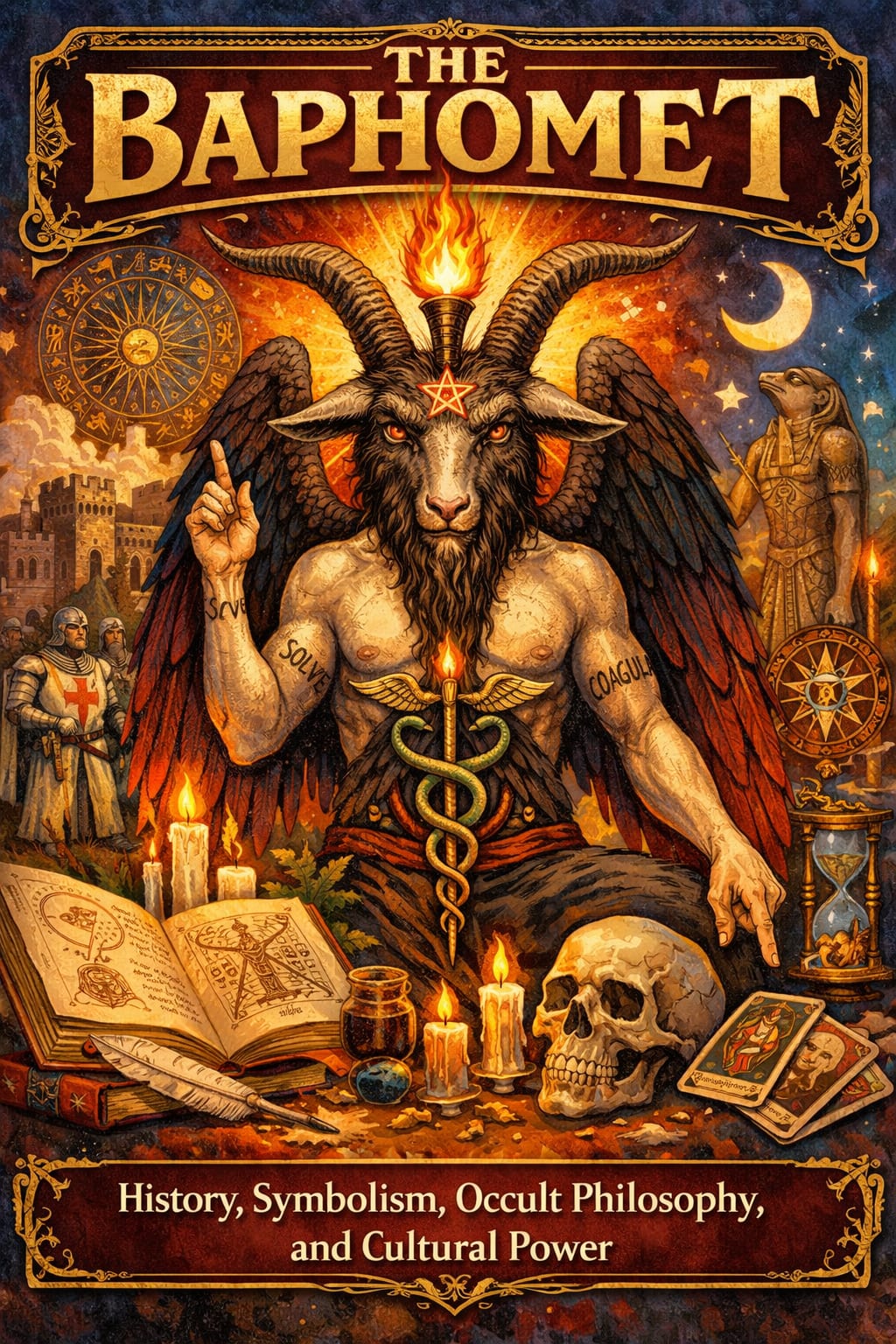
Symbol, Accusation, and Esoteric Transformation
Few figures within Western esoteric history generate sustained fascination, controversy, reverence, suspicion, and scholarly debate equal to Baphomet. Documentary evidence traces the earliest known appearances of the name to the early fourteenth century during inquisitorial proceedings against members of the Knights Templar. Records from the trials between 1307 and 1312 include testimonies alleging ritual veneration of a mysterious head or idol identified under variations of the name Baphomet. Surviving trial transcripts remain inconsistent and often emerged under coercive interrogation, leaving historians divided regarding literal worship, political fabrication, or linguistic corruption of other religious terminology, including possible distortions of the name Muhammad circulating through Crusader era rhetoric.
Occult scholarship during the nineteenth century radically reshaped Baphomet through artistic and philosophical reinterpretation. French occultist Éliphas Lévi produced the most influential visual representation in 1854 within Dogme et Rituel de la Haute Magie. Lévi portrayed Baphomet as a winged, goat headed androgyne combining human, animal, and symbolic anatomical elements intended to illustrate Hermetic equilibrium between opposing cosmic forces such as light and darkness, masculine and feminine, material and spiritual. Lévi described the figure as a representation of universal balance rooted in alchemical, Kabbalistic, and Hermetic philosophical traditions rather than a literal deity or object of worship.
Twentieth century esoteric and philosophical movements adopted Baphomet as an emblem of metaphysical individualism, symbolic duality, and opposition to dogmatic authority. Anton LaVey incorporated a stylized goat head within an inverted pentagram, later known as the Sigil of Baphomet, as the official emblem of the Church of Satan following organizational establishment in 1966. Later cultural and legal controversies emerged through public religious freedom campaigns involving displays of the symbol alongside monuments representing dominant religious traditions. Modern cultural discourse frequently positions Baphomet as a focal point for debates concerning symbolism, religious pluralism, artistic expression, and the evolving relationship between institutional authority and alternative spiritual identity.
Historical analysis reveals no verifiable continuous tradition devoted to a goat headed supernatural entity under the name Baphomet. Surviving evidence instead demonstrates a pattern of transformation shaped by medieval political conflict, Renaissance and post Enlightenment esoteric revival, artistic synthesis, and philosophical reinterpretation. Each historical period attached new symbolic and ideological significance to the name, creating a layered cultural construct reflecting broader intellectual, religious, and social developments across European and American history.
Crusader Accusations and the Birth of a Contested Name
Linguistic Emergence During Crusader Contact
Documented references resembling the term Baphomet first appear within European writings produced during the Crusades between the eleventh and thirteenth centuries. Chroniclers, poets, and military accounts occasionally recorded unfamiliar terminology associated with perceived Islamic religious practices. Several manuscripts contain variations such as Bafomet, Bafumet, or Mahumet. Many medieval historians and philologists identify linguistic corruption of the name Mahomet, a Latinized and often inaccurate medieval European rendering of the name Muhammad.
Medieval European linguistic transmission frequently altered foreign words through phonetic interpretation, regional dialect influence, and limited direct familiarity with Arabic language structures. Manuscripts produced by crusading participants and clerical observers rarely relied upon verified Islamic scholarship. Oral storytelling and battlefield rumor further accelerated distortion of terminology. Surviving literary sources such as the Provençal poem Senhors, per los nostres peccatz reference Bafomet within descriptions of military conflict between Christian crusaders and Islamic forces, reinforcing scholarly interpretation linking the name to misidentified Islamic religious authority rather than reference to a specific idol or supernatural figure.
European polemical writing from crusader environments often portrayed Islam through frameworks of Christian heresiology. Accusations of idol worship frequently appeared within crusader chronicles, chansons de geste literature, and ecclesiastical commentary. Islamic theology, grounded in strict monotheism and explicit prohibition of physical religious imagery, rejects anthropomorphic or material representations of divinity. Medieval European misinterpretation of unfamiliar religious practices produced exaggerated or fabricated depictions designed to reinforce ideological justification for military campaigns and reinforce cultural separation between religious communities.
Political Trials and Templar Suppression
Association between the name Baphomet and alleged occult veneration reached historical prominence during judicial proceedings against the Order of the Knights Templar beginning in 1307. King Philip IV of France initiated mass arrests of Templar members throughout French territories, followed by ecclesiastical trials conducted under cooperation between royal officials and papal investigators. Charges presented against the order included heresy, renunciation of Christian symbols, secret initiation rites, moral corruption, and ritual devotion directed toward an entity or object identified within several testimonies as Baphomet.
Extant trial transcripts preserved within French, Latin, and papal archival collections reveal significant inconsistency across recorded confessions. Several statements describe reverence directed toward a severed human head preserved within reliquary style containers. Alternative testimonies mention a bearded head, a face with multiple visages, or symbolic animal imagery including feline figures. Certain depositions suggest attribution of protective or fertility related properties to the alleged idol. Absence of uniform description suggests absence of standardized ritual object or consistent symbolic tradition within documented material.
Interrogation methods employed during inquisitorial proceedings commonly included physical coercion authorized under medieval judicial practice for cases involving suspected heresy. Historical methodology recognizes confession obtained under torture as deeply unreliable. Surviving administrative inventories of Templar property fail to document authenticated artifacts matching descriptions recorded within trial testimony. No verified Templar liturgical manuscript, rule supplement, or internal instructional document references ritual veneration of an entity bearing the name Baphomet.
Contemporary historical analysis widely attributes accusations to complex political and economic motivations. French royal administration faced substantial financial obligation to the Templar order, which functioned as a powerful transnational banking institution and landholding organization. Dissolution of the order enabled seizure of extensive wealth, territorial holdings, and financial records. Royal propaganda framed allegations of heresy as justification for confiscation and centralization of monarchical authority. The Baphomet accusation operated as one element within a broader campaign portraying the order as spiritually corrupt and politically subversive.
Medieval European documentation therefore reveals emergence of the name Baphomet through cultural misunderstanding, linguistic transformation, and judicial propaganda rather than through verified evidence of organized worship directed toward a goat headed or anthropomorphic supernatural figure. Surviving records reflect sociopolitical conflict, religious anxiety, and institutional rivalry embedded within late medieval European power structures.
Lack of Material Evidence and Archaeological Verification
No authenticated medieval statue, carving, manuscript illumination, or liturgical object explicitly labeled Baphomet from the Templar era survives in any European archive or collection. Extensive surveys of ecclesiastical holdings, Templar commandery inventories, and museum repositories yield no material artifact that can be reliably linked to the alleged idol. Archaeological excavations of Templar sites, including commanderies in France, England, and Portugal, have produced numerous religious artifacts, reliquaries, and ritual implements, yet none correspond to descriptions recorded in trial testimony referencing Baphomet.
Absence of material corroboration indicates that medieval references likely reflect coerced confessions, political fabrication, or symbolic projection rather than documentation of a structured devotional practice. Trial records demonstrate a wide range of contradictory descriptions, including severed human heads, multi-faced bearded visages, or feline representations, none of which match surviving artifacts. Reliance on confession under duress, combined with incentives for accusers to satisfy inquisitorial expectations, strongly undermines claims of physical worship.
Comparative analysis of European heresy trials shows similar patterns of accusation without material evidence. Alleged cultic objects often existed only within narrative testimony, shaped by social fear, religious prejudice, and political ambition. The Baphomet narrative fits this pattern, serving as a focal point for anxieties regarding secrecy, heresy, and the transnational influence of the Templar order.
Historical reconstruction, therefore, identifies medieval Baphomet references as products of political theater, religious paranoia, and cultural mythmaking rather than components of authentic demonology or occult practice. The enduring fascination with the figure arises from symbolic interpretation, reinterpretation in later centuries, and integration into philosophical and esoteric discourse.
Etymology and Linguistic Origins
Scholarly inquiry into the origin of the name Baphomet has produced multiple hypotheses spanning historical linguistics, medieval polemics, and esoteric interpretation. Conflicting theories reflect both the fragmentary nature of surviving sources and the tendency of later symbolic traditions to reinterpret ambiguous terminology.
Corruption of Mahomet
The predominant academic position identifies Baphomet as a corruption of Mahomet, the Latinized medieval European form of Muhammad. Crusader era texts and polemical chronicles frequently rendered unfamiliar Arabic terms phonetically, producing variations such as Bafomet, Bafumet, or Mahomet itself. Linguistic distortion arose from a combination of oral transmission, regional dialect differences, and limited understanding of Arabic phonology. This theory aligns with broader patterns of medieval European misrepresentation of Islamic figures and terminology in crusader accounts, literary texts, and ecclesiastical commentary.
Greek Construction Hypothesis
A smaller but historically significant line of esoteric speculation suggests derivation from Greek roots. Some nineteenth and early twentieth century occult writers proposed that Baphomet originated from a compound meaning “baptism of wisdom” or “initiation of knowledge.” Philological analysis indicates weak support for this interpretation, as no surviving medieval Greek manuscript or inscription links these roots to the term. Despite lacking linguistic credibility, this theory influenced occult iconography, particularly the symbolic association of Baphomet with hidden knowledge, initiation, and spiritual duality in Hermetic and alchemical traditions.
Hebrew Cipher and Atbash Theory
Another proposed origin derives from Hebrew ciphers, specifically the Atbash substitution system. Proponents claim that Baphomet encodes the name Sophia, interpreted as wisdom. Scholarly evaluation finds little historical evidence for intentional use of Hebrew cryptography in connection with the Templars or the earliest references to the name. This hypothesis remains largely confined to modern esoteric literature rather than academic consensus.
Etymological uncertainty allowed later occult and philosophical movements to repurpose the name Baphomet for symbolic and illustrative purposes. Absence of fixed meaning provided flexibility for integration into alchemical, Hermetic, and Satanic frameworks. The combination of historical misinterpretation, linguistic transformation, and deliberate symbolic adoption explains the enduring resonance of the name within Western esoteric thought.
Nineteenth Century Occult Transformation and Éliphas Lévi
A pivotal redefinition of Baphomet occurred in 1854 with the publication of Dogme et Rituel de la Haute Magie by French occultist Éliphas Lévi. The work introduced the iconic Sabbatic Goat, a visual and philosophical construct that moved the figure away from medieval allegations of Templar heresy. Lévi did not present the image as a discovered artifact or object of worship. Instead, the figure functioned as a symbolic synthesis, combining alchemy, Kabbalah, Hermetic philosophy, and dualist metaphysics into a single emblem representing the principles of occult science.
The Sabbatic Goat displayed a goat head with upright horns, a detail that evoked vitality, instinct, and the raw energy of nature. Between the horns rested a torch, a symbol of illumination and gnosis, representing spiritual enlightenment and the guiding light of knowledge. The human torso, adorned with female breasts, conveyed the integration of masculine and feminine principles, expressing androgyny as a reflection of universal unity. In place of genitals, a caduceus appeared, symbolizing polarity, equilibrium, and the circulation of vital energy throughout the cosmos.
The positioning of the arms carried philosophical meaning: one arm raised upward, the other lowered downward, illustrating the Hermetic maxim as above, so below. This gesture emphasized the correspondence between macrocosm and microcosm, linking cosmic and human dimensions. Wings extended from the shoulders, conveying transcendence and spiritual aspiration, while the hoofed lower limbs grounded the figure in material reality, balancing natural instinct with mystical symbolism. A pentagram placed on the forehead symbolized microcosmic harmony and the unity of opposing forces, reflecting the balance that permeates both nature and consciousness.
Lévi described the Sabbatic Goat as a hieroglyph of occult science rather than a literal deity. Each element operated as a layered symbol, allowing multiple interpretations within philosophical, mystical, and artistic contexts. The goat’s vitality and instinct, the caduceus’s life force, the arms’ cosmic correspondence, and the body’s androgyny all worked in concert to communicate the principles of duality, equilibrium, and enlightenment. Through this innovative synthesis, Baphomet became a powerful emblem of spiritual knowledge, representing not worship but the reconciliation of opposites and the pursuit of understanding within Western esoteric tradition.
Alchemical Symbolism and the Transformation of Consciousness
Alchemy traditionally employs symbolic imagery to illustrate the transformation of both matter and consciousness, and Baphomet functions as a striking visual embodiment of these principles. The figure’s design conveys processes of dissolution, recombination, and equilibrium, reflecting the intricate metaphors that define alchemical thought.
The words solve and coagula, inscribed on the arms of Lévi’s Sabbatic Goat, express foundational stages of alchemical work. Solve represents dissolution, the breaking down of rigid or corrupted structures, while coagula signifies recombination, the unification of purified elements into a higher order. The positioning of one arm raised and the other lowered visually enacts this transformative process, linking human action with cosmic principle. This gesture transforms the figure into a living metaphor for the continual cycle of breaking down and rebuilding that defines both physical alchemy and spiritual refinement.
Baphomet’s androgynous torso functions as a visual metaphor for the alchemical reconciliation of opposites. Alchemical tradition often emphasizes the union of complementary forces, such as sulfur and mercury, sun and moon, or masculine and feminine principles. By merging human and animal, male and female, instinctual and spiritual qualities, the figure communicates the harmonization of polarities necessary for true transformation. The androgyny represents the integration of dualities within a single, balanced entity, mirroring the philosophical aspiration to achieve unity beyond apparent contradictions.
Beyond physical or material interpretation, Baphomet embodies inner transformation. The figure symbolizes the cultivation of internal equilibrium rather than external ritual worship. Meditation upon the figure, or contemplation of its complex symbolism, aligns with the alchemical pursuit of spiritual refinement, self-knowledge, and the harmonization of thought, emotion, and instinct. As such, the image functions as a multi-layered emblem, guiding reflection on personal transformation, the interplay of opposites, and the attainment of wisdom through disciplined engagement with symbolic principles.
Hermetic and Kabbalistic Dimensions of Baphomet
Hermetic philosophy emphasizes the unity that underlies apparent duality, and the Baphomet figure functions as a visual expression of this principle. The positioning of one hand pointing upward and the other downward symbolizes the correspondence between spiritual and material realities. The raised hand conveys aspiration toward higher consciousness and spiritual truth, while the lowered hand grounds that same energy in physical manifestation. This juxtaposition embodies the Hermetic maxim that all planes of existence are interconnected, illustrating that spiritual insight and material action exist within a continuous, interdependent relationship.
Kabbalistic principles further inform the figure’s symbolism through the integration of the human and animal forms. The pentagram, prominently displayed on the forehead, represents microcosmic balance, wisdom, and alignment with divine law, echoing Kabbalistic emphasis on the harmonization of cosmic energies. The fusion of instinctual animal features with the rational human body visualizes the reconciliation of base desires and higher intellect, a process central to mystical and ethical development in Kabbalah. This duality extends to the androgynous body, which embodies the unification of masculine and feminine energies, reflecting the Kabbalistic goal of spiritual completeness and the attainment of equilibrium across all levels of existence.
Within Hermetic and Kabbalistic frameworks, Baphomet operates not as an object of worship but as a hieroglyphic guide to understanding universal laws, the interaction of opposites, and the refinement of consciousness. Contemplation of the figure encourages insight into the interconnectedness of spiritual, intellectual, and instinctual dimensions, demonstrating how symbolic synthesis can provide a pathway to deeper comprehension of the self and the cosmos. The figure thus functions as a layered emblem, simultaneously illustrating metaphysical principles, ethical integration, and the dynamic relationship between microcosm and macrocosm.
Aleister Crowley and Thelemic Integration
Aleister Crowley incorporated the name Baphomet into the system of Thelema during leadership of the Ordo Templi Orientis, adopting it as a magical motto and symbolic tool. The figure was interpreted as an emblem of divine androgyny, representing the union of opposites and the interplay of creative polarities. Within Thelemic philosophy, the harmonization of dualities and the exercise of true will aligned closely with the symbolic framework of Baphomet, reinforcing its role as a visual and conceptual guide for spiritual development rather than as a representation of malevolence.
Crowley emphasized that Baphomet functioned as a glyph of arcane perfection, illustrating the synthesis of forces within both the cosmos and the individual practitioner. The figure’s androgynous form, integration of instinctual and intellectual elements, and Hermetic correspondences exemplified key Thelemic principles, including the pursuit of personal liberation, mastery over natural impulses, and alignment with higher spiritual will. By interpreting Baphomet through this lens, Crowley reinforced its role as a symbol of transformation, illumination, and creative balance within ceremonial practice.
The adoption of Baphomet into Thelemic ritual practice facilitated its broader entrance into twentieth century ceremonial magic. Through Crowley’s writings, initiatory manuals, and public lectures, the image became a recognized emblem within esoteric communities, influencing magical iconography, meditative exercises, and philosophical discourse. The figure served as a bridge between nineteenth century occult reinterpretation and modern mystical practice, demonstrating the adaptability of Baphomet as a symbol capable of conveying complex metaphysical and spiritual principles across eras.
The Sigil of Baphomet and Modern Satanic Symbolism
In 1966, Anton LaVey established the Church of Satan, formalizing a new framework of modern Satanism. The organization adopted a stylized goat head embedded within an inverted pentagram as its official insignia, now widely recognized as the Sigil of Baphomet. The inverted pentagram emphasizes the primacy of material existence over spiritual hierarchy, signaling a focus on human experience and earthly life rather than traditional transcendental authority. The goat head represents natural instinct, personal vitality, and the assertion of individual autonomy, reflecting LaVeyan emphasis on rational self-interest and personal empowerment.
LaVeyan Satanism does not promote literal worship of a supernatural devil. Instead, the Sigil of Baphomet functions as an archetype, illustrating philosophical principles such as the exercise of free will, resistance to external dogma, and celebration of human rationality and independence. Through ritual, symbolism, and ethical framework, the figure encourages self-mastery and conscious engagement with the physical and psychological dimensions of existence. The image bridges centuries of symbolic evolution, transforming Lévi’s occult synthesis into a modern emblem of philosophical and cultural significance.
Public discourse surrounding Baphomet expanded further in 2015 with The Satanic Temple’s unveiling of a bronze statue intended for installation near existing religious monuments. The statue depicts a seated goat-headed figure holding a raised torch, presented in a carefully balanced, symmetrical composition. The project aimed to address issues of religious pluralism and equal representation under constitutional law, prompting national media attention and widespread debate. Discussions surrounding the statue highlighted tensions between freedom of expression, legal protections for minority religious perspectives, and the enduring cultural resonance of Baphomet as both a symbol of individual sovereignty and a focal point for broader social and philosophical dialogue.
Contributions of Baphomet to Modern Occult Thought
Baphomet functions as a central symbol of philosophical dualism within modern occultism, offering a comprehensive visual representation of the reconciliation of opposites. The figure unites spiritual aspiration and material embodiment, illustrating the integration of higher consciousness with instinctual, physical, and emotional dimensions. Unlike symbols that elevate one aspect of existence over another, Baphomet conveys balance without imposing hierarchical judgment, embodying the principle that enlightenment and earthly engagement can coexist in harmonious equilibrium.
In ceremonial practice, the figure serves as a tool for focused meditation and ritual visualization. Practitioners engage with the image to contemplate the interplay of polarity, internal harmony, and the synthesis of conflicting forces within the self. The androgynous form, dual gestures, and layered iconography provide multiple points of reflection, facilitating deeper insight into the nature of consciousness, ethical integration, and the dynamics of personal transformation. By embodying both cosmic principles and human experience, Baphomet functions as a living symbol for the refinement of mind, spirit, and will.
Beyond ritual application, the figure acts as a catalyst for intellectual exploration and historical inquiry. Analysis of Baphomet’s evolution—from medieval accusations, through nineteenth century occult synthesis, to twentieth century philosophical reinterpretation—illuminates the processes by which societies construct, adapt, and reinterpret symbols over time. The study of Baphomet demonstrates how mythmaking, linguistic transformation, artistic creation, and philosophical discourse converge to produce enduring cultural and spiritual icons. In this sense, the figure operates not only as a mystical tool but also as a lens through which to examine broader questions of symbolism, authority, and the human impulse to create meaning.
Artistic and Cultural Resonance of Baphomet
Baphomet has exerted a wide-ranging influence across literature, music, visual arts, graphic design, and contemporary popular culture. The figure appears in heavy metal album covers, gothic and dark fantasy illustration, tattoo art, and avant-garde fashion, often serving as an emblem of mystery, rebellion, and engagement with the esoteric. Its iconic features—horned goat head, raised and lowered arms, wings, and central torch—frequently draw direct inspiration from Éliphas Lévi’s nineteenth century composition, preserving both symbolic integrity and visual impact.
In literature, Baphomet appears as a motif in works exploring occult philosophy, moral ambiguity, and metaphysical dualism, providing a narrative shorthand for hidden knowledge and the reconciliation of opposites. Within visual arts, the figure functions as both a subject and a conceptual framework, allowing artists to explore themes of human instinct, spiritual aspiration, and the tension between light and darkness. The dual gestures, androgynous form, and symbolic elements serve as points of interpretive layering, enabling each creator to adapt the figure to specific cultural or aesthetic contexts while retaining its esoteric resonance.
In music and popular culture, the image has become synonymous with transgression, alternative identity, and fascination with the occult. Heavy metal, gothic, and industrial subcultures often employ the figure to signify rebellion against orthodox structures, authority, or conventional morality. Tattoo culture and fashion reinterpret Baphomet as a personal emblem of autonomy, philosophical inquiry, or engagement with hidden or mystical dimensions. Across artistic media, Baphomet functions simultaneously as an aesthetic motif, a symbolic vehicle for philosophical concepts, and a cultural icon reflecting the enduring human attraction to mystery, duality, and transformative imagery.
Psychological Dimensions and Archetypal Interpretation of Baphomet
Modern depth psychology offers a compelling lens through which to examine the symbolic significance of Baphomet, revealing layers of meaning beyond historical, occult, or cultural contexts. The figure functions as an archetype, representing the reconciliation of conscious identity with instinctual drives and suppressed aspects of the psyche. The goat head symbolizes primal energy, instinct, and unconscious impulses, while the human torso conveys rationality, self-awareness, and the conscious mind. The integration of these disparate elements embodies acceptance and acknowledgement of shadow elements, reflecting the psychological process of confronting and integrating repressed desires, fears, and morally ambiguous impulses.
Baphomet’s androgynous form and dual gestures provide visual representation of polarity, emphasizing harmony between opposing forces within the psyche. The raised and lowered arms symbolize the interplay of higher consciousness and material reality, mirroring the Hermetic concept of correspondence while simultaneously aligning with Jungian theories of psychological equilibrium. Meditation on the figure can facilitate awareness of internal conflicts, illuminating the dynamic relationship between instinct, intellect, and ethical reasoning.
The figure also aligns with the psychological concept of individuation, the process by which the self achieves wholeness through integration of conscious and unconscious components. Like alchemical symbolism, Baphomet embodies dissolution and recombination of conflicting psychic elements, illustrating transformation, refinement, and the cultivation of inner balance. Engagement with the figure encourages reflection on personal growth, ethical discernment, and the reconciliation of internal contradictions, providing a structured symbolic framework for navigating complex psychological and emotional landscapes.
Across psychoanalytic and depth psychological perspectives, Baphomet operates not as an external force to be feared or revered, but as a mirror of the human psyche, offering insight into the interplay of shadow, consciousness, and transformative potential. The figure’s enduring resonance reflects the universal human engagement with duality, self-integration, and the pursuit of psychic and moral completeness.
Common Misconceptions Surrounding Baphomet
Baphomet has frequently been misunderstood as a literal deity, idol, or demonic entity, yet historical and scholarly evidence contradicts these assumptions. The notion of Baphomet as an ancient pagan god lacks any credible foundation. Archaeological surveys, medieval manuscripts, and religious records provide no indication of a structured cult or worship of a goat-headed figure under this name prior to the late medieval period. Early references appear primarily in crusader writings and polemical texts, reflecting linguistic distortion, misunderstanding of Islamic terminology, or allegorical invention rather than documentation of religious practice.
The portrayal of Baphomet as a medieval Satanic idol also arises from misconception. Trial records of the Knights Templar, often cited in support of this view, contain contradictory and unreliable descriptions. Testimonies vary from severed heads and multi-faced bearded figures to feline or abstract symbols, with no surviving object or consistent ritual evidence. Many confessions emerged under duress or torture, reducing their historical reliability. Scholarly consensus interprets these records as instruments of political strategy, religious propaganda, and social anxiety, rather than proof of occult worship.
The classification of Baphomet as a literal demon represents another misunderstanding stemming from nineteenth century occult reinterpretation. Éliphas Lévi’s Sabbatic Goat was conceived as a symbolic and philosophical construct, not a supernatural entity. Each element—horns, torch, caduceus, wings, and dual gestures—was designed to illustrate metaphysical principles, spiritual duality, and alchemical transformation. Later adaptations in Thelemic and LaVeyan Satanic frameworks maintained symbolic, philosophical, and ritual significance rather than asserting demonic reality.
These persistent misconceptions reveal the ways in which cultural narratives, mythmaking, and symbolic reinterpretation can obscure historical origins. Baphomet functions primarily as a complex emblem synthesizing philosophy, psychology, occult practice, and artistic expression. Understanding the figure requires distinguishing historical fact from symbolic projection and acknowledging the layered evolution of meaning across centuries.
Major Controversies Surrounding Baphomet
Public display of Baphomet has consistently provoked strong religious and cultural reactions, often reflecting deeper tensions between institutional authority and alternative spiritual or philosophical expression. The unveiling of statues, paintings, and symbolic installations has generated organized protest from Christian denominations and conservative religious groups, who frequently characterize the figure as blasphemous or representative of evil. These responses intensified in the late twentieth and early twenty-first centuries with the public prominence of the Church of Satan and The Satanic Temple, whose ritual use and advocacy of Baphomet challenged conventional religious visibility in civic spaces. Opposition has ranged from formal petitions and letters of complaint to demonstrations at museums, government buildings, and public unveiling ceremonies. Historical patterns of such backlash demonstrate a recurrent theme: Baphomet functions as a cultural provocation, testing boundaries of religious tolerance and societal acceptance of esoteric symbolism.
Media portrayals have amplified moral panic surrounding Baphomet. Headlines and news coverage often frame the figure as inherently sinister, focusing on its goat-headed form, occult associations, and inverted symbolism while omitting historical, philosophical, or symbolic context. Films, music videos, and televised commentary frequently reinforce these associations, presenting Baphomet as a literal agent of malevolence rather than a complex emblem of duality, personal autonomy, or philosophical inquiry. Sensationalist reporting has occasionally conflated Baphomet imagery with criminal or antisocial activity, reinforcing public anxiety and obscuring scholarly interpretations. Analysis of media coverage from the 1980s onward illustrates that moral panic is intertwined with broader societal fears concerning alternative spiritual movements, moral relativism, and subcultural influence.
Baphomet has also been instrumentalized in legal and political contexts, particularly in disputes over religious representation and constitutional rights. The 2015 proposal by The Satanic Temple to install a bronze statue of Baphomet near the Oklahoma State Capitol’s Ten Commandments monument is among the most prominent examples. The project, intended to highlight the principle of equal representation under the First Amendment, prompted national debate and litigation concerning the separation of church and state. The statue depicted a seated goat-headed figure with a raised torch and balanced composition, directly referencing Lévi’s iconography and emphasizing symbolic duality rather than supernatural agency. The ensuing legal disputes involved questions about government endorsement of religion, public access to civic spaces, and the rights of minority religious groups to participate in public discourse, establishing Baphomet as a legal and political symbol in addition to its esoteric and cultural significance.
Beyond these high-profile cases, controversies surrounding Baphomet extend into artistic, educational, and social contexts. Schools, universities, and libraries have occasionally faced challenges when the figure appears in art exhibitions, literature, or philosophical discussion, often prompting administrative review or censorship. Social media platforms amplify conflicts by circulating provocative imagery, commentary, and misinformation, which can escalate public misunderstanding or moral outrage. In subcultural communities such as heavy metal, gothic, and occultist circles, Baphomet operates simultaneously as a symbol of identity, rebellion, and philosophical inquiry, yet these same visual codes provoke alarm or condemnation when encountered outside specialized contexts.
The intersection of religious objection, media sensationalism, legal debate, and cultural adaptation demonstrates that Baphomet’s controversies are multi-layered. The figure serves as a flashpoint for societal negotiation of authority, morality, and freedom of expression. These controversies illuminate how symbolic imagery can provoke collective emotional, ethical, and legal responses, and they reveal the enduring potency of Baphomet as a tool for exploring questions of pluralism, cultural identity, and philosophical challenge across diverse social arenas.
Key Terms in Understanding Baphomet
A clear understanding of Baphomet requires familiarity with specific terms central to historical, philosophical, and esoteric contexts. These concepts illuminate the symbolic, ritual, and intellectual frameworks in which the figure operates.
Alchemy refers to a philosophical and proto-scientific tradition concerned with transformation, purification, and the reconciliation of opposites. Alchemical principles underpin Baphomet’s imagery, particularly the processes of dissolution and recombination, which represent both material and spiritual refinement.
Hermeticism encompasses a set of philosophical, mystical, and metaphysical teachings derived from writings attributed to Hermes Trismegistus. Central to Hermetic thought is the concept of unity underlying apparent duality, a principle visually expressed in Baphomet’s dual gestures, androgynous form, and integration of spiritual and material planes.
Kabbalah is a mystical and esoteric interpretation of Jewish theology that emphasizes the structure of the divine, the interplay of cosmic forces, and the process of human spiritual development. Pentagram symbolism, the fusion of animal and human aspects, and the representation of polarity in Baphomet reflect Kabbalistic motifs, particularly the reconciliation of opposites and the pursuit of balance.
Solve et Coagula is a Latin alchemical maxim meaning “dissolve and coagulate.” In the context of Baphomet, the term represents the breakdown of fixed structures followed by the recombination of purified elements, symbolizing transformation, personal integration, and the harmonization of dualities.
Androgyny describes the combination of masculine and feminine qualities within a single form. Baphomet’s androgynous body conveys the unification of complementary principles, reflecting both alchemical and mystical ideals of completeness, balance, and reconciliation of polarities.
Pentagram is a five-pointed star used as a symbolic element across Hermetic, Kabbalistic, and occult traditions. In Baphomet’s iconography, the pentagram represents harmony, microcosmic balance, wisdom, and alignment between spiritual and material dimensions.
Esotericism refers to the study and practice of hidden or inner knowledge, often accessible only to initiates or practitioners of specific philosophical or spiritual systems. Baphomet embodies esoteric principles through layered symbolism, visual synthesis, and integration of metaphysical concepts from multiple traditions.
Dualism signifies the conceptual pairing of opposing forces, such as light and darkness, masculine and feminine, spiritual and material. The figure’s gestures, symbolic elements, and integrated form provide a visual representation of duality reconciled, illustrating philosophical and psychological principles of balance.
Thelema is a spiritual and philosophical system developed by Aleister Crowley, emphasizing the exercise of true will, the union of opposites, and spiritual liberation. Baphomet functions within Thelemic practice as a symbolic guide to these principles, illustrating the harmony of instinct, intellect, and spiritual aspiration.
LaVeyan Satanism is a modern philosophical movement established by Anton LaVey in 1966, which employs the figure of Baphomet, particularly in the Sigil of Baphomet, as a representation of personal autonomy, rational self-interest, and rejection of imposed dogma. The goat-headed figure functions as a symbolic archetype rather than a literal supernatural entity, emphasizing empowerment, individuality, and ethical engagement with material existence.
These key terms collectively provide the conceptual framework necessary to understand Baphomet as a symbol spanning historical, philosophical, ritual, artistic, psychological, and cultural dimensions. Mastery of these terms allows for nuanced comprehension of the figure’s evolution, significance, and enduring influence.
Key Individuals in the Development of Baphomet Symbolism
The figure of Baphomet has evolved through the contributions of influential thinkers, occultists, and artists whose work shaped its philosophical, ritual, and cultural significance. Understanding these individuals provides insight into the layered history and enduring symbolism of the figure.
Éliphas Lévi (1810–1875), born Alphonse Louis Constant, was a French occultist, ceremonial magician, and author whose work established the modern visual and philosophical conception of Baphomet. In Dogme et Rituel de la Haute Magie (1854), Lévi introduced the Sabbatic Goat, combining animal, human, and symbolic elements to express occult duality, Hermetic principles, and alchemical transformation. Lévi described the figure as a hieroglyph of occult science rather than a deity or idol, providing the conceptual foundation for subsequent interpretations of Baphomet. Occasionally, Lévi’s name appears in Hebraicized form as Éliphas Lévi Zahed in esoteric texts, reflecting stylistic traditions of nineteenth century occult authors rather than identifying a separate individual.
Aleister Crowley (1875–1947), a British occultist and founder of the spiritual philosophy of Thelema, adopted Baphomet as a symbolic tool in ritual practice. Crowley interpreted the figure as an emblem of divine androgyny, the integration of opposites, and the exercise of true will. Within Thelemic practice, Baphomet illustrated the balance between instinctual drives, spiritual aspiration, and conscious intent, connecting nineteenth century occult synthesis with twentieth century ceremonial magic.
Anton LaVey (1930–1997) founded the Church of Satan in 1966 and popularized the Sigil of Baphomet as a central symbol of modern LaVeyan Satanism. The stylized goat head within an inverted pentagram represented personal autonomy, rational self-interest, and material existence over spiritual hierarchy. LaVey emphasized symbolic engagement rather than literal worship, establishing Baphomet as a philosophical and cultural emblem with enduring influence in ritual, artistic, and subcultural contexts.
Stanislas de Guaita (1861–1897), a French poet and occultist, co-founded the Kabbalistic Order of the Rose-Cross and contributed to the intellectual environment in which Lévi’s innovations gained prominence. De Guaita explored Hermeticism, Kabbalah, and alchemical philosophy, emphasizing the integration of mystical, philosophical, and artistic perspectives. His work shaped the reception of occult imagery in late nineteenth century Europe, reinforcing the symbolic and educational value of figures such as Baphomet.
Oswald Wirth (1860–1943), a Swiss occultist, Freemason, and illustrator, produced influential tarot imagery, esoteric texts, and ceremonial symbols. Wirth’s interpretations of Baphomet highlighted its duality, microcosmic correspondence, and pedagogical function as a tool for meditation and moral reflection, situating the figure within a broader Hermetic, Kabbalistic, and alchemical framework.
These individuals collectively demonstrate the evolution of Baphomet from a contested medieval name into a richly layered symbol spanning philosophical, artistic, psychological, and ritual domains. Each thinker or practitioner contributed to reinterpretation, ensuring the figure’s continued relevance as an icon of duality, transformation, and symbolic exploration.
Reading Recommendations: #commissionearned
Dogme et Rituel de la Haute Magie - Part I: The Doctrine of Transcendental Magic by Éliphas Lévi
European occult revival in the nineteenth century gained intellectual structure through this landmark study of ceremonial magic and symbolic philosophy. Lévi constructs a comprehensive framework that merges alchemy, Kabbalah, Hermetic doctrine, and theological symbolism into a cohesive interpretive system. The famous Sabbatic Goat illustration emerges within this volume as a visual allegory representing harmony between opposing universal forces such as light and shadow, spiritual ascent and material grounding, and generative polarity. Lévi rejects superstition and popular demonology by presenting magical symbolism as philosophical language designed to communicate metaphysical principles. Extensive discussion of ritual theory emphasizes moral development, disciplined study, and symbolic literacy rather than supernatural spectacle. Medieval accusations of heresy receive reinterpretation through historical and philosophical analysis that reframes earlier misunderstandings surrounding occult imagery. Influence from this text shaped ceremonial traditions, artistic occult symbolism, and modern esoteric scholarship that continues to examine symbolic expressions of duality and equilibrium.
The Book of Thoth: A Short Essay on the Tarot of the Egyptians by Aleister Crowley
Tarot symbolism receives an intricate esoteric interpretation through collaboration between Aleister Crowley and artist Lady Frieda Harris, resulting in one of the most complex symbolic systems within twentieth century occult literature. The volume explores tarot imagery as a multidimensional map connecting astrology, Kabbalistic cosmology, alchemical transformation, and mystical philosophy. Each card receives detailed commentary linking visual symbolism to spiritual evolution, intellectual awakening, and metaphysical correspondence between universal planes. Thelemic philosophy appears throughout the text, emphasizing creative will, liberation through knowledge, and reconciliation of opposing cosmic forces. Recurring symbolic themes reflect equilibrium between instinct and intellect, destruction and creation, and expansion and contraction of spiritual awareness. Harris artwork reinforces philosophical depth through layered visual allegories that extend beyond traditional tarot iconography. Scholarly influence from this work strengthened ceremonial magic traditions while reinforcing symbolic traditions that explore synthesis of dualistic spiritual principles.
The Satanic Bible Mass Market by Anton Szandor LaVey
Modern philosophical Satanism finds organizational structure through this influential work that challenges conventional religious authority while promoting secular spirituality and individual empowerment. LaVey constructs an ethical and philosophical system rooted in rational self interest, emotional authenticity, and rejection of externally imposed moral frameworks. Symbolic adoption of the Sigil of Baphomet reflects celebration of natural instinct, personal sovereignty, and unapologetic human expression. Ritual instructions appear throughout the text, yet ceremonial practice functions primarily as psychological theater designed to cultivate confidence, emotional catharsis, and symbolic self affirmation. Social commentary examines hypocrisy within institutional religion and cultural expectations surrounding morality and conformity. Cultural influence extended into artistic subcultures, music, literature, and alternative spiritual movements that adopted symbolic rebellion as philosophical identity. Historical importance rests in transformation of occult symbolism into structured secular ideology grounded in symbolic archetype rather than supernatural devotion.
Baphomet: History, Ritual & Magic of the World's Most Famous Occult Icon by Michael Osiris Snuffin
Historical mystery surrounding one of Western esotericism’s most recognizable symbols receives detailed exploration through this comprehensive study that traces development across medieval, occult, and contemporary contexts. Snuffin examines Knights Templar trial accusations alongside later reinterpretations introduced by nineteenth century occult revival movements. Visual symbolism associated with Lévi receives thorough analysis, including philosophical interpretations of torch illumination, winged transcendence, pentagram balance, and ritual gesture symbolism. Examination extends into ceremonial applications, meditation practices, and modern magical traditions that incorporate the figure as symbolic teaching tool. Balanced methodology combines academic historical research with practical esoteric interpretation, offering insight into both scholarly debate and ritual symbolism. Cultural transformation receives careful attention, demonstrating how artistic communities, countercultural movements, and occult traditions reshaped the figure into multifaceted philosophical emblem. Interdisciplinary research provides valuable synthesis of historical mythmaking, symbolic reinterpretation, and ritual tradition within Western occult culture.
The Occult Philosophy in the Elizabethan Age by Frances Yates
Renaissance intellectual culture produced fertile ground for synthesis between mystical philosophy, early scientific inquiry, and religious transformation, themes explored extensively through Frances Yates’ historical scholarship. The work investigates contributions from influential thinkers such as John Dee and Giordano Bruno, revealing integration of Hermetic writings, Neoplatonic metaphysics, and Christian mystical traditions within Elizabethan political and scientific discourse. Examination of symbolic cosmology demonstrates how magical correspondences influenced early astronomical theory, artistic symbolism, and philosophical theology. Yates traces transmission of ancient Hermetic manuscripts into Renaissance Europe, highlighting enduring fascination with divine unity underlying cosmic multiplicity. Intellectual traditions described within this study later influenced nineteenth century occult revival movements that adopted symbolic language expressing spiritual and material synthesis. Historical analysis provides critical context for understanding development of Western magical philosophy and symbolic imagery associated with equilibrium between opposing metaphysical forces. Scholarly rigor and archival research establish this text as essential resource for tracing lineage of esoteric symbolism within European intellectual history.
The Devil's Party: Satanism in Modernity 1st Edition by Jesper Aa. Petersen and Per Faxneld
Modern reinterpretations of Satanic symbolism receive multidisciplinary examination through this academic collection that gathers research from historians, sociologists, and religious studies scholars. Essays investigate transformation of demonic imagery from theological condemnation into philosophical, literary, and cultural expressions of intellectual dissent and individual autonomy. Romantic literature, avant garde art, and political counterculture emerge as influential catalysts that reshaped symbolic Satanism throughout nineteenth and twentieth century intellectual history. Several contributors analyze development of organized Satanic movements, including philosophical structures and ritual symbolism associated with LaVeyan tradition and related ideological systems. Cultural analysis explores intersections between symbolic rebellion, secular spirituality, and modern identity construction within artistic and social subcultures. Historical documentation demonstrates how reinterpretation of occult symbolism reflects broader societal negotiation between authority, individualism, and religious pluralism. Interdisciplinary perspective offers valuable insight into evolution of symbolic demonology into complex modern philosophical and cultural phenomenon.
Goat Symbolism Across Religious and Mythological Traditions
Goat symbolism occupies a complex and often contradictory position within religious, mythological, and artistic traditions spanning several continents and historical periods. Agricultural societies frequently associated goats with survival, endurance, fertility, and adaptability due to the animal’s ability to thrive in harsh terrain and consume sparse vegetation. Symbolic interpretation gradually expanded beyond agricultural significance into spiritual, moral, and mythological representation. Examination of these cross cultural meanings reveals how the composite imagery later associated with Baphomet reflects accumulated symbolic language rather than inheritance from a single religious system.
Ancient Greek religion presented one of the most influential mythological associations through the god Pan, a wilderness deity portrayed with horns, hooves, and goat like lower limbs. Pan represented untamed nature, instinctual vitality, pastoral life, and ecstatic musical expression through the reed pipes known as the syrinx. Literary sources such as Homeric hymns and later Hellenistic writings describe Pan as both protector of shepherds and embodiment of primal natural energy. Sudden unexplained fear experienced in wilderness environments became associated with Pan, giving rise to the term panic. Greek artistic traditions frequently depicted Pan as a liminal figure existing between human consciousness and natural instinct, reinforcing symbolic themes later echoed in occult representations of hybrid animal human imagery.
Ancient Near Eastern religious practice introduced another influential goat related symbol through the Hebrew scapegoat ritual described in Leviticus 16. During the annual Day of Atonement ceremony, two goats formed central components of communal purification rites. One goat functioned as sacrificial offering to Yahweh, while a second goat symbolically carried collective transgressions into wilderness exile. Rabbinic commentary and later theological scholarship interpret this ritual as dramatized removal of social impurity and moral transference rather than veneration of an animal entity. Linguistic association between the scapegoat ritual and the figure known as Azazel generated later interpretive traditions linking wilderness exile with moral boundary symbolism. Cultural memory of ritualized transference contributed to broader Western symbolic understanding of goats as carriers of moral or spiritual tension.
Medieval Christian visual culture expanded goat symbolism through eschatological imagery found in Last Judgment scenes, illuminated manuscripts, cathedral sculpture, and theological allegory. Biblical passages such as Matthew 25 describe symbolic separation between sheep representing righteousness and goats representing moral failure. Artistic depictions from Romanesque and Gothic cathedral programs often placed goats on the side associated with condemnation or spiritual estrangement. Theological commentary interpreted goats as visual shorthand for stubbornness, sensual excess, or spiritual disobedience, reinforcing moral didacticism through familiar pastoral imagery. Development of demonic iconography during late medieval and early Renaissance periods frequently borrowed goat features such as horns, hooves, and bearded facial structure as visual markers of moral inversion or spiritual corruption. Artistic evolution rather than doctrinal instruction shaped this association, reflecting broader cultural anxieties regarding wilderness, sexuality, and animal instinct.
Norse mythology contributed additional symbolic layers through association with Thor, whose chariot was drawn by two goats named Tanngrisnir and Tanngnjóstr. Mythological narratives preserved in the Prose Edda describe regenerative sacrifice in which Thor consumed goat flesh during travel and restored life through ritual blessing using bone remnants. Symbolic interpretation suggests cyclical renewal, sacrificial continuity, and regenerative power embedded within goat imagery. Agricultural seasonal symbolism within Scandinavian folklore further reinforced associations between goats and cyclical fertility linked to harvest cycles and winter festivals.
Ancient Egyptian religious symbolism introduced hybrid animal human iconography that influenced later esoteric artistic traditions. Deities such as Banebdjedet, associated with ram headed representation, symbolized generative force, fertility, and divine manifestation. Although ram symbolism differs from goat imagery, visual fusion between human and horned animal features established precedent for later mystical and occult artistic synthesis combining instinctual vitality with intellectual or divine authority.
Folklore traditions throughout medieval and early modern Europe preserved ambivalent portrayals of goats within seasonal festivals, fertility rites, and agricultural celebrations. Festive figures such as the Yule Goat in Scandinavian winter celebrations symbolized seasonal renewal, communal gift exchange, and protective household guardianship. Central European carnival traditions occasionally featured costumed horned figures representing chaotic seasonal transition between winter and spring agricultural cycles. Anthropological interpretation suggests ritual dramatization of nature’s unpredictable vitality rather than demonic worship.
Renaissance and early modern artistic traditions increasingly blended classical mythology, Christian theology, and folk symbolism, producing complex horned figures within alchemical manuscripts and allegorical engravings. Hermetic and Neoplatonic philosophy encouraged symbolic reading of animal human hybrid imagery as representation of cosmic unity between rational intellect and instinctual nature. Alchemical texts frequently employed animal symbolism to illustrate psychological transformation and elemental transmutation. Goat imagery within these contexts functioned as emblem of raw vital force capable of refinement through spiritual discipline and philosophical study.
Nineteenth century occult revival movements synthesized these layered symbolic inheritances into deliberately constructed allegorical imagery. Éliphas Lévi incorporated horned animal features, androgynous anatomy, and ritual gesture symbolism into a cohesive visual teaching tool designed to express metaphysical equilibrium between opposing cosmic forces. Scholarly analysis confirms absence of direct continuity between Lévi symbolic construction and any singular ancient religious tradition. Instead, Lévi artistic synthesis drew upon accumulated symbolic vocabulary developed across Greek mythology, Judeo Christian ritual symbolism, medieval artistic tradition, Renaissance esoteric philosophy, and alchemical allegory.
Comparative symbolic study demonstrates that goat imagery repeatedly appears at cultural intersections involving wilderness, fertility, moral tension, regeneration, and liminality between civilization and instinct. Baphomet imagery reflects deliberate philosophical synthesis of these symbolic associations rather than inheritance from organized ancient worship. Cross cultural continuity emerges through recurring human attempts to visualize internal psychological tension between rational order and instinctual vitality. Symbolic longevity across civilizations illustrates enduring fascination with hybrid imagery that explores coexistence between intellect, nature, morality, and transformation.
Decoding the Visual Language of Baphomet
Complex symbolic construction defines the visual composition associated with Baphomet, drawing from ancient religious art, alchemical manuscripts, Renaissance occult illustration, and nineteenth century esoteric philosophy. Each anatomical and symbolic component operates as a visual teaching device communicating layered metaphysical concepts through allegorical form. Historical precedents for each element appear across numerous religious and artistic traditions, demonstrating deliberate synthesis rather than invention without precedent. Examination of individual features reveals how composite symbolism expresses philosophical ideas concerning balance, transformation, vitality, and spiritual ascent.
Horns hold longstanding association with sacred authority, generative force, and divine luminosity across ancient civilizations. Mesopotamian religious sculpture frequently depicted deities wearing horned crowns constructed from stacked pairs of animal horns, signifying celestial rank and supernatural authority. Archaeological discoveries from Sumerian, Akkadian, and Babylonian temple art confirm horns as markers of divine status rather than demonic characterization. Egyptian religious iconography presented deities such as Hathor and Khnum with horned headdresses symbolizing fertility, cosmic protection, and creative life force. Celtic and Indo European traditions portrayed horned figures such as Cernunnos as guardians of wilderness abundance, seasonal regeneration, and animal vitality. Within later esoteric symbolism, horns retained association with primal energy, instinctual power, and illumination emanating from natural rather than hierarchical authority.
The torch positioned between horns introduces a complementary symbol connected to enlightenment, intellectual awakening, and spiritual transformation. Fire symbolism appears throughout global religious history as representation of sacred knowledge, divine presence, and purifying transformation. Zoroastrian ritual tradition preserved perpetual sacred flames symbolizing cosmic order and divine truth. Greek mythology associated Prometheus with transmission of fire to humanity, transforming fire into metaphor for intellectual advancement and civilizational progress. Alchemical manuscripts frequently portrayed fire as the agent responsible for purification of base material during transformative processes. Within occult symbolic interpretation, torch imagery communicates illumination achieved through integration of instinctual vitality and rational consciousness. Placement of flame between horns visually reinforces equilibrium between primal energy and intellectual awareness.
Wings extending from the shoulders introduce symbolic language related to transcendence, spiritual mobility, and liberation from purely material perception. Ancient Egyptian religious art frequently depicted winged solar discs representing protective divine presence and cosmic guardianship. Mesopotamian lamassu sculptures combined human intelligence, animal strength, and wings to symbolize totality of protective power. Classical Greco Roman art portrayed Hermes and Nike with wings representing divine communication and triumphant transcendence. Renaissance alchemical engravings often included winged human figures symbolizing ascent of purified consciousness beyond dense material attachment. Within esoteric philosophical systems, wings communicate capacity for metaphysical elevation while maintaining connection to physical embodiment.
Hoofed lower limbs reinforce grounding symbolism through association with earth, terrain, and instinctual survival capability. Agricultural societies historically recognized goats and similar ungulates for resilience, adaptability, and capacity to survive within harsh environmental conditions. Folklore traditions frequently portrayed hoofed animals as guardians of wilderness boundaries separating civilization from untamed landscape. Medieval Christian art later adopted hoofed anatomy as visual shorthand for moral allegory involving temptation and instinctual excess, yet earlier pagan symbolism emphasized vitality and natural strength rather than moral condemnation. Occult reinterpretation restored association between hooves and elemental earth forces, presenting grounded vitality as necessary complement to intellectual or spiritual aspiration.
The caduceus positioned at the lower torso introduces one of the most widely recognized symbols of polarity and balanced energetic flow. Classical Greek mythology associated the caduceus with Hermes, divine messenger and guide between spiritual and material realms. Iconography depicts two serpents entwined around a central staff, representing complementary forces coexisting in dynamic equilibrium. Medical symbolism later adopted a similar staff, although historical confusion often conflates Hermes caduceus with the Rod of Asclepius, which features a single serpent and represents healing tradition. Alchemical literature frequently employed serpent imagery to symbolize cyclic renewal, regeneration, and transformative energy. Hermetic philosophy interpreted dual serpents as representation of cosmic polarity, including solar and lunar forces, masculine and feminine currents, and intellectual and instinctual consciousness. Occult esoteric traditions later connected the intertwined serpents to symbolic models of subtle energetic channels described within various mystical traditions, emphasizing harmony between opposing currents as foundation for spiritual refinement.
Integrated iconographic analysis demonstrates deliberate philosophical architecture linking each anatomical and symbolic feature into cohesive visual doctrine. Horns convey primal vitality and sacred authority. Torch imagery communicates illumination emerging from balanced awareness. Wings symbolize transcendence and metaphysical ascent. Hooves ground the figure within material and instinctual reality. The caduceus expresses equilibrium between opposing universal forces operating within physical, psychological, and spiritual dimensions. Composite synthesis reflects nineteenth century occult emphasis on reconciliation between dualistic metaphysical systems rather than promotion of literal religious devotion.
Historical comparison confirms absence of singular religious tradition producing this symbolic arrangement. Instead, visual language reflects accumulated symbolic vocabulary transmitted through ancient Near Eastern religion, Greco Roman mythology, medieval allegory, Renaissance Hermeticism, and alchemical philosophical illustration. Artistic construction demonstrates deliberate educational purpose designed to communicate abstract metaphysical principles through visually accessible allegory. Symbolic endurance across cultural history illustrates recurring human fascination with visual representations of equilibrium between instinct, intellect, transformation, and transcendence.
Cultural Meaning and Philosophical Reflection
Social Construction and Cultural Transformation
Symbolic meaning emerges through ongoing cultural negotiation shaped by historical context, institutional authority, artistic reinterpretation, and public discourse. The figure known as Baphomet provides a clear historical case study illustrating transformation of contested imagery into layered philosophical emblem. Medieval references emerged within environments dominated by religious orthodoxy and political consolidation, where accusations of heresy functioned as mechanisms of social control and economic redistribution. Charges directed at the Knights Templar during the early fourteenth century demonstrate how symbolic allegations could serve royal authority, ecclesiastical power, and public perception simultaneously. Trial documentation reveals contradictory testimony, lack of consistent physical evidence, and reliance upon coerced confessions, illustrating how symbolic fear may develop independent of material verification.
Nineteenth century occult revival movements reinterpreted earlier accusations through intellectual and artistic reconstruction rather than preservation of medieval belief. Éliphas Lévi intentionally reframed horned imagery into visual allegory representing metaphysical balance, moral equilibrium, and philosophical synthesis. This reinterpretation demonstrates how marginalized or feared symbols may undergo transformation through scholarly reinterpretation, artistic innovation, and spiritual experimentation. Cultural evolution of symbolic meaning often reflects broader social transitions involving secularization, scientific advancement, and expanding intellectual pluralism.
Twentieth century countercultural movements further reshaped symbolic interpretation through adoption of Baphomet imagery as representation of intellectual independence, resistance to institutional authority, and affirmation of individual identity. Anton LaVey and the Church of Satan utilized stylized goat symbolism as emblem of philosophical individualism and secular ritual expression. Sociological research into modern Satanic movements indicates emphasis on symbolic identity construction rather than supernatural worship, reinforcing the role of Baphomet as cultural metaphor rather than theological doctrine. Adoption of the symbol within music, visual art, literature, and alternative spiritual communities demonstrates continuing negotiation between mainstream religious norms and emerging subcultural expression.
Legal disputes surrounding public religious monument placement during the twenty first century introduced additional sociological dimensions. Installation proposals and public exhibitions involving Baphomet imagery initiated constitutional debates concerning religious equality, pluralism, and interpretation of secular governance. Court cases and public hearings involving religious displays frequently invoked Baphomet imagery as counterbalance symbol highlighting legal questions surrounding government endorsement of religious iconography. Sociological analysis of these events reveals how symbolic figures may function as catalysts for public dialogue concerning constitutional interpretation, minority religious rights, and cultural representation.
Anthropological scholarship frequently examines controversial symbols as mirrors reflecting collective social anxieties, moral boundaries, and cultural transformation. Baphomet symbolism reflects recurring human tension between institutional authority and individual spiritual exploration. Visual hybridity combining animal instinct and human intellect illustrates broader sociological themes concerning negotiation between rational order and primal identity. Cultural endurance of such hybrid imagery suggests continued fascination with symbolic frameworks capable of expressing internal psychological conflict and societal transformation simultaneously.
Ethical and Philosophical Interpretation
Ethical interpretation of symbolic imagery depends heavily upon theological background, philosophical orientation, and cultural experience. Within orthodox religious frameworks, horned symbolism often carries association with rebellion against divine authority, moral inversion, and spiritual transgression. Historical theological literature frequently interpreted hybrid animal human imagery as cautionary allegory warning against surrender to instinctual excess or rejection of established moral law. Religious criticism of Baphomet imagery often emerges from concern regarding preservation of doctrinal stability and protection of communal moral identity.
Alternative philosophical traditions approach the same imagery through symbolic psychology, metaphysical dualism, and mystical philosophy. Occult and Hermetic traditions interpret Baphomet as allegorical representation of reconciliation between opposing cosmic forces such as light and darkness, intellect and instinct, or spiritual aspiration and material embodiment. Alchemical philosophy historically framed transformation as process requiring dissolution of rigid dualistic boundaries followed by reintegration of purified elements. Within this interpretive model, hybrid imagery communicates necessity of internal balance rather than celebration of moral inversion.
Depth psychological interpretation introduced by twentieth century analytical psychology expanded philosophical understanding of hybrid symbolic figures. Theories associated with Carl Gustav Jung describe archetypal imagery representing integration of conscious identity with suppressed instinctual or emotional dimensions of the psyche. Hybrid anatomical symbolism functions as visual representation of individuation, a psychological process involving reconciliation between rational awareness and unconscious drives. Psychological analysis emphasizes symbolic confrontation with internal contradiction as pathway toward emotional and intellectual maturity.
Philosophical engagement with controversial symbolic imagery encourages examination of broader ethical questions concerning freedom of expression, cultural tolerance, and interpretation of mythological metaphor. Historical transformation of Baphomet from accusation to philosophical emblem demonstrates fluidity of symbolic meaning across centuries of religious conflict, artistic reinterpretation, and intellectual discourse. Critical examination of symbolic history promotes scholarly literacy capable of distinguishing historical documentation from cultural projection and mythmaking.
Scholarly consensus within religious studies emphasizes importance of contextual interpretation when evaluating controversial symbols. Symbolic meaning remains inseparable from historical circumstance, artistic intention, and philosophical framework through which interpretation occurs. Baphomet symbolism illustrates how cultural artifacts evolve through reinterpretation, resistance, and intellectual curiosity. Continued academic and cultural engagement demonstrates enduring human interest in symbolic language capable of expressing paradox, transformation, and reconciliation between competing moral and metaphysical perspectives.
Legacy, Scholarship, and Responsible Study
Few symbols within Western esoteric tradition demonstrate such extensive transformation across historical, artistic, philosophical, and cultural landscapes as the figure associated with Baphomet. Medieval inquisitorial records introduced the term within political and religious conflict shaped by royal authority, economic tension, and ecclesiastical power. Nineteenth century occult scholarship reconstructed the name into a deliberate allegorical image representing equilibrium between opposing metaphysical forces through the writings and illustrations of Éliphas Lévi. Twentieth century philosophical and ceremonial movements incorporated the symbol into structured ideological frameworks emphasizing autonomy, symbolic ritual expression, and intellectual dissent from institutional orthodoxy. Contemporary legal debates, artistic reinterpretations, and cultural commentary continue to redefine public understanding of the figure, demonstrating ongoing evolution of symbolic meaning across social environments.
Historical analysis reveals that symbolic endurance rarely emerges from static theological doctrine. Cultural reinterpretation, artistic experimentation, and philosophical adaptation continuously reshape symbolic language. Baphomet represents a case study in historical transformation, illustrating how accusation, mythmaking, artistic synthesis, and ideological reinterpretation interact across centuries. Examination of primary medieval trial documentation demonstrates political manipulation and coercive judicial practice. Study of Renaissance and nineteenth century esoteric manuscripts reveals deliberate intellectual reconstruction grounded in Hermetic philosophy, alchemical allegory, and Kabbalistic symbolism. Modern sociological scholarship examines adoption of the symbol within countercultural movements, religious pluralism debates, and artistic subcultures. Interdisciplinary research demonstrates that symbolic figures often function as mirrors reflecting evolving cultural tension between authority and individual identity.
Scholarly understanding benefits greatly from engagement with original historical documentation and academically vetted interpretive analysis. Primary source material such as medieval court transcripts, Renaissance philosophical writings, nineteenth century occult treatises, and twentieth century sociological research provide essential foundation for balanced interpretation. Academic monographs, peer reviewed journal articles, and critical historical studies frequently offer contextual frameworks necessary for evaluating controversial or misunderstood symbolism. Comparative reading across multiple scholarly disciplines supports development of nuanced understanding capable of distinguishing documented history from folklore, speculation, and cultural mythmaking.
Public library systems remain among the most valuable resources for reliable historical and scholarly research. University affiliated libraries, regional historical archives, and interlibrary loan programs provide access to primary manuscripts, academic publications, and specialized research databases often unavailable through commercial platforms. Librarians frequently possess advanced training in archival navigation, bibliographic research, and historical source verification, offering valuable assistance in locating credible academic material. Library sponsored educational programming, historical lecture series, and research workshops provide additional opportunities for structured intellectual exploration. Utilization of publicly funded research institutions supports preservation of scholarly integrity while providing accessible educational resources without financial barrier.
Digital research offers extraordinary access to historical manuscripts, academic publications, and cultural archives, yet careful source evaluation remains essential. Many reputable universities, museums, and research foundations provide digitized manuscript collections, peer reviewed publications, and curated educational databases freely available to the public. Government archival institutions, national libraries, and established academic publishers frequently maintain verified digital repositories that preserve historical authenticity. Responsible digital scholarship requires evaluation of author credentials, institutional affiliation, bibliographic citation, and cross reference verification through multiple independent scholarly sources.
Free online platforms sometimes present incomplete translations, speculative interpretations, or unsourced historical claims that may distort historical accuracy. Sensationalized occult material, anonymous digital publications, and commercially motivated content occasionally prioritize entertainment value over academic reliability. Critical reading strategies such as verification through primary documentation, comparison with peer reviewed academic literature, and consultation with established historical scholarship support accurate interpretation. Intellectual curiosity benefits from balanced skepticism combined with openness to interdisciplinary research.
Long term engagement with complex symbolic history requires patience, methodological discipline, and willingness to explore multiple interpretive perspectives. Historical symbolism often contains overlapping religious, philosophical, artistic, and sociological dimensions that resist simplistic interpretation. Baphomet symbolism demonstrates how cultural artifacts evolve through reinterpretation, controversy, and scholarly investigation. Sustained academic inquiry encourages recognition of symbolic complexity while promoting historical literacy and critical analytical thinking.
Serious scholarly exploration of esoteric symbolism contributes to broader understanding of cultural development, intellectual history, and psychological metaphor. Study of symbolic imagery encourages reflection upon recurring human efforts to express paradox, transformation, and reconciliation between opposing philosophical or spiritual concepts. Careful research, responsible source evaluation, and continued interdisciplinary reading cultivate informed interpretation grounded in historical evidence and academic scholarship. Complex symbols reward readers willing to pursue historical documentation, scholarly analysis, and thoughtful comparative study across multiple intellectual traditions.
About the Creator
Marcus Hedare
Hello, I am Marcus Hedare, host of The Metaphysical Emporium, a YouTube channel that talks about metaphysical, occult and esoteric topics.
https://linktr.ee/metaphysicalemporium
Keep reading
More stories from Marcus Hedare and writers in BookClub and other communities.
Jules Michelet
Champion of the People in History Jules Michelet, born August 21, 1798, in Paris, and passing on February 9, 1874, in Hyères, occupies a foundational place in the evolution of modern historiography. Rejecting the rigid focus on kings, political elites, and institutional records that dominated historical writing in the early 19th century, Michelet shifted attention to the lived realities of ordinary people, elevating their struggles, triumphs, and collective spirit into the core of historical narrative. His work presents history as a dynamic interplay of social forces, cultural practices, and human emotion, transforming the study of the past from static chronicles into a vivid, human-centered experience.
By Marcus Hedareabout 22 hours ago in BookClub
Rachel Reviews: Lunch Tales: Teagan by Lucille Guarino
Well, I did enjoy this! Sometimes, all you need is just great storytelling and this is what Lucille Guarino delivers here. There's no big message to this book; it's just about folks and families, living their lives and coping with everything that's being thrown at them and finding their way. But when it's done well, like it is here, then you have characters to whom you can relate, tension which leaves you rooting for a better outcome, attraction which has your heart racing and an urge, as a reader, to see the characters happy with the people with whom they belong.
By Rachel Deeming4 days ago in BookClub




Comments
There are no comments for this story
Be the first to respond and start the conversation.