Peter Ayolov
Bio
Peter Ayolov’s key contribution to media theory is the development of the "Propaganda 2.0" or the "manufacture of dissent" model, which he details in his 2024 book, The Economic Policy of Online Media: Manufacture of Dissent.
Stories (25)
Filter by community
Notes from a Quoting Mind: On Language, Power, and Repetition
Homo Citans: The Quoting Man Against Originality Homo citans names the human as a quoting animal, a being who speaks by repeating, citing, echoing, and rearranging the words of others. Every sentence enters the world already inhabited: by traditions, concepts, metaphors, and rhythms that precede the speaker. To cite is therefore not an exception of scholarly life but its default condition. Researchers, writers, and thinkers are links in a chain, not origins; they validate knowledge by showing where it comes from, how it travelled, and whom it passed through. Citation is thus not merely a technical practice but an ethical acknowledgement of interdependence, a recognition that thought emerges collectively rather than individually.
By Peter Ayolov2 days ago in Writers
The One Problem
(This essay transforms the fragmented material into a single philosophical, future-oriented but non-naive vision. It treats humanity’s problems as one problem: governance understood as the art of living together over time, under shared responsibility, memory, and judgement. It avoids utopian innocence, and stages the solution historically: 2026, 2050, 2075, 2100.)
By Peter Ayolov3 days ago in Earth
The Obsolete Industry Dilemma
The Obsolete Industry Dilemma: What If the World Stopped Inertia-Production for One Year? Imagine not a technological breakthrough, not a green miracle, but a simple interruption. For one year, the world stops inertia-production: the endless manufacture of goods, services, movements, and institutions that persist not because they are needed, but because stopping them would expose how deeply human life has been reorganised around motion without purpose. This is not merely a pause in car production or construction or transport. It is a pause in the logic that turns people into components, societies into mechanisms, and the planet into an enormous clockwork Earth, rotating endlessly through repetition, habit, and systemic momentum.
By Peter Ayolov4 days ago in Humans
The Automotive Dilemma
The Automotive Dilemma: What If the World Stopped Making Cars for One Year? Imagine a global pause button. For twelve months, the automotive industry stops producing new cars. No new petrol cars, no new EVs. Instead, governments, manufacturers, and suppliers redirect their full capacity to one task: retrofitting existing cars with electric motors and batteries. It sounds like a thought experiment, but the numbers behind it reveal a startling dilemma.
By Peter Ayolov4 days ago in Critique
Electrifying the Existing Fleet
Electrifying the Existing Fleet: National Retrofitting as an Industrial and Climate Strategy Abstract The large-scale electrification of used internal combustion engine vehicles through retrofitting has emerged as a contested but increasingly plausible strategy within circular economy and climate policy frameworks. Rather than relying exclusively on the production of new electric vehicles, national-scale conversion programmes propose extending the life of existing vehicle fleets, particularly for government and commercial use. This article analyses the environmental rationale, economic viability, industrial constraints, policy landscape, and consumer adoption challenges associated with used-car electrification. Drawing on European case studies, cost comparisons, and current incentives, it argues that retrofitting is not a universal substitute for new electric vehicles but represents a strategically efficient solution for specific use cases, especially urban fleets operating on predictable routes.
By Peter Ayolov4 days ago in Futurism
Moral Outrage Networks, The Sociology of Digital Anger (2026)
Peter Ayolov, Moral Outrage Networks: The Sociology of Digital Anger (2026) Moral Outrage Networks: The Sociology of Digital Anger continues and deepens Peter Ayolov’s earlier work The Economic Policy of Online Media (2023), in which he developed the theory of the Manufacture of Dissent and outlined the Propaganda 2.1 Model as an update to classical propaganda theory under conditions of platform capitalism. While the earlier book focused on the political economy of digital media and the monetisation of dissent, this new volume turns decisively toward the emotional infrastructure that makes such systems viable. Ayolov now advances a more fundamental claim: moral anger is not merely exploited by digital media systems but constitutes one of the basic structural conditions of morality itself, and therefore of social life in networked societies.
By Peter Ayolov6 days ago in BookClub
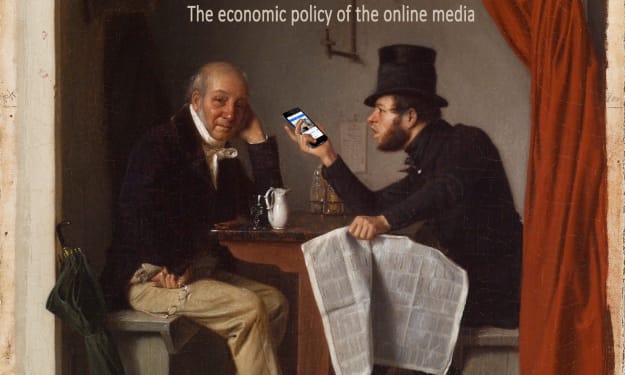
The Economic Policy of Online Media: Manufacture of Dissent
Peter Ayolov’s The Economic Policy of Online Media: Manufacture of Dissent is best read as a political economy of attention written from inside the contemporary media machine: a study of how dissent is not simply reported, represented, or ‘allowed’, but produced as a monetisable output of platform capitalism. The book’s organising intuition is both simple and unsettling. In the online environment, conflict is not a malfunction of communication; it is a business model. What appears to users as spontaneous outrage, grassroots polarisation, or organic ‘culture war’ is, at scale, a routinised industrial process—engineered through incentives, metrics, and infrastructures that reward emotional volatility and punish slow, careful public reasoning.
By Peter Ayolov6 days ago in BookClub
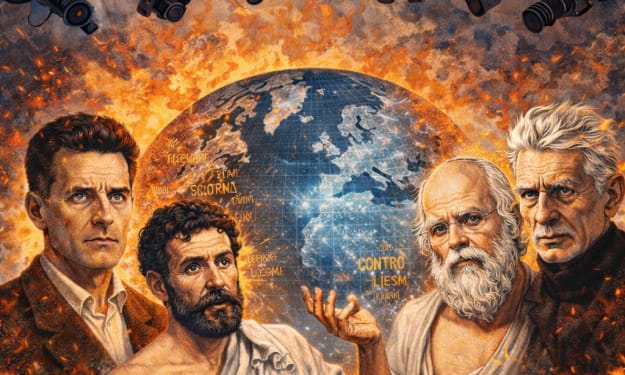
Toward the Linguistic Apocalypse
Toward the Linguistic Apocalypse What stands before the present age is not a technological crisis but a linguistic one. Artificial intelligence does not announce the rise of a new sovereign intelligence; it announces the collapse of an old regime of words. Power is unraveling not because machines are becoming conscious, but because language is becoming uncontrollable. The monopoly over meaning, interpretation, memory, and narration is dissolving, and with it dissolves the architecture of authority that depended on silence, delay, and scarcity.
By Peter Ayolov10 days ago in Critique
Language After Power
Abstract This article examines recent warnings about artificial intelligence delivered at the World Economic Forum by Yuval Noah Harari, situating them within a broader political economy of language and power. While public discourse frames AI as an emerging autonomous intelligence threatening humanity, this paper proposes an alternative interpretation: the primary fear articulated by global elites is not independent artificial intelligence but the democratisation of advanced linguistic power. Drawing on theories of language, power visibility, and informational exposure, the article argues that large language models threaten existing systems of authority by enabling unprecedented access to linguistic production, interpretation, and disclosure. AI does not merely automate language; it accelerates what can be described as an informational apocalypse, understood in its original sense as revelation. The article concludes by suggesting that contemporary anxieties surrounding AI governance reflect elite concern over the loss of narrative control rather than genuine existential risk, signalling a possible reconfiguration of authority away from financial and institutional actors toward linguistic and philosophical power.
By Peter Ayolov10 days ago in Critique
The Unique Case of Alma Mater TV
(A Review of Charmaine Voigt's Dissertation on Practical Media Training) Abstract This review examines the Bulgarian case study of Alma Mater TV as discussed in Charmaine Voigt's doctoral dissertation College Television: Practical Media Training in US and German Higher Education. While Voigt's work focuses primarily on Anglo-American and German contexts, the Bulgarian example stands out as an exceptional and largely unmatched model of student television in Europe. Alma Mater TV, based at the Faculty of Journalism and Mass Communication at Sofia University 'St. Kliment Ohridski', functioned not merely as a training platform but as a fully operational public-facing television project. Students produced and aired original programmes on Bulgaria's largest national broadcasters without censorship or editorial interference, while simultaneously participating in the creation of a European student television network. This review argues that Alma Mater TV represented a globally unique pedagogical and institutional experiment whose decline resulted not from structural failure but from a lack of strategic vision at the university leadership level. Particular attention is paid to the decisive roles of Professor Svetla Bozhilova and Professor Peter Ayolov in establishing and sustaining this model.
By Peter Ayolov15 days ago in Education
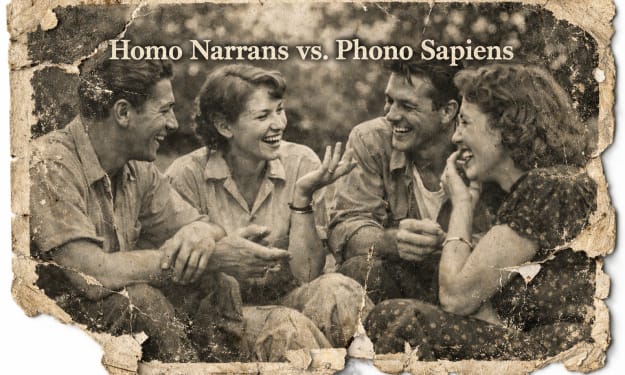
Homo Narrans Vs. Phono Sapiens
Peter Ayolov, Sofia University “St. Kliment Ohridski” Abstract This article examines the contemporary shift from storytelling as a shared, dialogical practice to storyselling as a performative, market-oriented mode of self-presentation. Drawing on Byung-Chul Han’s book The Crisis of Narration, the analysis argues that narration has lost its primary social function: the creation of a common symbolic world sustained through reciprocal exchange. Traditional storytelling depended on at least two participants and unfolded as a movement back and forth, producing memory, cohesion, and future-oriented meaning. In contrast, storyselling treats narrative as a one-directional instrument for selling identity, success, or visibility, reducing listeners to passive consumers. The article situates this shift within broader transformations of digital capitalism, self-optimisation culture, and communication coaching, showing how conversational depth is replaced by predictable, strategic self-branding. The loss of genuine conversation is presented not as a stylistic problem but as a structural erosion of social bonds and shared meaning.
By Peter Ayolov15 days ago in Critique