Doc Sherwood
Bio
Stories (563)
Filter by community
Romeo and Juliet
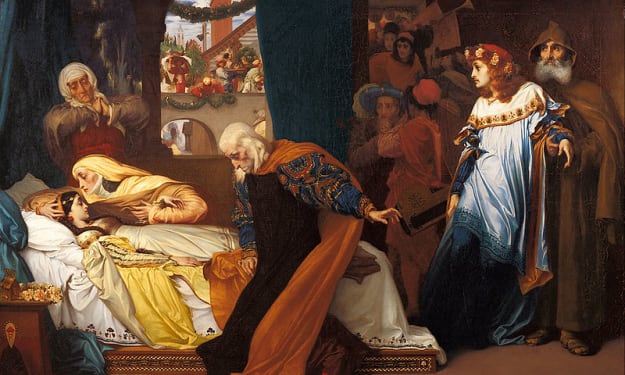
When William Shakespeare wrote Romeo and Juliet, relatively early in his illustrious career, he did what he nearly always did: reworked a story that was already well-known, and made his version the one that history would remember. The tragic tale of the Montague and Capulet family feud, which seems to have had some basis in fact, was first documented by Italian and French poets from the years 1530 to 1559. Shakespeare worked primarily from Arthur Brooke’s 1562 version, which was the first one written in English. Romeo and Juliet proved popular with audiences and was published twice during Shakespeare’s lifetime, in 1587 and 1599. It then appeared in the 1623 first collected edition.
By Doc Sherwood2 years ago in BookClub
William Shakespeare's The Winter's Tale
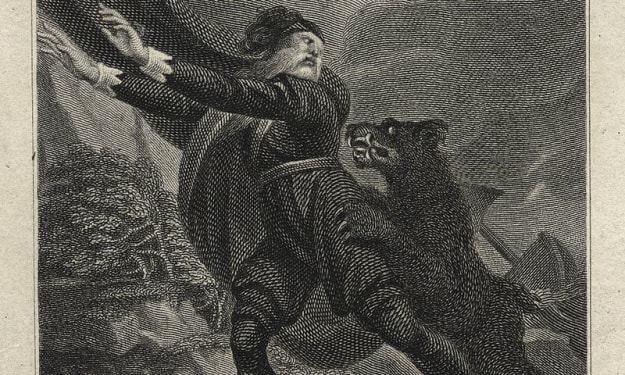
Written sometime between 1609 and 1611, The Winter’s Tale is grouped alongside Cymbeline, Pericles and The Tempest as Shakespeare’s four Late Comedies, also known as his Romances. These are often regarded as Shakespeare’s final plays, or at any rate the last ones he wrote alone, since his remaining works after The Tempest were all co-authored with John Fletcher. (Strictly speaking, Pericles was co-authored too.) Like The Tempest and Cymbeline, The Winter’s Tale did not see print during Shakespeare’s lifetime. The earliest text is in the First Folio of 1623.
By Doc Sherwood2 years ago in BookClub
The American Civil War: A Literary Perspective
In 1861, an America irretrievably divided over the issue of slavery descended into Civil War. Eleven southern States, determined to protect their right to keep slaves, seceded from the Union. Styling themselves the Confederate States of America, these entered into open hostilities with the north.
By Doc Sherwood2 years ago in BookClub
Mark Twain
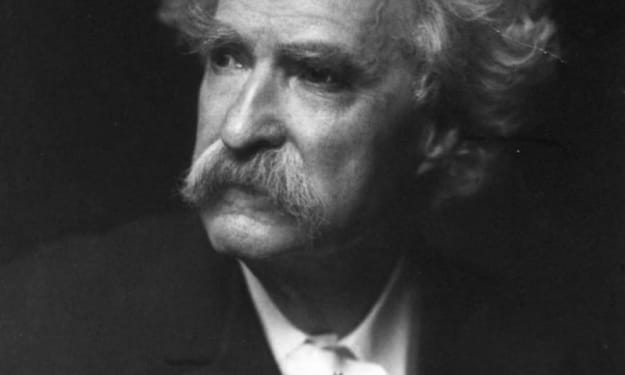
Part One Mark Twain’s real name was Samuel Langhorne Clemens. The phrase he would come to use as his pen-name was one he first heard while working as a boatman on the Mississippi River between 1857 and 1861. For freshwater sailors, “mark twain” means a depth of two fathoms, the shallowest point at which it remains safe to continue navigating. The term was used as a warning-cry on boats that were heading into dangerously low waters.
By Doc Sherwood2 years ago in BookClub
The Transcendentalists. Top Story - August 2023.
The town of Concord, Massachusetts was where the first gunshots were fired in the Revolutionary War. On April the 19th 1775, more than a year before the Declaration of Independence was signed, British troops marched on Concord to seize a cache of weapons hidden there. Local residents and farmers, alerted mere hours in advance by Paul Revere and William Dawes, organized into a militia now known as the Minutemen and met the British with armed resistance. In a firefight at Concord’s Old North Bridge, the advancing troops were turned back.
By Doc Sherwood2 years ago in History
Desperately Seeking Pseudangelos, Chapter Three
What other way could it have gone though? Joe had intimated as much to Flashshadow on the drive over. As long as this was still his land, not Yon’s, the latter wouldn’t be the only one who commanded multitudes. That first afternoon with Sonica, several of Joe’s had looked in. Now he needs must summon another.
By Doc Sherwood3 years ago in Chapters
Desperately Seeking Pseudangelos, Chapter Two
The rabble herded and jostled Joe’s company to the edge of the outdoor pool. Yon held court from a lifeguard’s chair at the far end, overlooking all, while the rest of that writhing jabbering crew clustered close at our heroes’ backs. On either side the twisty shapes of waterslides and other apparatus rose into heavens of lead, which by now were alive with thunderous rumblings and lightning-bursts spanning the spectrum.
By Doc Sherwood3 years ago in Chapters
Desperately Seeking Pseudangelos, Chapter One
Joe’s subconscious self might have said they were circling the wagons. That one and Mini-Flash Splitsville were already at the rendezvous-point, having driven down together the minute they received word. Mini-Flash Robin and Mini-Flash Juniper had gone directly in the school minibus, he necessarily sleeping out the journey. Our hero himself had opted for a needful Boston detour, for now that he remembered his crimson-coloured space-racer, he missed it. Now he was skimming sandy hills on the last stretch of a familiar childhood holiday route, bound for what promised to be anything but, his landing-party lieutenant beside him in the passenger-seat.
By Doc Sherwood3 years ago in Chapters
Doc Sherwood Chips In...
Here's an exercise I used to do with students on my Advanced Writing course. First, I'd give them the following copy, taken from the back of a packet of barbeque flavour Joe Chips by the Joe Tea Company, and attributed to their promotional character “Off Road Joe”:
By Doc Sherwood3 years ago in Writers
Robinson Crusoe and the Colonial Legacy
Part One The character Friday in Daniel Defoe’s Robinson Crusoe (1719) is of comparable significance to Shakespeare’s Othello. Between them, they are probably the two most important nonwhite figures in all English literature.
By Doc Sherwood3 years ago in BookClub