Doc Sherwood
Bio
Stories (563)
Filter by community
English Literature in the Eighteenth Century
Eighteenth-Century English literature was by and large written according to a principle called neoclassicism. The main argument of this position was that the classics – that is, the writers of ancient Greece and Rome – had already perfected the art of self-expression. The duty of the modern author, therefore, was simply to imitate them as closely as possible. Individual imagination and personal insights were therefore not considered as important as skill and accuracy in the emulation of classical styles.
By Doc Sherwood2 years ago in BookClub
The Middle English Period
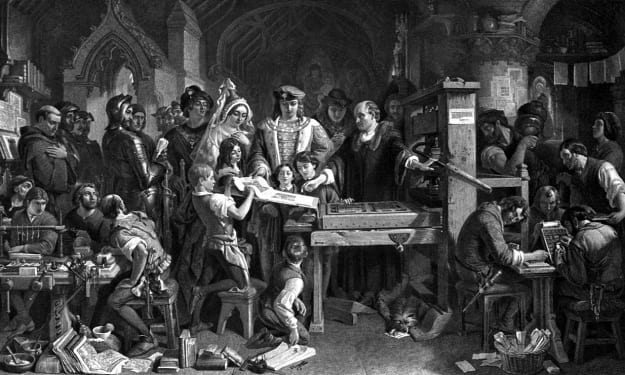
Above: The Nineteenth-Century painter Daniel Maclise imagines William Caxton around 1476, demonstrating the first English printing-press to King Edward the Fourth and his royal family. The girl directly in front of the Queen is Elizabeth of York, whose marriage to King Henry the Seventh would end the Wars of the Roses and usher in a long-overdue era of peace. A more tragic destiny awaits the King’s two sons, situated at the very centre of the tableau, who today are remembered as The Princes in The Tower.
By Doc Sherwood2 years ago in History
Geoffrey Chaucer
Although Geoffrey Chaucer was not born into the English aristocracy, he was personally known to many of the significant players in the conflicts and upheavals over the British crown that characterized the Middle English Period. Chaucer also lived just long enough to see the deposition of King Richard the Second by Henry the Fourth, which act would ultimately result in years of bloodshed during the Wars of the Roses.
By Doc Sherwood2 years ago in BookClub
William Shakespeare's Henry the Sixth, Part One
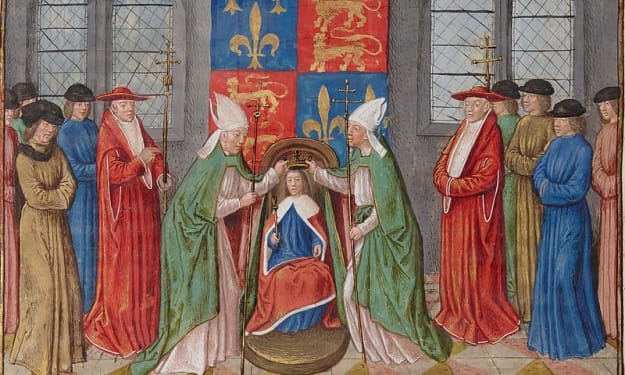
Written around 1592, The First Part of Henry the Sixth was one of Shakespeare’s earliest plays, but probably not his very first. Despite the title, it’s widely believed that the plays now known as Henry the Sixth, Part Two and Part Three were written before it. These, under different titles, had been published in Shakespeare’s lifetime as a two-part sequence, and Part One was probably intended as a prequel, dealing with earlier historical events, to cash in on the popularity of the previous pair. The First Part did not appear in print until the folio edition of 1623, which collected all the history plays in chronological sequence rather than the order in which they were written.
By Doc Sherwood2 years ago in BookClub
You Know Where You Sent Her, Chapter Two
Joe hurried upstairs, only to discover questions and answers were going to have to wait. He’d known his alter-ego was perilously low on energy, but found that one barely conscious, Mini-Flash Splitsville tending to him at his bedside. Joe had had no idea things were so bad. Not wanting to trouble his student with an additional crisis, he confined himself to earnestly commending Splitsville for her efforts and then set off alone.
By Doc Sherwood2 years ago in Chapters
You Know Where You Sent Her, Chapter One
Since the schism, Joe’s subconscious self and Mini-Flash Splitsville had been operating out of an old abandoned barnyard safely secluded in the wilderness beyond Boston. Besides a very modest tumbledown farmhouse, and a clutch of cavernous crumbling outbuildings, there was nothing but endless field and endless sky. Here the fenland lay flat from horizon to horizon, which was why the place had become headquarters for the rest of our heroes too, now they were united at last and preparing to make their move.
By Doc Sherwood2 years ago in Chapters
Doc Sherwood's Antony and Cleopatra, Act Two
SCENE 6 Rome, the council chamber. CAESAR, AGRIPPA and LEPIDUS, discussing the Egyptian threat. CAESAR: So much for our visions of averting this. Seems Cleopatra's more than capable of waging war on us, without any help from Antony.
By Doc Sherwood2 years ago in Chapters
Doc Sherwood's Antony and Cleopatra, Act One
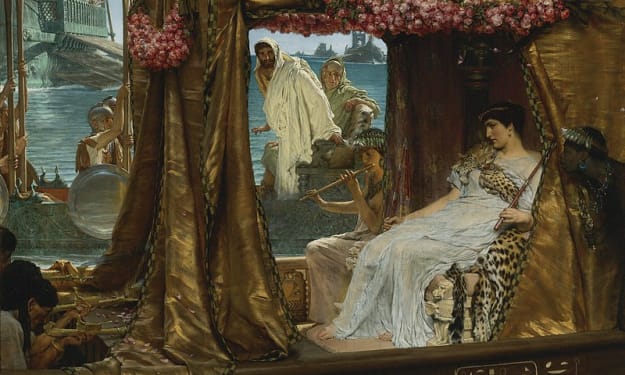
Now here's something I've been meaning to do for a while! My old Antony and Cleopatra script, adapted into modern English. It goes without saying you're all more than welcome to use it with any budding young thespians of your own! The clips, complete with original Shakespearean dialogue, are from the last time we staged the play: late 2019, Northeast China, as part of the entertainments for a student speech-making competition!
By Doc Sherwood2 years ago in Chapters
Malvolio, in William Shakespeare's Twelfth Night
Twelfth Night; or, What You Will does not appear to have seen print until the first collected edition of Shakespeare’s works in 1623. We know however it was written around 1601, and performed in February 1602. This would make Twelfth Night the last in the group of plays we consider Shakespeare’s great comedies. By 1602 Shakespeare had already begun work on what are sometimes called the four great tragedies, and his more ambiguous and troubling comedies which are now known as the problem plays.
By Doc Sherwood2 years ago in BookClub
William Shakespeare's The Comedy of Errors
The Comedy of Errors was written around 1594, and is one of the eight or so plays that may have been Shakespeare’s first. Like several others from the early group, it does not appear to have seen print until the collected edition of 1623.
By Doc Sherwood2 years ago in BookClub
Cross-Dressing in Shakespeare's Comedies
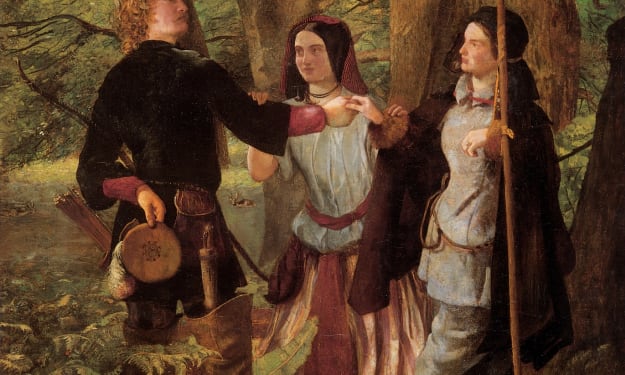
The comedies of William Shakespeare usually feature at least one female character who dresses up as a man or boy. Shakespeare did not invent this theatrical device, but he used it extensively. The Two Gentlemen of Verona is the first in which a heroine cross-dresses, and Cymbeline the last. Since these are respectively one of Shakespeare’s very first plays, and one of the last he wrote alone, we might say the cross-dressing tendency is a constant throughout the run of comedies.
By Doc Sherwood2 years ago in BookClub