
Why the Cardinals Hiring Mike LaFleur Feels Like a Pivot, Not a Plan
Breaking Down the 2026 NFL Coaching Carousel

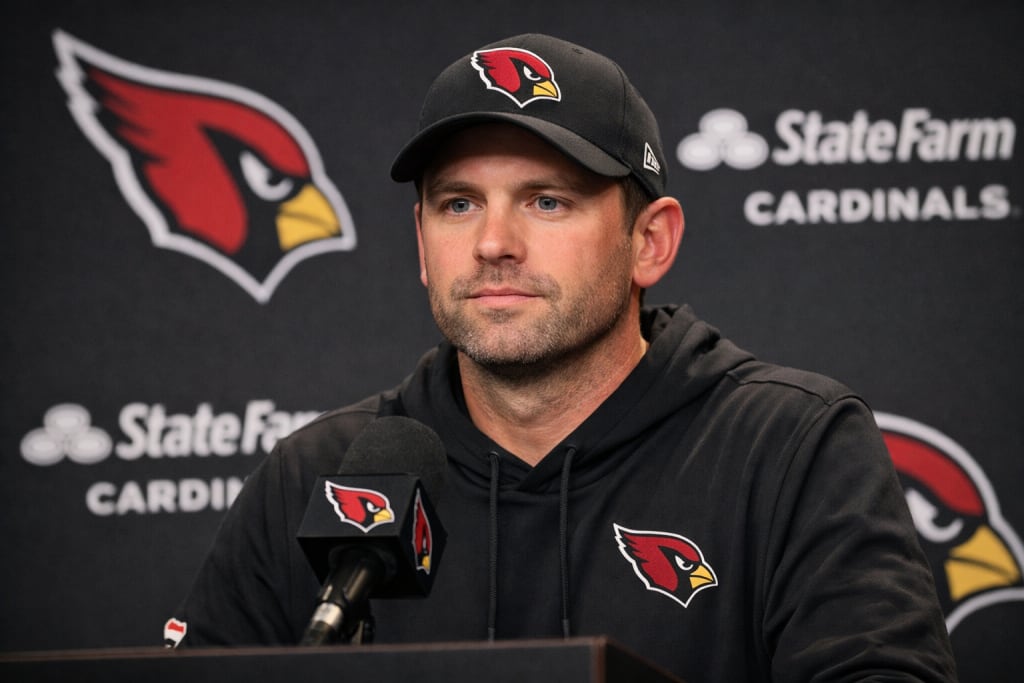
When the Arizona Cardinals finally announced Mike LaFleur as their next head coach, the reaction around the league was less excitement and more confusion. Not because LaFleur lacks credentials, but because the timeline of the hire suggests something uncomfortable: he wasn’t their first choice.
Arizona’s coaching search dragged longer than most. While other teams moved quickly, the Cardinals waited deep into the cycle, fueling speculation that they were holding out for a coordinator still coaching in the Super Bowl. That speculation didn’t come out of nowhere. Reports tied the Cardinals to Klint Kubiak, among others, and once those candidates either stayed put or landed elsewhere, Arizona pivoted. Shortly after, LaFleur became the hire.
That matters. Timing in NFL coaching searches often tells the real story. When a team truly identifies “their guy,” they don’t usually wait until the board is cleared. The Cardinals did — and LaFleur looks more like the best remaining option than the original plan.
The reasoning behind his rise is easy to trace. LaFleur spent the past three seasons with the Los Angeles Rams, attached to one of the league’s most productive offenses. In a league obsessed with offensive innovation, that alone is enough to launch a coordinator into head-coaching conversations. But here’s the problem: that offense belongs to Sean McVay.
McVay is widely regarded as one of the NFL’s true offensive masterminds. He designs the system, calls plays, adjusts in-game, and has done so successfully regardless of who stands next to him. LaFleur may have contributed to weekly game planning and preparation, but crediting him as the driving force behind that offense stretches the evidence. The Rams didn’t suddenly become explosive because McVay found the right assistant; they were explosive because McVay is McVay.
That distinction becomes critical when you look at the only place LaFleur actually ran an offense on his own.
During his time as offensive coordinator for the New York Jets, the results were ugly. The Jets consistently ranked near the bottom of the league in scoring and efficiency, and most damningly, LaFleur failed to develop Zach Wilson, a top-five draft pick. Wilson didn’t just stagnate — he regressed. Mechanics broke down, decision-making worsened, and the offense eventually had to be simplified because the quarterback couldn’t function within it.
Quarterback development is the single most important trait for a modern head coach. LaFleur’s résumé contains exactly one meaningful test in that area, and it ended in one of the league’s most visible failures.
That’s what makes this hire especially risky given the uncertainty surrounding Kyler Murray. If Arizona keeps Kyler, LaFleur isn’t being asked to develop a quarterback — he’s being asked to optimize one. That’s a safer assignment. But if the Cardinals move on from Murray, or even flirt with the idea, they’re putting a quarterback reset into the hands of a coach whose track record suggests that scenario is his weakest.
There’s also the experience factor. This is LaFleur’s first head-coaching job at any level. He’s never run a program, never managed an entire staff, never been the final authority on game-day decisions, culture, or accountability. The Cardinals aren’t just betting on his offensive ideas — they’re betting on leadership traits he has never been required to demonstrate.
That doesn’t make the hire doomed. But it does make it fair to question whether Arizona identified the right coach for their timeline — or simply the most defensible option once other doors closed.
⸻
Why Arizona Believes (And Why the Leash Is Short)
To be fair, there is a logic behind the hire. The Cardinals clearly want an offensive-minded coach, and LaFleur comes from a coaching tree that front offices trust. He’s young, modern, and has seen how elite organizations operate. Arizona likely believes he absorbed enough from McVay to implement a cleaner, more QB-friendly system than what they’ve had.
But belief doesn’t buy time.
If Kyler Murray stays, LaFleur inherits a quarterback the organization already seems uneasy about. That means wins are mandatory, early. There’s little patience for “growing pains” when the roster already has a franchise QB and the front office is debating his future.
And if Kyler goes? Then the pressure doubles. LaFleur would be tasked with developing a new quarterback while simultaneously proving he’s more than a McVay assistant — something he has yet to show.
Either way, this feels like a short-leash hire.
The Cardinals didn’t hire a proven program builder. They hired projection. They hired association. They hired upside — after waiting for bigger names to disappear.
Time will tell if that gamble pays off. But based on the process, the résumé, and the timing, it’s fair to ask whether Arizona found its head coach — or simply the best answer left on the board.
About the Creator
Logan M. Snyder
https://linktr.ee/loganmsnyder
Keep reading
More stories from Logan M. Snyder and writers in Unbalanced and other communities.
Why the Vikings Were Right to Fire Their GM — And Why the Decision Was Inevitable
The Minnesota Vikings didn’t fire their general manager because of impatience. They didn’t do it because of panic, or ownership meddling, or a sudden philosophical shift. They did it because the most important decision in football — quarterback evaluation — went disastrously wrong, and the consequences were impossible to ignore.
By Logan M. Snyder3 days ago in Unbalanced
Wild Card Weekend Recap: What Happens Now?
I think I figured out why I love Wild Card Weekend so much. It's because it's the first playoff anything of the calendar year. The NFL season starts in the fall, and once upon a time, the champion was crowned either on or slightly before New Year's. The evolution of the NFL schedule has resulted in the playoffs starting just into the New Year, and currently, the final week of the season falls on the first weekend of the New Year, with Wild Card Weekend coming a week after that. So yes, chronologically, the NFL's Wild Card Weekend serves as the first playoff anything of the calendar year.
By Clyde E. Dawkins20 days ago in Unbalanced
Perth Parables Part 2
Day 4 Today we definitely left the postcode, and headed out to the Northeastern outskirts of Perth. Meandering through the suburbs of Perth it was interesting to observe how subtly different, yet also familiar, some things were here on the other side of the country. From these passing observations and the short time I’ve spent out west, I can see why many people love living out here. As far as sporting facilities go, I would have to say WA punches so far above its weight. I might be easily influenced, because we don’t even have change rooms at our home field, but they have certainly impressed me.
By S. J. Leahy7 days ago in Unbalanced



Comments
There are no comments for this story
Be the first to respond and start the conversation.