
Respiratory Care Devices Market Size and Forecast 2026–2034
Rising Global Burden of Lung Diseases to Accelerate Market Growth Through 2034

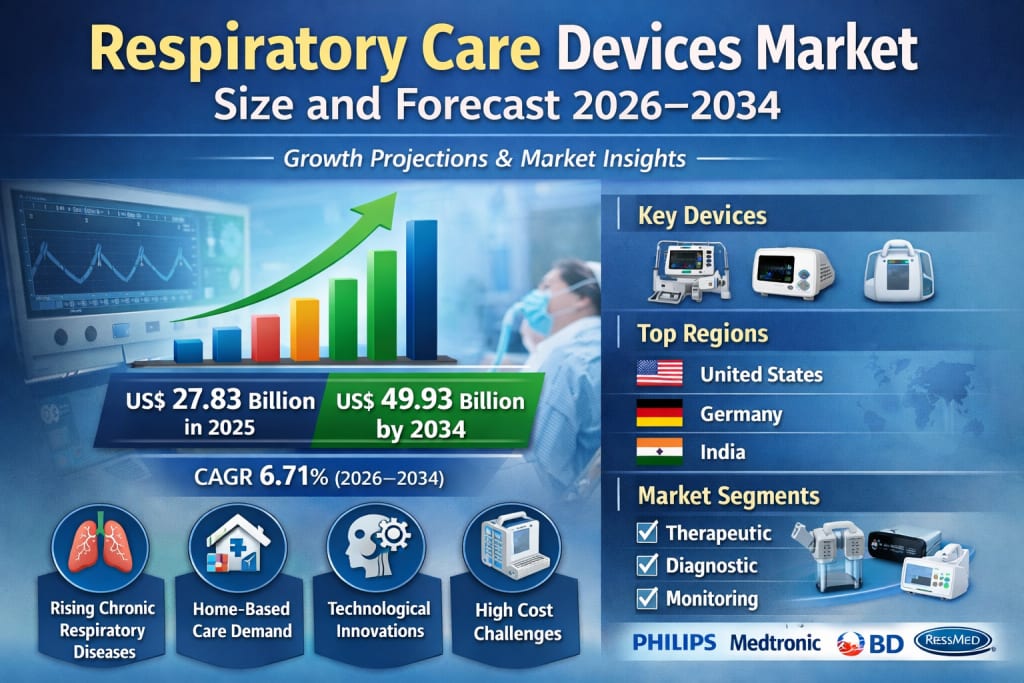
The global Respiratory Care Devices Market is entering a transformative decade. According to Renub Research, the market is expected to grow from US$ 27.83 billion in 2025 to US$ 49.93 billion by 2034, expanding at a CAGR of 6.71% from 2026 to 2034. The steady rise reflects a convergence of medical necessity, demographic shifts, and technological innovation.
Respiratory care devices have become essential tools in modern healthcare systems. From life-saving ventilators in intensive care units to compact oxygen concentrators in patients’ homes, these devices are redefining how respiratory diseases are managed worldwide.
Respiratory Care Devices Market Overview
Respiratory care devices are designed to support, monitor, and enhance breathing functions in patients suffering from acute or chronic respiratory disorders. These include conditions such as asthma, chronic obstructive pulmonary disease (COPD), sleep apnea, pneumonia, pulmonary fibrosis, and respiratory distress syndrome.
Core product categories include:
Mechanical ventilators
Oxygen concentrators
CPAP and BiPAP machines
Nebulizers
Inhalers
Spirometers
Pulse oximeters
Capnography monitors
These devices assist with oxygen delivery, airflow regulation, airway clearance, and respiratory monitoring. Their applications extend across hospitals, ambulatory centers, and increasingly, home care settings.
Globally, respiratory diseases are becoming more prevalent due to environmental pollution, smoking, urbanization, occupational hazards, and aging populations. The COVID-19 pandemic further emphasized the critical importance of respiratory support systems, driving large-scale investments in ventilators, oxygen therapy infrastructure, and monitoring technologies.
Today, early diagnosis awareness, home-care expansion, and better healthcare accessibility in emerging economies are fueling sustained market momentum.
Key Market Drivers
Rising Prevalence of Chronic Respiratory Diseases
Chronic respiratory diseases are among the most pressing global health concerns. In 2023 alone, they accounted for approximately 569.2 million cases and 4.2 million deaths worldwide.
Conditions such as COPD, asthma, sleep apnea, and pulmonary fibrosis are increasingly diagnosed due to:
Aging populations
Increased tobacco consumption
Industrial pollution exposure
Urban air quality deterioration
These disorders require long-term management, creating steady demand for inhalers, nebulizers, oxygen therapy systems, and non-invasive ventilators.
In the WHO European Region, chronic respiratory diseases rank as the sixth leading cause of death, claiming nearly 400,000 lives annually, with approximately 80% linked to COPD. Improved survival rates also contribute to a growing patient base that requires ongoing respiratory support.
As healthcare systems shift from reactive treatment to proactive disease management, respiratory care devices are becoming foundational in chronic disease care pathways.
Growing Demand for Home-Based Respiratory Care
One of the most transformative trends reshaping the market is the migration from hospital-based treatment to home-based respiratory care.
Home care offers:
Reduced hospitalization costs
Improved patient comfort
Lower risk of hospital-acquired infections
Better long-term disease management
Technological innovation has made devices more compact, portable, and user-friendly. Home ventilators, oxygen concentrators, CPAP and BiPAP systems are now designed for ease of use without constant medical supervision.
In May 2025, ABM Respiratory Care announced a multicenter home-care study with Delve Health to evaluate the effectiveness of its BiWaze® Clear System in patients with bronchiectasis—highlighting the growing importance of decentralized respiratory treatment.
The expansion of telemedicine and remote patient monitoring further supports this shift, allowing physicians to track oxygen levels and respiratory performance in real time.
Technological Advancements and Innovation
Innovation remains central to market expansion.
Modern respiratory care devices now incorporate:
Smart sensors
Digital monitoring systems
Wireless connectivity
AI-enabled diagnostics
Noise-reduction engineering
Wearable and battery-powered configurations
In April 2024, Getinge AB introduced the Servo-c mechanical ventilator, designed to serve both pediatric and adult populations with enhanced precision and usability.
The emergence of smart inhalers and connected oxygen systems allows healthcare providers to collect patient data for better clinical decision-making. As digital health ecosystems expand, integration with cloud platforms and hospital information systems is becoming standard.
Market Challenges
High Cost of Advanced Devices
Advanced ventilators and respiratory monitoring systems require significant investment. The total cost of ownership includes maintenance, consumables, and replacement components.
In low- and middle-income countries, affordability remains a major barrier. Limited reimbursement coverage in some regions further restricts widespread adoption.
Balancing innovation with cost-effectiveness remains a critical challenge for manufacturers and healthcare policymakers.
Regulatory Complexity and Skilled Workforce Gaps
Respiratory devices are subject to stringent regulatory standards related to safety, performance, and quality assurance. Navigating regulatory frameworks can delay product approvals and increase development costs.
Additionally, effective device usage often requires trained respiratory therapists and clinicians. Workforce shortages in certain regions limit optimal utilization. Training programs and post-sales support add to operational expenditures for manufacturers.
Segment Insights
Respiratory Care Monitoring Devices Market
Monitoring devices such as pulse oximeters, capnography monitors, spirometers, and respiratory rate monitors are crucial for early detection of breathing complications.
Their importance grew substantially during the pandemic and continues to expand in ICUs and home-care settings. Advances in sensor technology and wireless monitoring are expected to drive sustained demand.
Respiratory Care Diagnostic Devices Market
Diagnostic devices—including spirometry systems, peak flow meters, and polysomnography equipment—are vital for early disease detection.
Growing awareness of preventive healthcare and outpatient diagnostic services is driving adoption. Enhanced portability and cloud connectivity are improving clinical workflow efficiency.
Nebulizers Market
Nebulizers play a significant role in delivering medication directly to the lungs. They are particularly useful for children and elderly patients who struggle with inhaler techniques.
The introduction of mesh and ultrasonic nebulizers has improved treatment efficiency and reduced therapy time.
Obstructive Sleep Apnea (OSA) Devices Market
OSA devices, primarily CPAP and BiPAP systems, are widely used for sleep-disordered breathing. Rising obesity levels and increased awareness of sleep health are accelerating demand.
Enhanced comfort features and reduced noise levels are improving patient compliance.
Hospital Segment
Hospitals remain a dominant end-user segment due to demand for ventilators, oxygen therapy systems, and emergency respiratory support. Increased investments in ICU infrastructure and emergency preparedness programs support steady procurement growth.
Country-Level Analysis
United States
The U.S. remains one of the largest markets, driven by high prevalence of COPD, asthma, and sleep apnea. Advanced healthcare infrastructure and strong reimbursement frameworks facilitate device adoption.
In October 2025, Synchrony Medical launched the LibAirty™ Airway Clearance System, expanding innovative home respiratory therapy options across the country.
Major industry players operating in the U.S. include:
Medtronic Plc
ResMed Inc.
Masimo Corporation
General Electric Company
Germany
Germany benefits from a robust medical infrastructure and strong reimbursement systems. Chronic disease management strategies and early diagnostics promote advanced ventilator and CPAP adoption.
In February 2022, AstraZeneca partnered with Honeywell to develop inhalers using low global-warming potential propellants—demonstrating sustainability-driven innovation in respiratory therapy.
India
India’s market is expanding rapidly due to rising pollution levels and increased respiratory illness incidence. Affordable oxygen concentrators, nebulizers, and handheld spirometers are in high demand.
In August 2022, AstraZeneca India collaborated with Alveofit to deploy IoT-enabled spirometers nationwide, strengthening digital lung health diagnostics.
Saudi Arabia
Government investment in healthcare modernization is propelling market growth. Hospital expansion and critical care infrastructure development are increasing demand for ventilators and monitoring devices.
Local exhibitions such as Arab Health 2025 have showcased innovations from regional players like Respircare Company.
Market Segmentation
By Device Type:
Therapeutic Devices
Monitoring Devices
Diagnostic Devices
Consumables & Accessories
By Product:
Respiratory Consumables
Nebulizers
Oxygen Concentrators
Polysomnography Devices
Pulse Oximeters
Mechanical Ventilators
Spirometers
By Application:
COPD
Obstructive Sleep Apnea
Asthma
Respiratory Distress Syndrome
Cystic Fibrosis
By End User:
Hospitals
Home Care
Ambulatory Care
Regional Coverage:
North America, Europe, Asia-Pacific, Latin America, and Middle East & Africa.
Competitive Landscape
Key companies shaping the industry include:
Koninklijke Philips
Becton Dickinson
Chart Industries Inc.
Inogen Inc.
These companies are investing heavily in R&D, digital integration, and strategic partnerships to strengthen market positioning.
Final Thoughts
The Respiratory Care Devices Market is poised for sustained expansion through 2034, supported by rising disease prevalence, demographic aging, home-care adoption, and technological innovation.
As healthcare systems worldwide prioritize early diagnosis, chronic disease management, and digital connectivity, respiratory devices are transitioning from emergency-use tools to everyday life-enhancing technologies.
With the market projected to reach US$ 49.93 billion by 2034, manufacturers that balance affordability, regulatory compliance, and smart technology integration will be best positioned to lead this rapidly evolving global healthcare segment.
About the Creator
Philippines Savory Snack Market 2026: Urban Lifestyles, Flavor Innovation & Expanding Retail Channels
Philippines Savory Snack Market Overview The Philippines savory snack market is growing steadily as changing consumption patterns, rising disposable incomes and expanding urban retail landscapes drive demand for convenient and flavorful snack options. Savory snacks — including chips, crackers, extruded snacks and other ready-to-eat products — have become staple items in daily diets, appealing to a broad range of consumers due to their convenience, variety and taste appeal. Market growth is supported by modern retail penetration, evolving snacking habits and continuous product innovations that cater to both traditional preferences and global flavor influences.
By Manisha Dixitabout 10 hours ago in Trader
US Mobile App Development Market Size Growth, Trends & Forecast to 2034
The Transformation of the US Mobile App Development Market in the Age of 5G and AI Mobile applications have become deeply embedded in everyday life across the United States. Whether ordering groceries, managing investments, booking healthcare appointments, or collaborating with remote teams, consumers increasingly rely on mobile platforms as their primary digital interface. What once started as simple utility apps has now evolved into a sophisticated ecosystem powered by high-speed connectivity, artificial intelligence, and cross-platform innovation.
By Kim Soo hyunabout 12 hours ago in Trader


Comments
There are no comments for this story
Be the first to respond and start the conversation.