
Global Electric Vehicles Market Size and Forecast 2026–2034
Rapid Electrification, Battery Breakthroughs, and Policy Push to Power a US$ 1.77 Trillion Future

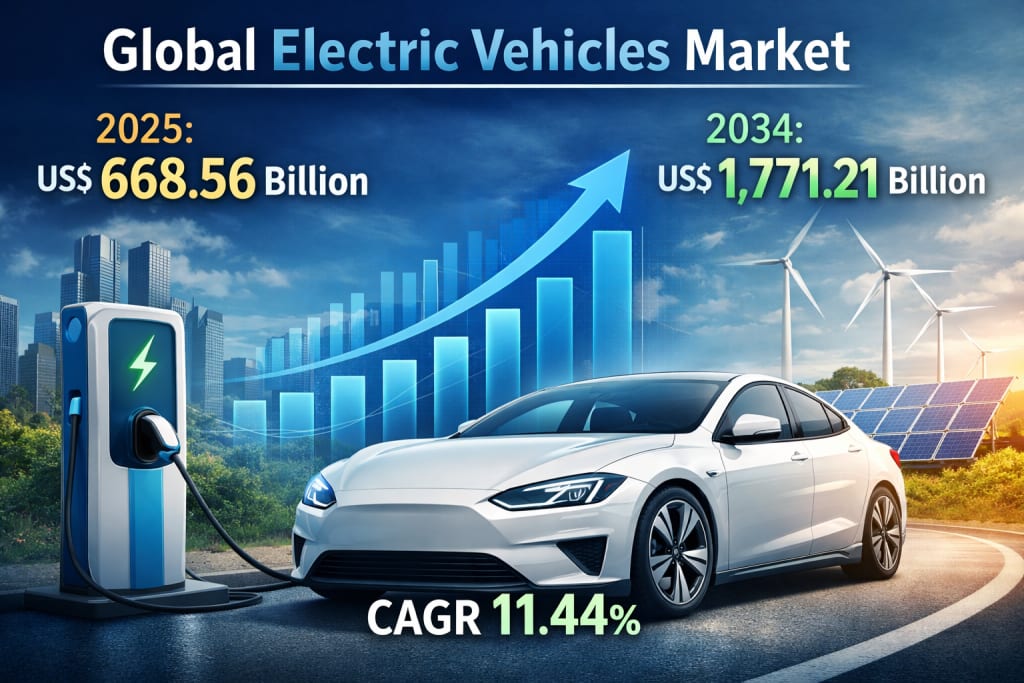
The Global Electric Vehicles (EV) Market is entering a transformative decade. According to Renub Research, the market is projected to expand from US$ 668.56 billion in 2025 to US$ 1,771.21 billion by 2034, registering a CAGR of 11.44% from 2026 to 2034. This remarkable growth reflects a structural shift in the global automotive landscape, driven by environmental concerns, rapid battery advancements, and supportive government policies.
Electric vehicles are no longer niche alternatives—they are becoming mainstream mobility solutions across passenger, commercial, and two-wheeler segments worldwide.
Global Electric Vehicles Market Overview
Electric vehicles are automobiles powered partially or entirely by electricity rather than conventional internal combustion engines (ICE). They operate using electric motors fueled by rechargeable batteries, most commonly lithium-ion batteries. EVs are broadly categorized into:
Battery Electric Vehicles (BEVs) – Fully electric vehicles with zero tailpipe emissions.
Plug-in Hybrid Electric Vehicles (PHEVs) – Vehicles combining electric propulsion with an internal combustion engine.
Unlike gasoline or diesel vehicles, EVs emit little to no tailpipe emissions, significantly reducing greenhouse gas output. This environmental advantage, coupled with technological improvements in driving range and charging speed, has made EVs increasingly practical and desirable.
Globally, demand is rising due to heightened climate awareness, decarbonization commitments, and a steady increase in fuel prices. Governments across continents are offering subsidies, tax rebates, and regulatory support to accelerate adoption. Simultaneously, innovation in battery technology is enhancing range, reducing charging times, and lowering costs—making EVs viable for everyday mobility.
Key Growth Drivers in the Electric Vehicles Market
1. Stringent Emission Regulations and Government Incentives
More than 120 countries have pledged to achieve net-zero emissions by 2050 or earlier. Transportation electrification is central to this mission. Over 20 countries have announced plans to phase out ICE vehicle production within the next 10 to 30 years.
Governments are implementing:
Purchase subsidies
Reduced registration taxes
Free toll road access
Lower road taxes
Investment in charging infrastructure
According to the International Energy Agency (IEA), global electric car sales surpassed 17 million units in 2024, marking over 25% year-on-year growth. The sales increase in 2024 alone exceeded total EV sales recorded in 2020, highlighting accelerating adoption.
These policy frameworks are significantly strengthening the global EV ecosystem.
2. Advancements in Battery Technology and Cost Reduction
Battery innovation remains the cornerstone of EV expansion. Improvements in lithium-ion chemistry have increased energy density and extended vehicle range while reducing charging time. At the same time, economies of scale and technological efficiency have brought battery costs down dramatically over the past decade.
Emerging technologies such as solid-state batteries and alternative chemistries promise further enhancements in performance, safety, and durability.
In December 2025, Graphene Manufacturing Group Ltd. announced progress on its Graphene Aluminium-Ion Battery technology, developed with the University of Queensland under a Joint Development Agreement with Rio Tinto and supported by the Battery Innovation Center of Indiana. Such innovations indicate that next-generation battery breakthroughs are on the horizon.
3. Rising Fuel Prices and Consumer Shift Toward Sustainability
Escalating fuel prices and increasing climate awareness are encouraging consumers to transition to electric mobility. EVs offer lower operating and maintenance costs compared to gasoline-powered vehicles, making them economically attractive over the vehicle’s lifecycle.
Corporate fleets and logistics providers are also adopting EVs to meet sustainability targets and reduce carbon footprints.
In September 2025, VinFast introduced its premium electric SUVs, VF 6 and VF 7, in India—marking its strategic entry into a fast-growing EV market. The move underlines how automakers are expanding globally to meet rising demand.
Challenges in the Electric Vehicles Market
Limited Charging Infrastructure and Range Anxiety
Despite significant progress, charging infrastructure remains unevenly distributed, especially in developing nations. Charging time is still longer compared to refueling traditional vehicles, contributing to range anxiety among consumers.
High Upfront Costs and Supply Chain Constraints
Although battery costs have declined, EVs still carry higher upfront prices in many regions. Additionally, raw materials such as lithium, cobalt, and nickel face supply chain risks, geopolitical uncertainties, and price volatility—potentially impacting production and pricing stability.
Segment Insights
Battery Electric Vehicles (BEVs)
The BEV segment represents the fastest-growing category within the EV market. Fully electric and emission-free, BEVs offer lower maintenance and operational costs. While slow charging once limited adoption, advancements in fast-charging technologies are accelerating consumer acceptance.
Hybrid Electric Vehicles (HEVs)
Hybrid vehicles serve as a transitional solution between conventional and fully electric mobility. By combining electric motors with internal combustion engines, HEVs improve fuel efficiency without relying solely on external charging infrastructure. This makes them particularly appealing in regions where charging networks are still developing.
151–300 Miles Range Segment
The 151–300 miles range category balances affordability and practicality. Vehicles in this range are ideal for daily commuting and medium-distance travel. Improvements in battery efficiency are enabling manufacturers to offer this range at competitive prices, reducing range anxiety without significantly increasing costs.
Two-Wheeler Electric Vehicle Market
The two-wheeler EV segment is expanding rapidly, especially in densely populated and emerging economies. Electric scooters and motorcycles provide affordable, energy-efficient transportation solutions for urban commuters and last-mile delivery services.
Low purchase costs, minimal charging needs, and rising fuel prices are propelling demand. This segment will play a crucial role in global electrification, particularly in Asia-Pacific.
Commercial Electric Vehicle Market
The commercial EV segment includes electric buses, trucks, vans, and delivery vehicles. Growth is driven by corporate sustainability goals, regulatory mandates, and lower total cost of ownership.
Urban delivery services, public transport electrification, and low-emission zones are accelerating adoption. Enhanced battery capacity and fast-charging infrastructure are enabling longer routes and heavier payload capacities.
Country-Level Analysis
United States Electric Vehicle Market
The United States is witnessing robust EV growth, supported by federal and state incentives such as tax credits and rebates. Automakers are expanding their electric portfolios across SUVs, trucks, and passenger cars.
In September 2023, Kia America introduced the 2024 EV9, a three-row electric SUV priced at USD 54,900. Built on 800V architecture, it supports fast DC charging from 10% to 80% in under 25 minutes.
Corporate fleet electrification, rising fuel costs, and domestic battery production investments are further strengthening the U.S. EV ecosystem.
Germany Electric Vehicle Market
Germany remains a key European EV hub, backed by strict emission regulations and strong domestic automakers. Government subsidies and tax benefits support adoption.
In December 2025, Chinese EV manufacturer Zeekr, owned by Geely Group, announced entry into the German market with models starting at €37,990. Competitive pricing and advanced technology are reshaping the European EV landscape.
Germany’s focus on battery innovation and renewable energy integration further enhances its EV growth potential.
India Electric Vehicle Market
India’s EV industry is growing swiftly due to initiatives aimed at reducing pollution and fuel imports. The market is dominated by two-wheelers, three-wheelers, buses, and commercial vehicles.
Government subsidies, tax rebates, and local manufacturing incentives are boosting adoption. However, affordability and infrastructure gaps remain challenges.
In August 2025, VinFast inaugurated its manufacturing facility in Thoothukudi, Tamil Nadu, with a planned investment of Rs. 16,000 crore (approx. US$ 1.83 billion), reinforcing India’s position in global EV manufacturing.
Saudi Arabia Electric Vehicle Market
Saudi Arabia’s EV market is expanding as part of its economic diversification and sustainability strategy. Government investments in renewable energy and charging infrastructure are encouraging adoption.
In 2022, construction began on Lucid Motors’ manufacturing facility in King Abdullah Economic City, with a production capacity of 155,000 vehicles annually. The project represents over SAR 12.3 billion in investment and underscores the Kingdom’s commitment to electric mobility.
Market Segmentation
By Product:
Battery Electric Vehicle (BEV)
Hybrid Electric Vehicles (HEV)
Plug-in Hybrid Electric Vehicle (PHEV)
By Range:
Up to 150 Miles
151–300 Miles
Above 300 Miles
By Vehicle Type:
Two-Wheeler
Passenger Cars
Commercial Vehicles
By Region:
North America (U.S., Canada)
Europe (France, Germany, Italy, Spain, UK, Belgium, Netherlands, Turkey)
Asia-Pacific (China, Japan, India, Australia, South Korea, Thailand, Malaysia, Indonesia, New Zealand)
Latin America (Brazil, Mexico, Argentina)
Middle East & Africa (South Africa, Saudi Arabia, UAE)
Competitive Landscape
Key industry players include:
Tesla
BMW Group
BYD Company Ltd.
Mercedes-Benz Group AG
Ford Motor Company
General Motor Company
Nissan Motor Co. Ltd.
Toyota Motor Corporation
These companies are investing heavily in R&D, expanding production capacity, and strengthening battery supply chains to secure competitive advantage.
Each company analysis includes:
Overview
Key Personnel
Recent Developments & Strategies
Product Portfolio
Financial Insights
Final Thoughts
The Global Electric Vehicles Market is not merely expanding—it is redefining the future of mobility. With projected growth to US$ 1.77 trillion by 2034, the industry stands at the intersection of environmental responsibility, technological innovation, and economic transformation.
Government mandates, battery breakthroughs, and rising consumer consciousness are collectively reshaping transportation systems worldwide. While infrastructure gaps and supply chain constraints persist, ongoing investments and innovation signal strong long-term momentum.
About the Creator
Philippines Spices & Seasonings Market 2026: Flavor Innovation, Culinary Heritage and Retail Expansion
Philippines Spices & Seasonings Market Overview The Philippines spices and seasonings market growth is expanding steadily as consumers increasingly prioritise flavour diversity, culinary authenticity and convenient cooking solutions. Spices and seasonings — including herbs, blended mixes and salt substitutes — play a central role in Filipino cuisine and modern food preparation practices. The growing popularity of traditional dishes, combined with rising experimentation with international flavours, is strengthening demand across household kitchens, foodservice establishments and processed food manufacturers.
By Manisha Dixit8 days ago in Trader
Mexico Pharmaceuticals Market Size, Growth, Latest Trends and Forecast to 2033
Mexico Pharmaceuticals Market Overview The Mexico pharmaceuticals market is one of the most important healthcare sectors in Latin America. The industry plays a vital role in ensuring access to essential medicines, supporting healthcare systems, and improving public health outcomes. With a large population, expanding healthcare infrastructure, and increasing awareness about disease prevention and treatment, the pharmaceutical sector continues to grow steadily.
By Jackson Watson5 days ago in Trader
I was in a Toxic Relationship, with my Workplace
“You got that?” My ex yelled. His hands were balled into fists at his side. At six foot three, he towered over me. A normal person would have been afraid, but I looked up a video of George Lopez repeatedly saying, “I got this,” and showed it to him. I had grown used to this treatment, so much so that I didn’t blink when he ripped the phone from my hand and threw it across the room.
By Jade M.5 days ago in Confessions



Comments
There are no comments for this story
Be the first to respond and start the conversation.