
US Mobile App Development Market Size Growth, Trends & Forecast to 2034
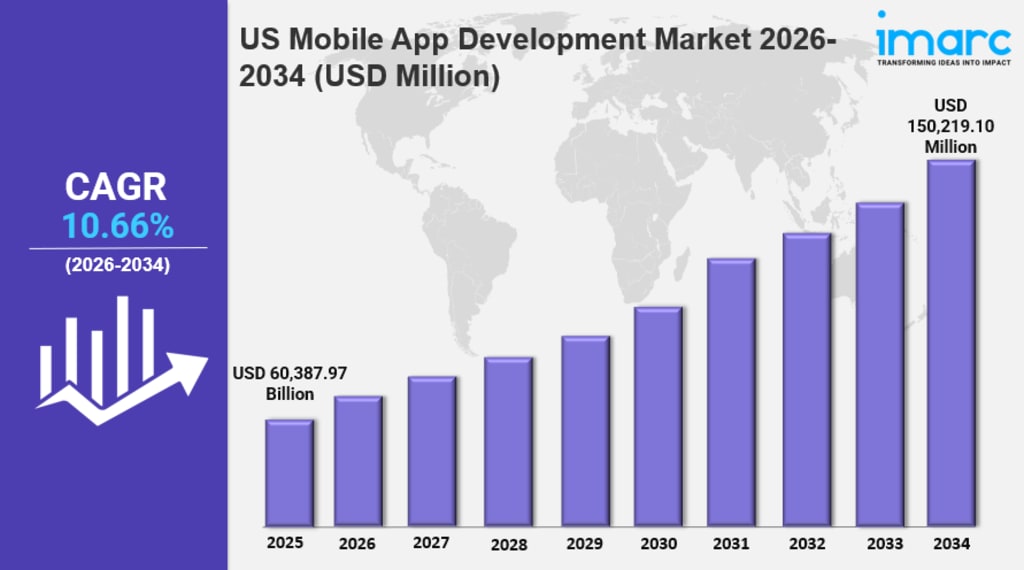
US Mobile App Development Market reached USD 60,387.97 Million in 2025 and is projected to hit USD 150,219.10 Million by 2034, growing at a CAGR of 10.66%.

The Transformation of the US Mobile App Development Market in the Age of 5G and AI
Mobile applications have become deeply embedded in everyday life across the United States. Whether ordering groceries, managing investments, booking healthcare appointments, or collaborating with remote teams, consumers increasingly rely on mobile platforms as their primary digital interface. What once started as simple utility apps has now evolved into a sophisticated ecosystem powered by high-speed connectivity, artificial intelligence, and cross-platform innovation.
The US mobile app development market reached approximately USD 60.38 billion in 2025 and is projected to grow to nearly USD 150.22 billion by 2034, expanding at a CAGR of 10.66% between 2026 and 2034. This substantial growth reflects both technological advancement and the broader digital transformation of American businesses.
Request a Sample Report with Latest 2026 Data & Forecasts:
5G Infrastructure Is Unlocking New Capabilities
The rollout of 5G networks is fundamentally changing how mobile applications are designed and experienced. With significantly lower latency and higher bandwidth compared to previous generations, developers can now build apps that rely heavily on real-time data transmission.
Bandwidth-intensive applications such as augmented reality (AR), virtual reality (VR), high-definition streaming, and cloud gaming are benefiting directly from enhanced connectivity. Healthcare providers are increasingly integrating telemedicine apps that support real-time diagnostics, while logistics companies use real-time tracking and collaboration tools.
As 5G coverage continues expanding nationwide, expectations for instant load times and seamless interaction are becoming standard rather than premium features.
Artificial Intelligence Is Reshaping User Experience
Artificial intelligence (AI) and machine learning (ML) are transforming the way mobile applications function. Instead of offering static features, apps are becoming adaptive, predictive, and highly personalized.
Retail apps now provide dynamic product recommendations based on user behavior. Financial apps incorporate AI-driven fraud detection and risk assessment tools. Fitness and health apps use machine learning algorithms to deliver personalized workout routines and health insights.
Chatbots, voice assistants, predictive search, and intelligent automation are increasingly embedded within mobile ecosystems. These features not only improve user satisfaction but also enhance operational efficiency for businesses.
As AI adoption becomes more widespread across industries, its integration into mobile applications is no longer a competitive advantage — it is quickly becoming a baseline expectation.
Cross-Platform Frameworks Are Accelerating Development
Another key structural shift is the growing reliance on cross-platform development frameworks. Rather than building separate applications for iOS and Android, companies are leveraging unified codebases to reduce development cycles and optimize costs.
This approach shortens time-to-market and allows startups and mid-sized firms to compete more effectively. Faster updates, easier maintenance, and consistent user experiences across devices are additional advantages.
In a market where agility matters, cross-platform strategies are helping businesses respond quickly to evolving consumer demands.
Personalization and Real-Time Collaboration
Modern users expect apps to adapt to their preferences and behaviors. Personalization has become central to user retention strategies. Whether through curated content feeds, tailored notifications, or behavior-based recommendations, customization enhances engagement.
Real-time collaboration tools are also gaining prominence. With hybrid and remote work models firmly established, enterprise mobility apps now emphasize shared dashboards, cloud integration, and instant communication features.
These capabilities are particularly important in sectors such as education, finance, healthcare, and professional services, where digital coordination drives productivity.
US Mobile App Development Market Segmentation
Analysis by Categories:
• Gaming
• Non-Gaming
Analysis by Platform:
• iOS
• Android
• Windows
Analysis by End User:
• Banking
• Retail
• Airlines
• Media
• Education
• Transport
• Hotels and Restaurant
• Government
Analysis by Region:
• Northeast
• Midwest
• South
• West
Security and Regulatory Considerations
As mobile apps become more integrated into financial transactions and personal data management, cybersecurity and privacy regulations are increasingly important. Developers must navigate evolving compliance standards and implement robust data protection mechanisms.
User trust plays a critical role in app adoption and retention. Any lapse in security can significantly impact brand credibility and long-term growth.
Talent and Innovation Challenges
Despite strong growth prospects, the market faces certain structural challenges. Skilled developers specializing in AI integration, cybersecurity, cloud computing, and UI/UX design remain in high demand. Talent competition can drive up costs and limit scalability for smaller firms.
Additionally, app marketplaces are highly competitive. User acquisition costs continue to rise, making retention strategies just as important as development quality.
Outlook Through 2034
The outlook for the US mobile app development market remains highly positive. Continued 5G expansion, deeper AI integration, enterprise digitization, and demand for intelligent automation will likely sustain double-digit growth through 2034.
Mobile devices are increasingly serving as the primary gateway to commerce, communication, entertainment, and professional services. As a result, app development is no longer merely a technical service — it is a central component of modern business infrastructure.
Organizations that prioritize innovation, user-centric design, data security, and cross-platform efficiency are expected to lead the next phase of expansion in this rapidly evolving digital landscape.
About the Creator
Kim Soo hyun
My name is Kim Soo hyun, and I am a research analyst at IMARC Group, specializing in market trends and data analysis to provide insights and support strategic decision-making.
Keep reading
More stories from Kim Soo hyun and writers in Trader and other communities.
Canada Cheese Market Size, Share, Trends & Forecast to 2033
How Changing Food Habits Are Shaping the Canada Cheese Market Cheese has long been a staple in Canadian households, but in recent years it has evolved far beyond a basic dairy product. Today, cheese reflects broader lifestyle trends — from premium indulgence to health-conscious snacking and artisanal craftsmanship. As consumer preferences shift, the Canadian cheese industry is entering a new phase of steady and diversified growth.
By Kim Soo hyun5 days ago in Trader
Philippines LED Market 2026: Energy-Efficient Lighting Growth, Infrastructure Expansion & Sustainability Trends
Philippines LED Market Overview The Philippines LED market is expanding steadily as energy-efficient lighting solutions gain traction across residential, commercial, institutional and industrial applications. Light Emitting Diode (LED) technology offers significant advantages over conventional lighting — including lower energy consumption, longer lifespan, reduced maintenance costs and environmental sustainability — making it a preferred choice in new construction, retrofit projects and infrastructure upgrades. Market growth is supported by rapid urbanisation, increasing environmental awareness among consumers and businesses, and ongoing innovations that enhance LED performance and versatility.
By Manisha Dixitabout 7 hours ago in Trader
NVIDIA Corporation: The Stock Powering the Global Artificial Intelligence Boom
NVIDIA Corporation has emerged as one of the most influential companies of the modern technology era. While it was once known primarily for gaming graphics cards, NVIDIA has transformed into the backbone of artificial intelligence, high-performance computing, and data-center innovation. For investors, this shift has turned NVIDIA stock into a symbol of the AI revolution itself.
By Hammad Nawaz6 days ago in Trader
Flower Bloom 369
FLOWER Bloom 2/25/26 Wednesday By Mariann Carroll Karen had been with Tony for 7 years. Tony started acting strangely after her surgery. He would mow the lawn in the rain and be on his cellphone. He started pushing Karen away. Tony came clean about seeing someone. Karen moved out two months later. Karen moved in with a friend. She felt betrayed.
By Mariann Carroll5 days ago in Fiction



Comments
There are no comments for this story
Be the first to respond and start the conversation.