
Neonatal Intensive Care Market Size & Forecast 2026–2034
Rising Preterm Births and Advanced NICU Technologies Propel Global Growth

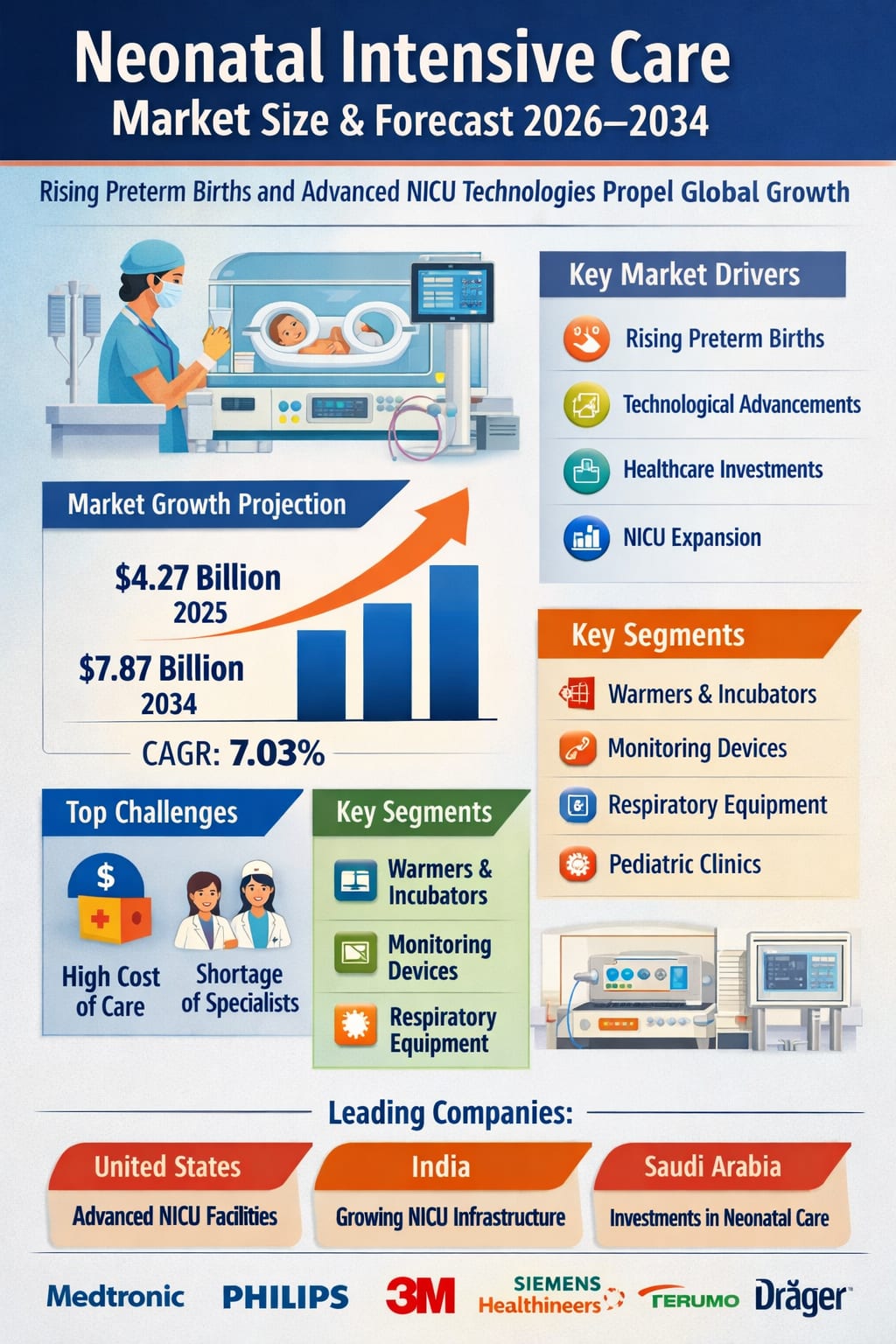
The global Neonatal Intensive Care (NIC) Market is entering a transformative decade. According to Renub Research, the market is projected to expand from US$ 4.27 billion in 2025 to US$ 7.87 billion by 2034, growing at a CAGR of 7.03% during 2026–2034.
This steady growth trajectory reflects a combination of rising preterm birth rates, increasing healthcare expenditure focused on maternal and infant care, and rapid technological innovation in neonatal monitoring, respiratory care, incubators, and temperature management systems. As healthcare systems worldwide prioritize infant survival and long-term health outcomes, Neonatal Intensive Care Units (NICUs) are becoming central pillars of modern hospital infrastructure.
Neonatal Intensive Care Market Overview
Neonatal Intensive Care (NIC) refers to specialized medical interventions provided to premature infants, low birth weight newborns, and babies with congenital disorders, infections, or life-threatening conditions. These services are delivered within Neonatal Intensive Care Units (NICUs), which are equipped with advanced life-support systems, ventilators, incubators, infusion pumps, cardiac monitors, and diagnostic tools.
NICUs are staffed by highly trained neonatologists, neonatal nurses, respiratory therapists, and pediatric specialists. The goal is not only survival but also minimizing long-term complications and supporting healthy development.
Globally, neonatal intensive care has gained greater prominence due to:
Increasing preterm birth incidence
Higher maternal age and assisted reproductive technologies
Improved awareness of infant survival outcomes
Government-backed maternal health initiatives
Expansion of NICU infrastructure in emerging economies
With improved survival rates among extremely premature infants, healthcare systems are increasingly investing in advanced neonatal care capabilities.
Key Market Drivers
Rising Preterm Birth Rates and Neonatal Complications
One of the most powerful growth drivers is the rising number of preterm births worldwide. An estimated 15 million babies are born prematurely each year, and complications from preterm birth remain a leading cause of death in children under five.
Several contributing factors include:
Increasing maternal age
Chronic maternal health conditions
Lifestyle-related risks
Growth in multiple pregnancies due to assisted reproductive technologies
Preterm and high-risk newborns require continuous monitoring, respiratory support, nutritional assistance, and temperature regulation—services delivered exclusively in NICUs. Early intervention significantly improves survival and long-term developmental outcomes, further strengthening demand for neonatal intensive care services.
Technological Advancements in Neonatal Care Equipment
Rapid innovation in neonatal devices has significantly improved treatment precision and safety. Modern NICUs are equipped with:
High-performance incubators
Non-invasive ventilators
Wireless monitoring systems
Advanced infusion devices
Real-time data analytics platforms
Companies such as Medtronic PLC, Koninklijke Philips N.V., and Drägerwerk AG & Co. KGaA are continuously innovating in neonatal respiratory and monitoring solutions.
In 2025, Medisys introduced next-generation Anaesthesia & Neonatal Solutions in India, emphasizing patient-first design and local manufacturing. Technological integration now allows seamless connectivity between NICU devices and electronic medical records (EMRs), improving data-driven decision-making and clinical accuracy.
Increasing Healthcare Investments and NICU Infrastructure Expansion
Governments and private healthcare providers are expanding NICU capacity worldwide. Developing nations are investing heavily in maternal and child health infrastructure, while developed nations are upgrading existing NICUs with digital and AI-enabled technologies.
For example, in January 2026, Children’s Hospital of Richmond at VCU expanded its NICU capacity with a new 20-bed unit, increasing total capacity to 60 beds. Such investments reflect a growing emphasis on specialized neonatal infrastructure.
Insurance coverage improvements and reimbursement frameworks are also increasing NICU service accessibility, particularly in developed economies.
Challenges in the Neonatal Intensive Care Market
High Cost of Neonatal Intensive Care Services
NICU treatment involves sophisticated equipment and specialized personnel, leading to high operational costs. Prolonged stays for premature infants can impose financial burdens on families and healthcare systems, especially in regions with limited insurance coverage.
Additionally, the capital expenditure required to establish advanced NICUs can be prohibitive for smaller hospitals, limiting market penetration in low-resource settings.
Shortage of Skilled Neonatal Healthcare Professionals
NICUs require highly trained professionals, including neonatologists and neonatal nurses. Many countries face workforce shortages, slowing the expansion of NICU capacity and affecting service quality.
Investment in training programs and workforce development remains critical to sustaining long-term market growth.
Product Segment Insights
Warmers Market
Neonatal warmers play a crucial role in preventing hypothermia, a major cause of neonatal morbidity. Modern systems feature infrared heating and real-time temperature monitoring to ensure thermal stability.
Improved affordability and technological enhancements are increasing adoption in both public and private hospitals.
Monitoring Devices Market
Continuous monitoring devices track vital parameters such as heart rate, oxygen saturation, blood pressure, and temperature. Technological advancements include:
Wireless connectivity
Real-time graphical data
EMR integration
Enhanced sensor accuracy
Companies like Masimo Corporation and Siemens Healthcare GmbH are advancing neonatal monitoring precision through innovative sensor technologies.
Respiratory Devices Market
Respiratory distress is common among preterm infants. Neonatal ventilators, CPAP systems, and oxygen delivery devices are critical components of NICU infrastructure.
Manufacturers such as Terumo Corporation and 3M Company are contributing to respiratory device innovation, emphasizing non-invasive ventilation and lung-protective strategies.
With respiratory complications being a leading cause of neonatal morbidity, this segment is expected to witness sustained growth.
Pediatric Clinics & Childcare Segment
Post-NICU care is becoming increasingly important. Pediatric clinics provide developmental monitoring, chronic disease management, and immunization services for high-risk infants.
Telemedicine integration is expanding access to follow-up care, particularly in rural and underserved areas. As healthcare systems adopt comprehensive neonatal care models, pediatric clinics are emerging as vital extensions of NICU services.
Regional Market Analysis
United States
The United States represents one of the most advanced neonatal intensive care markets globally. High healthcare expenditure, strong reimbursement systems, and early adoption of medical innovations drive growth.
Frequent investments in hospital expansions and cutting-edge neonatal technologies reinforce market leadership. The presence of major medical device manufacturers further strengthens innovation capabilities.
United Kingdom
The United Kingdom benefits from a structured public healthcare system under the NHS, ensuring standardized neonatal care across the country.
Despite budgetary constraints, continuous investments in NICU modernization and family-centered care models are supporting growth. The opening of large-scale NICU facilities, such as the £32 million unit at Queen’s Medical Centre, highlights long-term commitment to neonatal healthcare.
India
India’s neonatal intensive care market is expanding rapidly due to high birth rates and increasing awareness of infant health outcomes.
Government initiatives aimed at reducing infant mortality and expanding maternal health infrastructure are driving NICU investments. The private healthcare sector is also contributing significantly, especially in urban regions.
In February 2025, Amrita Hospital launched India’s first Mother and Neonatal Intensive Care Unit (MNICU), emphasizing zero separation from birth and kangaroo mother care practices.
Saudi Arabia
Saudi Arabia’s neonatal intensive care market is fueled by strong government healthcare spending and modernization of hospital infrastructure.
Hospitals are integrating genomic screening programs and advanced neonatal monitoring technologies. In October 2025, a collaboration between Rady Children’s Institute for Genomic Medicine and King Faisal Specialist Hospital & Research Centre marked a significant advancement in newborn screening capabilities in the region.
Market Segmentation
By Product:
Warmers
Incubators
Monitoring Devices
Respiratory Devices
Phototherapy Equipment
Others
By End-User:
Hospitals & Neonatal Pediatric Hospitals
Pediatric Clinics & Childcare Centers
Others
By Region:
North America (United States, Canada)
Europe (France, Germany, Italy, Spain, United Kingdom, Belgium, Netherlands, Turkey)
Asia Pacific (China, Japan, India, Australia, South Korea, Thailand, Malaysia, Indonesia, New Zealand)
Latin America (Brazil, Mexico, Argentina)
Middle East & Africa (South Africa, Saudi Arabia, UAE)
Competitive Landscape
The neonatal intensive care market is characterized by strong competition among global medical device manufacturers. Key players include:
Masimo Corporation
3M Company
Medtronic PLC
Koninklijke Philips N.V.
Siemens Healthcare GmbH
Terumo Corporation
Angio Dynamics
Drägerwerk AG & Co. KGaA
These companies are investing in research and development, strategic partnerships, product portfolio expansion, and digital integration to strengthen market presence.
Final Thoughts
The Neonatal Intensive Care Market is poised for steady expansion through 2034, driven by demographic trends, technological advancements, and growing global awareness of infant survival outcomes. With the market expected to reach US$ 7.87 billion by 2034, opportunities abound for device manufacturers, healthcare providers, and policymakers.
While challenges such as high treatment costs and workforce shortages persist, sustained investment in NICU infrastructure, innovation in neonatal devices, and policy-driven healthcare expansion will likely overcome these barriers.
About the Creator
Can Gold Be Tokenized? Understanding a New Way to Invest
Gold has always been a symbol of financial security and long-term stability. For centuries, investors have relied on it to hedge against inflation, currency fluctuations, and economic downturns. Today, technological innovation is transforming the way gold is bought, sold, and owned. Gold Tokenization is emerging as a modern investment model that blends the stability of physical gold with the efficiency of blockchain technology. This digital transformation is making gold investment more accessible, transparent, and globally tradable.
By Michal steve6 days ago in Trader


Comments
There are no comments for this story
Be the first to respond and start the conversation.