
Bariatric Surgery Devices Market Size & Forecast 2026–2034
Rising Obesity Rates and Technological Innovation Propel Global Market Toward US$ 4.92 Billion by 2034

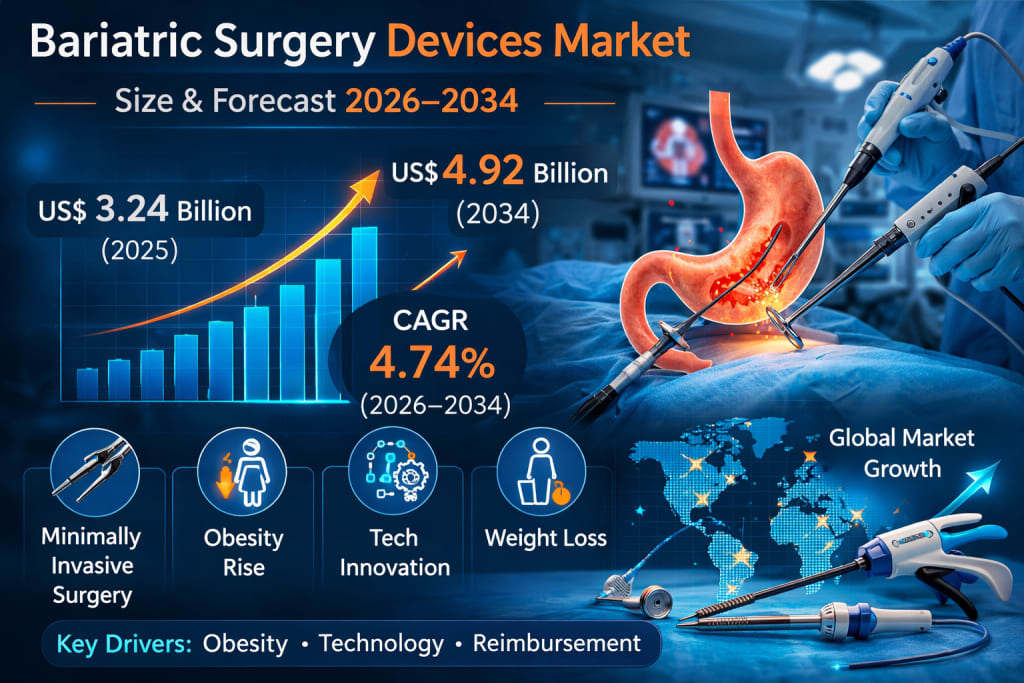
The global Bariatric Surgery Devices Market is entering a transformative phase, driven by escalating obesity rates, increasing awareness of minimally invasive procedures, and sustained innovation in surgical technologies. According to Renub Research, the market is projected to grow from US$ 3.24 billion in 2025 to US$ 4.92 billion by 2034, registering a CAGR of 4.74% between 2026 and 2034.
This steady expansion reflects more than just numbers—it signals a shift in global healthcare priorities. Obesity, once viewed primarily as a lifestyle issue, is now recognized as a chronic disease with serious metabolic and cardiovascular consequences. As a result, bariatric surgery devices have become central to modern obesity management strategies.
Understanding Bariatric Surgery Devices
Bariatric surgery devices are specialized medical instruments designed to assist surgeons in performing procedures that promote significant and sustained weight loss. These devices are primarily used in procedures such as:
Gastric bypass
Sleeve gastrectomy
Adjustable gastric banding
Key device categories include surgical staplers, energy devices, suturing instruments, trocars, and advanced visualization systems. Most bariatric surgeries are performed laparoscopically, making precision-driven, minimally invasive tools critical to successful outcomes.
These devices function by reducing stomach capacity or altering digestive pathways, thereby limiting food intake or nutrient absorption. Over time, they help patients achieve durable weight loss while improving obesity-related comorbidities.
Global Obesity: The Primary Growth Catalyst
The most powerful driver behind the bariatric surgery devices market is the alarming global rise in obesity. Sedentary lifestyles, calorie-dense diets, and rapid urbanization have fueled a public health crisis across both developed and emerging economies.
Recent global data indicates:
35 million children under five were overweight in 2024
Over 390 million children and adolescents aged 5–19 were overweight in 2022
2.5 billion adults were overweight in 2022
More than 890 million adults were classified as obese
Obesity significantly increases the risk of type 2 diabetes, cardiovascular disease, hypertension, and sleep apnea. While lifestyle interventions remain important, they often fail to deliver long-term results in cases of severe obesity. Bariatric surgery has emerged as one of the most effective long-term treatment solutions, improving quality of life and reducing mortality rates.
As awareness of these clinical benefits grows among both patients and healthcare providers, procedural volumes continue to increase globally—directly boosting demand for advanced surgical devices.
Technological Advancements in Minimally Invasive Surgery
Innovation is reshaping bariatric surgical practices. Modern devices now feature powered stapling systems, advanced energy platforms, and high-definition visualization technologies that enhance surgical precision and safety.
In September 2025, Arthrex introduced the NanoNeedle™ scope 2.0, an advanced minimally invasive imaging platform first used clinically at Anderson Sports Medicine in Michigan. Such advancements highlight how precision imaging and micro-instrumentation are redefining surgical workflows.
Minimally invasive bariatric procedures offer multiple benefits:
Reduced hospital stays
Faster recovery
Lower post-operative pain
Reduced infection risk
As hospitals increasingly invest in laparoscopic and robotic platforms, demand for high-performance bariatric surgery devices continues to strengthen.
Growing Acceptance and Reimbursement Support
Historically perceived as elective or cosmetic, bariatric surgery is now widely recognized as medically necessary for severe obesity management. Professional medical associations increasingly recommend surgical intervention for eligible patients with metabolic disorders.
Improved insurance coverage—particularly in North America and parts of Europe—has reduced financial barriers. This shift has increased procedural volumes and expanded patient access to advanced surgical solutions.
The rise in dedicated bariatric centers and trained specialists further reinforces this growth trajectory.
Key Market Challenges
High Cost of Devices and Procedures
Despite promising growth, cost remains a critical barrier. Advanced stapling systems, disposable accessories, and robotic platforms contribute significantly to procedural expenses. In regions with limited reimbursement frameworks, out-of-pocket costs deter patients from pursuing surgery.
Hospitals in emerging markets also face financial pressure when investing in premium surgical systems, slowing market penetration despite rising obesity rates.
Surgical Risks and Complications
Although technology has improved safety outcomes, bariatric surgery still carries inherent risks, including infection, leakage, bleeding, and nutritional deficiencies. Lifelong dietary adjustments may also discourage patients.
Regulatory requirements and the need for highly trained surgeons add complexity to device adoption, particularly in underdeveloped healthcare systems.
Market Insights by Segment
Bariatric Minimally Invasive Surgical Procedures
The minimally invasive segment is witnessing strong expansion. Laparoscopic sleeve gastrectomy and gastric bypass procedures are increasingly preferred due to shorter recovery times and improved patient comfort. Hospitals are prioritizing investments in such technologies to enhance efficiency and clinical outcomes.
Bariatric Surgery Assisting Devices
Assisting devices—including trocars, insufflators, retractors, and suturing systems—play a vital role in enhancing surgical precision and workflow efficiency. As procedural volumes rise, demand for durable and ergonomic assisting tools continues to grow steadily.
Sleeve Gastrectomy Devices
Sleeve gastrectomy has become the global standard in bariatric surgery. Its safety profile and effectiveness in treating morbid obesity have accelerated demand for specialized stapling and resection devices.
Weight Loss Bariatric Devices
This broad category includes implantable and procedural devices aimed at long-term weight reduction. With obesity now classified as a chronic disease, surgical interventions are gaining legitimacy, supporting sustained demand growth.
End-User Insights: Hospitals Lead the Market
Hospitals account for the largest revenue share due to their comprehensive infrastructure. These facilities provide preoperative evaluation, surgical execution, and postoperative care under one system.
Reimbursement support and dedicated bariatric centers within hospitals further strengthen device utilization rates. As global surgery volumes increase, hospitals will remain central to market revenue generation.
Regional Market Analysis
United States
The United States represents the largest market globally, driven by high obesity prevalence and advanced healthcare infrastructure.
Companies such as Johnson & Johnson Services Inc. are actively investing in robotic surgical innovation. In January 2026, the company filed its OTTAVA Robotic Surgical System for De Novo classification with the U.S. FDA.
Additionally, Intuitive Surgical Inc. continues to advance robotic-assisted platforms that enhance minimally invasive bariatric procedures. Favorable reimbursement policies and technological leadership position the U.S. as a dominant force in this market.
United Kingdom
The United Kingdom market is expanding steadily under the framework of the National Health Service (NHS). Bariatric surgery is increasingly viewed as a medically necessary treatment rather than a cosmetic option.
In January 2024, NHS-operated hospitals introduced gastric balloons developed by Allurion Technologies Inc., expanding pre-surgical weight management solutions. Strict regulatory oversight ensures high safety standards while supporting controlled market growth.
India
India’s bariatric surgery devices market is growing rapidly due to urbanization, lifestyle changes, and rising obesity awareness. The country’s expanding middle class and medical tourism sector further fuel demand.
In December 2024, Boston Scientific entered India’s weight-loss segment, launching endoscopic sleeve gastroplasty and intragastric balloon solutions. Competitive pricing and private healthcare expansion are strengthening India’s position in the Asia-Pacific region.
Saudi Arabia
Saudi Arabia is witnessing rapid growth due to high obesity prevalence across the Middle East. Government-led preventive healthcare initiatives and increased healthcare spending are driving device adoption.
The Ministry of Health launched awareness campaigns in December 2025 promoting responsible bariatric surgery practices, reflecting growing institutional support.
Competitive Landscape
Leading companies covered in the market analysis include:
Apollo Endosurgery Inc.
GI Dynamics
Intuitive Surgical Inc.
Johnson & Johnson Services Inc.
Medtronic Inc.
Olympus Corporation
Reshape Lifesciences Inc.
TransEnterix Inc.
Each company is evaluated across five viewpoints: overview, key persons, recent developments, product portfolio, and financial insights.
Market Segmentation Overview
By Procedure Type:
Minimally Invasive
Non-Invasive
By Device Type:
Assisting Devices
Implantable Devices
By Procedure:
Sleeve Gastrectomy
Adjustable Gastric Banding
Roux-en-Y Gastric Bypass
Biliopancreatic Diversion with Duodenal Switch
Others
By Application:
Weight Loss
Hereditary Disease
Others
By End User:
Hospitals
Bariatric Surgery Clinics
Others
By Geography:
North America, Europe, Asia Pacific, Latin America, Middle East & Africa
Final Thoughts
The Bariatric Surgery Devices Market is poised for consistent, innovation-driven growth through 2034. Rising global obesity rates, expanding healthcare infrastructure, growing reimbursement coverage, and technological breakthroughs are collectively shaping a dynamic industry landscape.
Although cost pressures and surgical risks remain challenges, continued advancements in minimally invasive and robotic technologies are likely to mitigate barriers over time.
With the market projected to reach US$ 4.92 billion by 2034, bariatric surgery devices will remain integral to global obesity management strategies—bridging clinical necessity with technological progress and redefining the future of weight-loss treatment worldwide.
About the Creator
Philippines Passenger Vehicles Lubricants Market 2026: Rising Car Ownership, Synthetic Oil Shift and Maintenance Awareness
Philippines Passenger Vehicles Lubricants Market Overview The Philippines passenger vehicles lubricants market is steadily expanding as vehicle ownership increases and consumers place greater emphasis on regular maintenance and engine efficiency. Passenger vehicle lubricants — including engine oils, transmission fluids, greases and hydraulic oils — play a critical role in reducing friction, enhancing fuel efficiency and extending vehicle lifespan. As the Philippines automotive sector grows and mobility demand rises, lubricant consumption continues to strengthen across private vehicle fleets nationwide.
By Manisha Dixit5 days ago in Trader
S&P BSE Sensex: Understanding India’s Most Influential Stock Market Index
Introduction The S&P BSE Sensex stands at the heart of the Indian stock market, acting as a powerful indicator of investor sentiment and economic direction. Often quoted in daily financial news, the Sensex reflects how India’s largest and most established companies are performing in real time. For investors, analysts, and policymakers, movements in the S&P BSE Sensex offer valuable insight into the strength, stability, and future outlook of the Indian equity market.
By Hammad Nawaz7 days ago in Trader
A Historic Declaration
We the People of the Husbands of the United States of America, in Order to form a more perfect Union, and I mean you...with me...establish Justice, insure domestic Tranquility, provide for the common defence, promote the general Welfare, and secure the Blessings of Liberty to ourselves, after Puberty, do ordain and establish this Declaration of Co-Dependence.
By Gerard DiLeo4 days ago in Humans



Comments
There are no comments for this story
Be the first to respond and start the conversation.