
Assortment and Space Optimization (ASO) Market Size and Forecast 2026–2034
Retail Intelligence Redefining Shelf Space, Product Mix, and Profitability

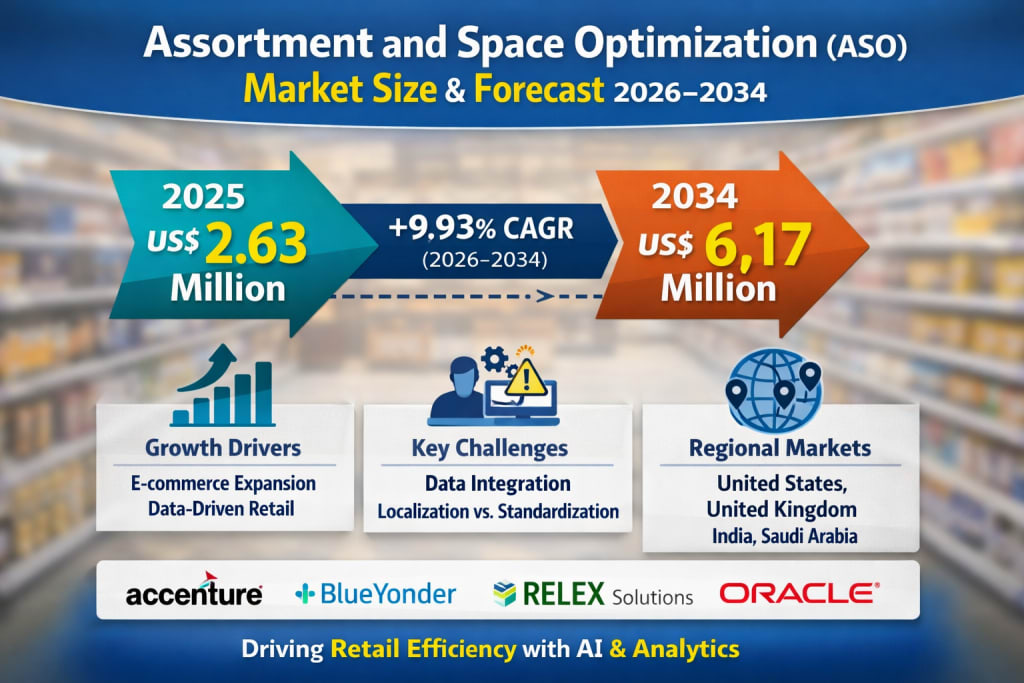
The global Assortment and Space Optimization (ASO) Market is entering a transformative growth phase as retailers worldwide accelerate their shift toward data-driven merchandising strategies. According to Renub Research, the ASO market is projected to reach US$ 6.17 million by 2034, rising from US$ 2.63 million in 2025, registering a CAGR of 9.93% from 2026 to 2034.
As retailers navigate rising operational costs, SKU proliferation, and increasingly demanding consumers, ASO solutions are becoming central to profitability and competitive differentiation. By leveraging advanced analytics, artificial intelligence (AI), and cloud-based retail platforms, ASO enables businesses to optimize product assortment, allocate shelf space efficiently, and improve both in-store and online merchandising performance.
Assortment and Space Optimization (ASO) Industry Overview
The ASO industry plays a critical role in modern retail ecosystems by enabling businesses to strategically determine what products to stock, where to place them, and how much space to allocate. In an environment characterized by shrinking margins and intense competition, data-backed assortment planning is no longer optional—it is essential.
Traditionally, merchandising decisions were driven by experience and historical sales patterns. Today, retailers integrate real-time point-of-sale (POS) data, consumer insights, demand forecasts, loyalty analytics, and supply chain constraints into sophisticated optimization algorithms. These systems allow retailers to maximize sales per square foot, reduce stockouts and overstock, and improve inventory turnover.
In brick-and-mortar retail, ASO tools assist with:
Planogram design and shelf layout optimization
SKU rationalization
Promotional space allocation
Regional and store-specific assortment customization
In e-commerce and omnichannel retail, ASO solutions optimize:
Digital shelf placement
Product ranking and visibility
Personalized recommendations
Inventory synchronization across platforms
The integration of AI and machine learning has significantly improved predictive accuracy, enabling retailers to simulate multiple scenarios before implementing changes. Cloud-based ASO platforms have further expanded accessibility, scalability, and real-time analytics capabilities.
As global retail becomes more data-intensive, ASO solutions are increasingly offered by enterprise software providers, consulting firms, and specialized retail analytics companies, often customized to specific retail formats and sectors such as grocery, apparel, electronics, and FMCG.
Growth Drivers in the ASO Market
1. Rising Demand for Data-Driven Retail Decision-Making
Retailers today operate in an environment defined by volatile demand patterns, frequent product launches, and omnichannel complexity. Data-driven decision-making has become the backbone of modern retail strategy.
ASO platforms aggregate multiple data streams—including POS transactions, customer behavior analytics, pricing trends, and supply chain metrics—to determine the optimal product mix at store and regional levels. This minimizes reliance on intuition-based merchandising while improving measurable outcomes.
Advanced analytics tools enable:
Real-time assortment adjustments
Dynamic planogram updates
Improved promotional effectiveness
Accurate demand forecasting
As retailers increasingly prioritize operational precision and revenue maximization, investment in ASO technologies continues to rise.
2. Expansion of Multi-Channel and E-Commerce Retail
The rapid expansion of e-commerce and omnichannel retail models is significantly accelerating ASO adoption. Retailers now operate across physical stores, online marketplaces, mobile applications, and click-and-collect services.
Managing consistent assortments across these channels presents complex challenges. ASO solutions ensure synchronized inventory planning and optimal digital shelf visibility. In e-commerce environments, algorithm-driven product placement and recommendation engines directly influence conversion rates and basket size.
Omnichannel strategies—such as subscription services and hybrid fulfillment models—have increased SKU complexity, making sophisticated assortment management tools indispensable.
3. Increasing Pressure to Maximize Retail Space and Profitability
With rising real estate costs, especially in urban centers, maximizing the productivity of every square foot is crucial. ASO solutions help retailers:
Identify high-performing SKUs
Eliminate underperforming products
Optimize promotional displays
Increase cross-selling opportunities
In physical retail, shelf space is finite and expensive. In digital retail, visibility and ranking function as virtual shelf space. Both require strategic optimization to drive profitability.
As competition intensifies and margins tighten, retailers increasingly view ASO as a strategic lever for sustained growth and operational efficiency.
Challenges in the ASO Market
1. Data Complexity and Quality Issues
ASO systems rely heavily on accurate, comprehensive, and timely data. However, retail environments often involve fragmented systems and inconsistent data formats.
Common issues include:
Incomplete sales records
Outdated product hierarchies
Disconnected legacy systems
Inconsistent store-level reporting
Without strong data governance and integration frameworks, ASO outputs may lack reliability. Maintaining clean datasets and integrating external market intelligence further complicate implementation.
2. Balancing Standardization with Localization
Retailers must strike a delicate balance between standardized assortments for operational efficiency and localized customization to reflect regional preferences.
Over-standardization can ignore local demand variations, while excessive localization increases complexity and inventory risk. ASO tools must incorporate demographic, geographic, and store-format variables to produce scalable yet personalized solutions.
Internal resistance also poses challenges, as merchandising teams may hesitate to adopt algorithm-driven recommendations. Effective change management and cross-departmental alignment are critical for success.
Regional Market Insights
United States ASO Market
The United States remains one of the most advanced and mature markets for ASO adoption. Retailers across grocery, FMCG, fashion, and specialty retail are leveraging AI-powered optimization platforms to improve sales productivity and inventory efficiency.
The rise of private labels, frequent product introductions, and omnichannel fulfillment models has increased merchandising complexity. Cloud-based ASO solutions are particularly popular due to scalability and integration ease.
Despite challenges related to legacy systems and execution consistency, the U.S. ASO market is expected to witness sustained growth through 2034.
United Kingdom ASO Market
In the United Kingdom, retailers are focusing heavily on maximizing space productivity amid high real estate costs and growing urban store formats. ASO solutions are widely adopted in grocery and convenience segments.
Advanced analytics and machine learning are used to tailor assortments based on store size and neighborhood demographics. While data integration challenges persist, the UK market continues to expand as retailers prioritize efficiency and customer-centric merchandising.
India ASO Market
As you operate from India, it’s worth noting that the Indian ASO market is rapidly emerging, driven by organized retail expansion and digital transformation.
Retailers across FMCG, electronics, and fashion are investing in analytics-driven assortment planning to address regional diversity and price sensitivity. Cloud deployment models are gaining traction due to cost efficiency and scalability.
However, fragmented data systems and varying store formats present implementation challenges. Despite this, India is expected to become a significant growth engine within the global ASO landscape over the forecast period.
Saudi Arabia ASO Market
Saudi Arabia’s retail modernization under Vision 2030 initiatives is fueling ASO adoption. Investments in hypermarkets, malls, and omnichannel platforms are increasing demand for advanced space optimization tools.
Retailers are leveraging AI-based systems to localize assortments and improve shelf productivity. While analytical maturity is still developing, steady growth is anticipated through 2034.
Recent Developments in the ASO Ecosystem
Recent innovations demonstrate how broader retail technology advancements are shaping ASO capabilities:
In February 2024, Brevo launched its Customer Data Platform (CDP) following strategic acquisitions, strengthening data integration capabilities for retailers.
In February 2024, Zoho Corporation introduced Zakya, a POS system tailored for Indian retailers, supporting centralized retail operations.
At the Big Retail Show in January 2024, Lenovo showcased AI-powered retail solutions aimed at enhancing operational efficiency and customer engagement.
These developments reflect the broader convergence of CRM, POS, AI, and analytics technologies that support advanced ASO functionalities.
Market Segmentation
By Component:
Solutions
Services
By Deployment Type:
On-premises
Cloud-based
By Enterprise Size:
Large Enterprises
Small and Medium-sized Enterprises
Regional Coverage:
North America, Europe, Asia Pacific, Latin America, and Middle East & Africa, with detailed country-level analysis.
Competitive Landscape
Leading companies operating in the ASO market include:
Accenture plc
Aptos LLC
Blue Yonder Group Inc.
Invent Analytics
McKinsey & Company
Nielsen Consumer LLC
Oracle Corporation
RELEX Solutions
SymphonyAI
TATA Consultancy Services Limited
These companies compete based on technology sophistication, AI capabilities, cloud integration, consulting expertise, and global retail partnerships.
Final Thoughts
The Assortment and Space Optimization (ASO) market is no longer a niche technology segment—it is becoming a foundational pillar of modern retail strategy. With the market projected to grow from US$ 2.63 million in 2025 to US$ 6.17 million by 2034, retailers worldwide are recognizing the importance of optimizing every square foot and every digital impression.
As AI, machine learning, and cloud technologies continue to evolve, ASO platforms will become increasingly predictive, automated, and personalized. Retailers that invest early in robust data governance and integrated optimization frameworks will gain a competitive advantage in efficiency, customer satisfaction, and profitability.
In an era where retail margins are tight and consumer expectations are high, smart assortment and space decisions are not just operational improvements—they are strategic imperatives driving the future of global retail.
About the Creator
Australia Cold Chain Equipment Market 2026: Perishable Logistics Boom, Smart Refrigeration and Infrastructure Expansion
Australia Cold Chain Equipment Market Overview Australia’s cold chain equipment market is undergoing rapid transformation as demand for temperature-controlled storage and transportation solutions intensifies across food, pharmaceutical and export industries. Cold chain equipment — including refrigerated storage systems, transport refrigeration units, monitoring devices and insulated containers — plays a critical role in preserving product quality and regulatory compliance throughout the supply chain. As Australia’s consumption of fresh and frozen products grows alongside pharmaceutical logistics expansion, investments in advanced cold chain infrastructure continue to rise.
By Amyra Singh4 days ago in Trader
Why an Indie Accounting Podcast Is Not Boring!
Try to stay awake. I’m going to be discussing accounting and bookkeeping. Come on now. I see your eyes closing! What I love about this indie podcast is that it faces its perceived weaknesses head-on (accounting is boring!) and inverts them into a strength.
By Frank Racioppi5 days ago in Trader


Comments
There are no comments for this story
Be the first to respond and start the conversation.