
n-Hexane Market Size and Forecast 2026–2034
Expanding Edible Oil Demand and Industrial Solvent Applications Sustain Steady Growth

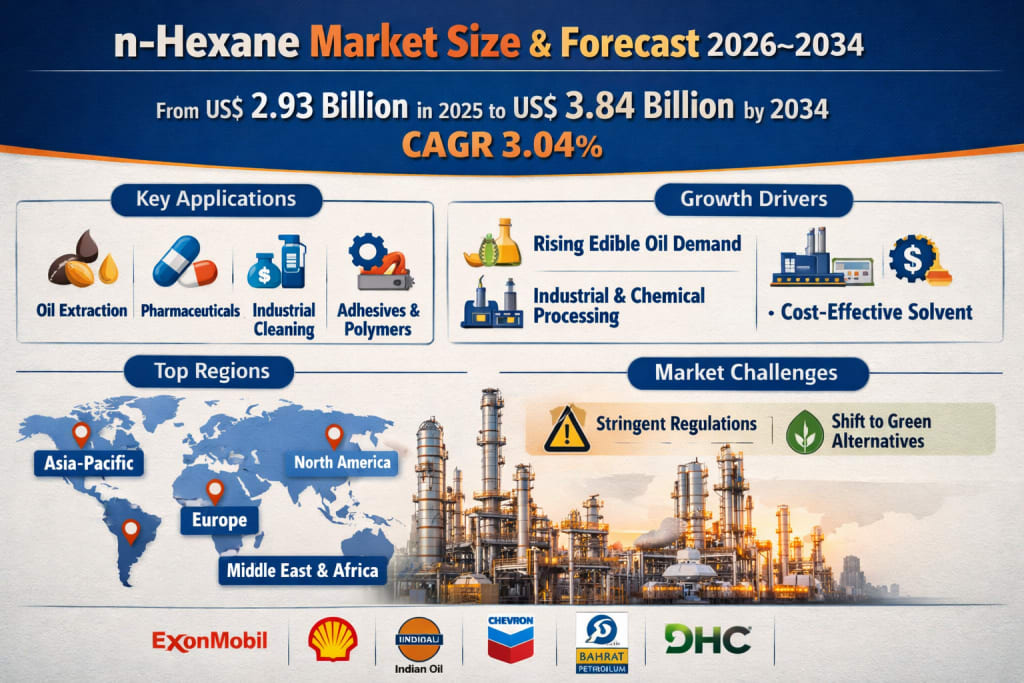
The global n-Hexane Market is projected to reach US$ 3.84 billion by 2034, rising from US$ 2.93 billion in 2025, expanding at a CAGR of 3.04% during 2026–2034. The market’s steady trajectory reflects its indispensable role across edible oil extraction, chemical manufacturing, pharmaceuticals, and industrial cleaning.
Despite increasing regulatory scrutiny and the emergence of alternative solvents, n-hexane continues to dominate large-scale industrial applications due to its cost efficiency, high solvency power, and compatibility with existing infrastructure. According to Renub Research, long-term demand will remain stable, supported primarily by food processing expansion and industrial manufacturing growth.
n-Hexane Industry Overview
n-Hexane (C₆H₁₄) is a linear alkane hydrocarbon derived mainly from crude oil refining and natural gas processing. Typically obtained from light petroleum fractions such as straight-run gasoline, it is valued for its:
Excellent oil-dissolving properties
Low boiling point (facilitating easy recovery)
High volatility and rapid evaporation
Cost-effectiveness in bulk industrial usage
Its largest application is in the edible oil industry, where it is used to extract vegetable oils from soybeans, rapeseed, sunflower seeds, mustard seeds, and cottonseed. Thanks to its high extraction efficiency and ease of solvent recovery through distillation, n-hexane remains the global industry standard for large-scale oilseed processing.
Beyond food processing, it is widely used in:
Adhesives and coatings manufacturing
Rubber and polymer formulation
Pharmaceutical purification processes
Industrial cleaning and degreasing
Laboratory and analytical applications
Geographically, Asia-Pacific dominates the global market due to large edible oil production bases in China and India, alongside expanding manufacturing sectors. Meanwhile, North America and Europe represent mature markets characterized by stable demand and stringent environmental oversight.
Market Growth Drivers
1. Expanding Global Demand for Edible Oils
The most significant growth driver for the n-hexane market is the sustained increase in global vegetable oil consumption. Population growth, urbanization, and the rapid expansion of processed and convenience foods are driving higher oil consumption worldwide.
Emerging economies across Asia-Pacific, Latin America, and Africa are witnessing growth in oilseed crushing capacity. Countries such as India and China continue investing in domestic oil extraction facilities to reduce import dependency and strengthen food security.
n-Hexane remains the solvent of choice due to:
High oil recovery rate
Operational cost efficiency
Compatibility with existing extraction plants
Proven industrial scalability
While alternative extraction methods such as supercritical CO₂ are gaining attention, few can currently match n-hexane’s cost-performance balance at industrial scale. This ensures long-term stability in the oil extraction segment.
2. Growth in Industrial Manufacturing and Chemical Processing
Industrialization across developing regions is fueling solvent demand. n-Hexane plays a vital role as a reaction medium, diluent, and cleaning agent in manufacturing adhesives, coatings, polymers, and specialty chemicals.
Growth in sectors such as:
Construction
Automotive
Electronics
Packaging
indirectly boosts demand for adhesives and coatings that rely on n-hexane formulations.
Additionally, pharmaceutical manufacturing and laboratory research require high-purity hexane grades for analytical and purification processes. As countries invest in manufacturing infrastructure—particularly in Asia-Pacific—solvent consumption is expected to remain steady.
3. Cost Advantage and Infrastructure Compatibility
n-Hexane benefits from established petroleum refining infrastructure, ensuring reliable supply chains and competitive pricing. Many industries operate on tight margins, particularly edible oil processors, making cost-effective solvents critical.
Although bio-based and low-toxicity alternatives are emerging, many face:
Higher production costs
Limited scalability
Lower extraction efficiency
Until affordable, scalable substitutes become widely available, n-hexane’s economic advantage will continue to anchor market demand.
Market Challenges
1. Stringent Health, Safety, and Environmental Regulations
One of the most pressing challenges for the industry is regulatory scrutiny. Prolonged exposure to n-hexane vapors has been linked to neurotoxic effects, prompting regulatory agencies in North America and Europe to tighten occupational exposure limits.
Manufacturers must comply with:
Workplace exposure standards
VOC emission regulations
Residual solvent limits in food products
Compliance increases operational costs and necessitates advanced solvent recovery systems. Smaller operators may face financial pressure due to regulatory complexity.
2. Rising Adoption of Alternative and Bio-Based Solvents
Sustainability concerns and ESG commitments are pushing companies toward greener alternatives. Supercritical CO₂ extraction, bio-based solvents, and low-toxicity hydrocarbon blends are under evaluation across industries.
While most alternatives are not yet cost-competitive at large scale, technological innovation could gradually reshape solvent selection criteria. Consumer awareness regarding food safety and environmental sustainability is also influencing long-term industry decisions.
Country-Level Market Insights
United States
The United States represents a mature yet stable market. Soybean oil extraction drives primary demand, supported by the country’s advanced agricultural processing infrastructure.
Industrial manufacturing—especially adhesives, coatings, and rubber products—further sustains solvent consumption. However, strict occupational and environmental regulations emphasize controlled usage, solvent recovery, and emission management.
Overall, the U.S. market demonstrates steady demand with limited high-growth potential.
United Kingdom
The UK market is relatively modest in size but stable. Edible oil extraction and industrial applications such as coatings and polymers drive demand. Strong regulatory oversight shapes market dynamics, encouraging emission reduction and improved solvent handling.
Growth remains restrained due to regulatory pressures and gradual exploration of alternative solvents.
India
India represents one of the fastest-growing markets for n-hexane. Rapid expansion in edible oil extraction—particularly soybean, mustard, sunflower, and cottonseed processing—drives strong volume demand.
Rising packaged food consumption, increasing population, and manufacturing expansion contribute to growth. Compared to developed markets, regulatory enforcement remains moderate, supporting continued large-scale adoption.
India’s growing refining and petrochemical infrastructure ensures steady domestic supply, strengthening long-term prospects.
United Arab Emirates
The UAE functions primarily as a trade and processing hub. While it lacks extensive oilseed crushing capacity, demand arises from refining, blending, and industrial solvent applications.
Construction, automotive, and manufacturing sectors support solvent usage. Regulatory frameworks emphasize workplace safety and environmental protection, prompting efficient solvent recovery practices.
Market growth remains stable rather than aggressive.
Recent Industry Developments
In May 2025, Bharat Petroleum Corporation Ltd announced a reduction in domestic hexane prices effective May 16, 2025, reflecting market dynamics and potential supply adjustments.
On May 8, 2024, CAPGC Pte. Ltd., a joint venture between Glencore and Chandra Asri Capital, agreed to acquire Shell’s Energy and Chemicals Park in Singapore from Shell plc, strengthening regional petrochemical assets.
On May 3, 2024, Exxon Mobil Corporation completed its acquisition of Pioneer Natural Resources, expanding its Permian Basin development capacity.
These developments highlight ongoing consolidation and strategic positioning within the broader petrochemical landscape that indirectly influences solvent supply chains.
Market Segmentation
By Application
Oil Extraction
Pharmaceuticals
Adhesives
Industrial Cleaning
Polymerisation
Degreasing
Rubber Processing
Others
Oil extraction remains the dominant segment, accounting for the majority of global consumption.
By Region
North America
United States
Canada
Europe
France
Germany
Italy
Spain
United Kingdom
Belgium
Netherlands
Turkey
Asia-Pacific
China
Japan
India
Australia
South Korea
Thailand
Malaysia
Indonesia
New Zealand
Latin America
Brazil
Mexico
Argentina
Middle East & Africa
South Africa
Saudi Arabia
United Arab Emirates
Competitive Landscape
Key market participants include:
Exxon Mobil Corporation
Shell plc
Indian Oil Corporation Ltd
Chevron Corporation
Bharat Petroleum Corporation Ltd
DHC Solvent Chemie GmbH
Sak Chaisidhi Company Limited
Liaoning Yufeng Chemical Co. Ltd.
Each company is evaluated across five viewpoints:
Overview
Key Persons
Recent Developments
SWOT Analysis
Financial Insights
Major players leverage integrated refining capabilities, global supply networks, and established distribution systems to maintain competitive positioning.
Final Thoughts
The global n-hexane market reflects a balance between industrial necessity and regulatory evolution. With projections reaching US$ 3.84 billion by 2034, the industry demonstrates resilience despite environmental and health concerns.
Edible oil extraction remains the backbone of demand, particularly in Asia-Pacific. Industrial manufacturing and chemical processing add diversified application support. Meanwhile, regulatory pressures in developed regions are shaping safer handling practices rather than eliminating usage altogether.
About the Creator
Laundry Detergent Market: Innovation, Sustainability, and the Future of Fabric Care
Laundry Detergent Market Overview Laundry detergents are cleaning agents specifically formulated to remove dirt, stains, and odors from fabrics. They are available in various formats including powder, liquid, gel, pods, and sheets. Each format caters to specific consumer preferences and washing machine technologies.
By James Smith5 days ago in Trader




Comments
There are no comments for this story
Be the first to respond and start the conversation.