
United States E-Commerce Payment Market Size & Forecast 2026–2034
Digital Wallets, Cards, and Real-Time Payments Redefine How America Shops Online

Introduction
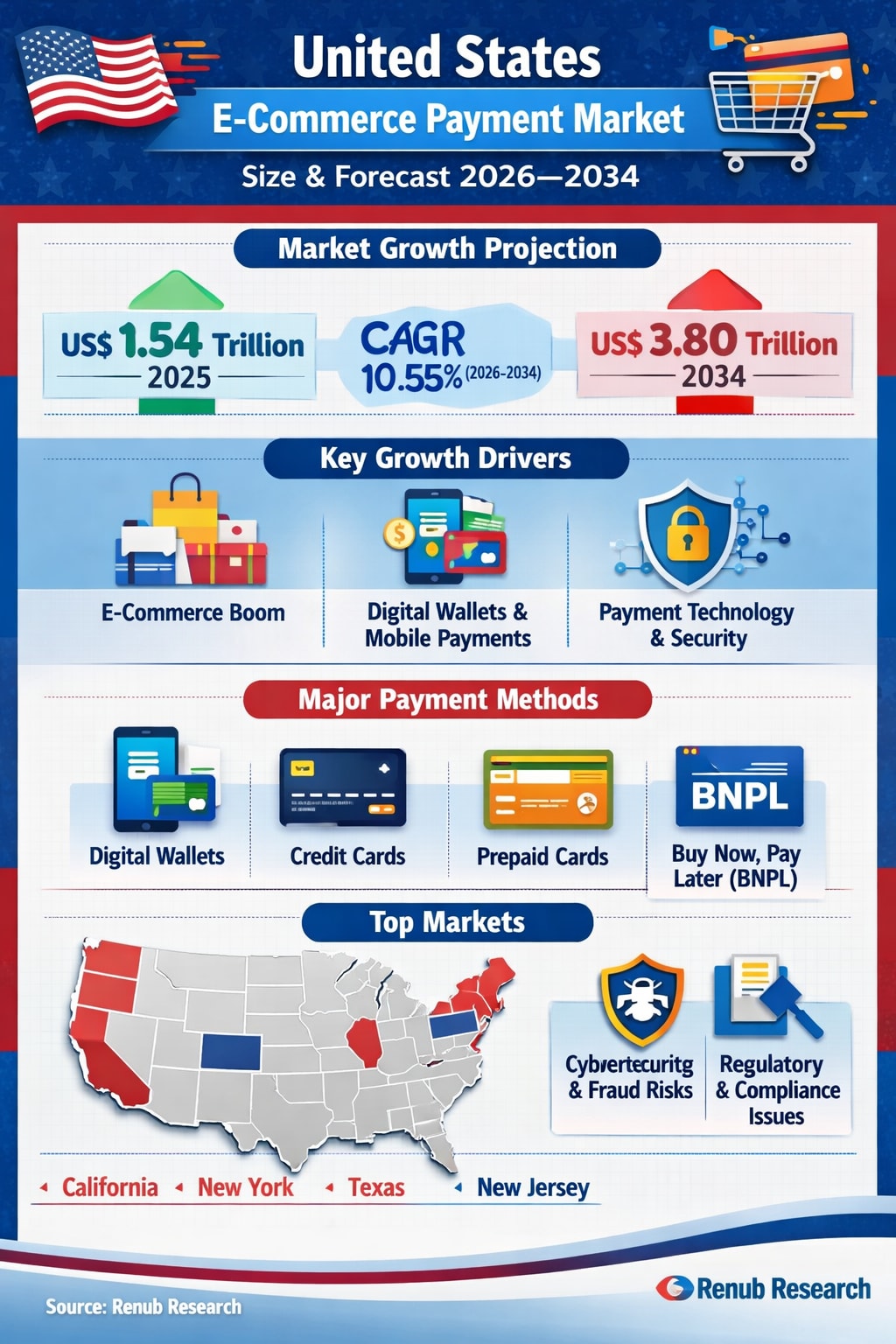
The United States e-commerce payment market is entering a powerful growth phase, driven by rapid digital adoption, changing consumer behavior, and continuous innovation in payment technologies. According to Renub Research, the U.S. online payment market is expected to expand from US$ 1.54 trillion in 2025 to US$ 3.80 trillion by 2034, registering a strong compound annual growth rate (CAGR) of 10.55% from 2026 to 2034.
This impressive expansion reflects the rising volume of online transactions, the accelerating adoption of digital wallets and mobile payments, and constant improvements in payment security and user experience. From everyday retail purchases to subscription services, travel bookings, and digital content, e-commerce payments have become the backbone of the modern U.S. digital economy.
E-commerce payments refer to the online methods and technologies used to process transactions when consumers purchase goods or services over the internet. These include credit and debit cards, digital wallets, bank transfers, buy-now-pay-later (BNPL) services, prepaid solutions, and emerging real-time payment systems. The core objective of these systems is to provide fast, secure, reliable, and frictionless transactions while protecting users from fraud through encryption, tokenization, and multi-factor authentication.
In the United States, a mature digital infrastructure, high smartphone penetration, and strong consumer trust in online platforms have created an ideal environment for e-commerce payment systems to flourish. As businesses increasingly compete on customer experience, the checkout process and payment flexibility have become key differentiators in winning and retaining customers.
United States E-Commerce Payment Market Overview
The U.S. e-commerce payment ecosystem is one of the most advanced in the world. Credit and debit cards remain the most widely used payment instruments, but digital wallets and mobile payment solutions have gained significant momentum due to their convenience, speed, and enhanced security features. Consumers today expect one-click checkouts, saved credentials, and seamless integration across websites, mobile apps, and social commerce platforms.
The growth of subscription models, on-demand services, and direct-to-consumer (D2C) brands has further increased the need for reliable and flexible payment systems. At the same time, merchants are investing heavily in fraud detection tools, data protection technologies, and compliance frameworks to ensure secure transactions and maintain customer trust.
Fintech innovation continues to reshape the market. From real-time payments and embedded finance to AI-driven fraud prevention and biometric authentication, the U.S. e-commerce payment market is evolving rapidly to meet the demands of both consumers and businesses.
Key Growth Drivers
Rapid Expansion of E-Commerce and Omnichannel Retail
One of the most powerful drivers of the U.S. e-commerce payment market is the continued growth of online shopping and omnichannel retail. Consumers now shop across multiple touchpoints—websites, mobile apps, social media platforms, and online marketplaces—and expect a consistent and smooth payment experience across all of them.
Same-day delivery, click-and-collect services, and mobile commerce have made speed and convenience essential. Payment solutions must now integrate seamlessly across channels, allowing customers to start a purchase on one device and complete it on another without friction. Direct-to-consumer brands, digital marketplaces, and subscription-based services are further fueling transaction volumes and increasing demand for flexible payment options.
As competition intensifies among e-commerce platforms, businesses are focusing more on reducing cart abandonment and improving checkout experiences, which directly boosts the adoption of advanced payment technologies.
Rising Adoption of Digital Wallets and Mobile Payments
Digital wallets have become one of the fastest-growing segments of the U.S. e-commerce payment market. Consumers prefer them for their speed, ease of use, and enhanced security features such as tokenization and biometric authentication. With credentials securely stored, users can complete purchases in seconds without repeatedly entering card details.
The rapid growth of mobile shopping and widespread smartphone usage have further accelerated wallet adoption. For merchants, offering digital wallets often leads to higher conversion rates, smoother checkout experiences, and stronger customer loyalty. Many wallets now integrate loyalty programs, rewards, and buy-now-pay-later options, making them even more attractive to users.
As convenience and security continue to dominate consumer priorities, digital wallets are expected to capture a growing share of online transactions in the coming years.
Innovation in Payment Technologies and Fraud Protection
Technological innovation is another major growth engine for the U.S. e-commerce payment market. Advances in artificial intelligence, machine learning, and real-time data analytics have significantly improved fraud detection and risk management. These tools help identify suspicious transactions instantly, reducing losses for merchants while maintaining a smooth experience for legitimate customers.
Security technologies such as tokenization, multi-factor authentication, and secure APIs have become standard across the industry. At the same time, payment providers are enhancing their capabilities in cross-border payments, subscriptions, and recurring billing.
The launch and expansion of real-time payment systems in the U.S. financial ecosystem have further strengthened the digital payment landscape, enabling faster settlements and improving cash flow for businesses.
Key Challenges
Rising Cybersecurity Risks and Payment Fraud
Despite technological progress, cybersecurity threats remain a major challenge for the e-commerce payment industry. Data breaches, account takeovers, and payment fraud continue to pose serious risks. Even a single high-profile incident can damage customer trust and lead to significant financial and reputational losses for businesses.
Smaller merchants, in particular, may struggle to invest in advanced security infrastructure, making them more vulnerable to cyber threats. As transaction volumes grow, the industry must continuously upgrade its defenses to stay ahead of increasingly sophisticated fraud techniques.
Complex Regulatory and Compliance Requirements
The U.S. e-commerce payment landscape is governed by a complex web of regulations related to data protection, anti-money laundering, consumer rights, and payment security. Compliance with these rules can be costly and time-consuming, especially for companies operating across multiple states or handling international transactions.
Regulatory requirements also evolve over time, forcing payment providers and merchants to constantly update their systems and processes. While these rules are essential for protecting consumers, they add operational complexity and cost to the industry.
Segment Insights
Digital Wallet Payment Market
Digital wallets are among the fastest-growing segments within the U.S. e-commerce payment industry. Their ability to offer quick, one-click checkouts, combined with strong security features, makes them highly attractive to both consumers and merchants. Integration with mobile apps and BNPL services further strengthens their appeal. As mobile commerce continues to expand, digital wallets are expected to play an increasingly central role in online payments.
Credit Card Payment Market
Credit cards remain the most popular online payment method in the United States due to their widespread acceptance, familiarity, and reward programs. They also offer strong consumer protections, including fraud monitoring and chargeback options. Despite the rise of alternative payment methods, credit cards continue to account for a significant share of e-commerce transactions, especially for higher-value purchases.
Prepaid Payment Market
Prepaid cards and prepaid solutions are gradually gaining traction in the U.S. e-commerce market. These options are particularly useful for consumers who want better control over spending, value privacy, or are underserved by traditional banking. Prepaid solutions are commonly used for gift cards, subscriptions, and youth-focused or unbanked segments, and their digital distribution is supporting steady growth.
Application-Based Market Trends
Electronics & Media
The electronics and media segment is one of the largest contributors to U.S. e-commerce payment growth. Consumers frequently purchase smartphones, laptops, gaming devices, subscriptions, and digital content online, requiring fast and secure payment solutions. Credit cards and digital wallets dominate this segment, while BNPL services are gaining popularity for high-value electronics. The continued growth of digital entertainment and gaming is expected to sustain strong payment demand.
Fashion Accessories
The online fashion accessories market in the U.S. is growing steadily, driven by strong demand for apparel, footwear, jewelry, and lifestyle products. Consumers in this segment prioritize convenience, speed, and flexible payment options. Digital wallets, mobile payments, and BNPL services are particularly popular among younger shoppers, while credit cards remain important for premium purchases. The rise of social commerce and influencer-driven sales is further boosting the need for seamless and secure payment solutions.
State-Level Market Highlights
California
California represents one of the largest and most technologically advanced e-commerce payment markets in the United States. Home to many leading tech and fintech companies, the state is at the forefront of payment innovation. Digital wallets, mobile payments, and BNPL services are widely adopted, while merchants активно invest in AI-driven fraud detection and risk management tools to handle high transaction volumes.
New York
New York plays a crucial role in the U.S. e-commerce payment ecosystem due to its strong financial sector, large consumer base, and vibrant retail and media industries. The state has a mature payments infrastructure with widespread use of credit cards, mobile payments, and bank-led solutions. Fashion, luxury goods, media, and subscription services contribute significantly to online transaction volumes, driving continuous demand for secure and efficient payment systems.
New Jersey
New Jersey’s e-commerce payment market has shown consistent growth, supported by high per-capita income, strong digital adoption, and proximity to major logistics and fulfillment hubs. Consumers активно use credit cards and mobile payments, while merchants focus on secure payment technologies such as tokenization to build trust and reduce fraud risks.
Texas
Texas is one of the fastest-growing e-commerce payment markets in the country, driven by population growth, rising internet penetration, and increasing online shopping activity. Digital wallets, mobile payments, and BNPL services are gaining popularity, especially in categories like fashion, electronics, and home décor. The growing number of small and medium-sized online businesses in the state is also boosting demand for scalable and cost-effective payment solutions.
Market Segmentation
By Type:
Digital Wallet, Credit Card, Debit Card, Account-to-Account (A2A), Buy Now Pay Later (BNPL), Cash on Delivery (CoD), PrePay, Others
By Application:
Electronics & Media, Food & Personal Care, Fashion Accessories, Furniture & Appliances, Others
By Top States:
California, Texas, New York, Florida, Illinois, Pennsylvania, Ohio, Georgia, New Jersey, Washington, North Carolina, Massachusetts, Virginia, Michigan, Maryland, Colorado, Tennessee, Indiana, Arizona, Minnesota, Wisconsin, Missouri, Connecticut, South Carolina, Oregon, Louisiana, Alabama, Kentucky, Rest of United States
Competitive Landscape
The U.S. e-commerce payment market is highly competitive, with major global and domestic players continuously investing in technology, security, and user experience. Companies are analyzed across five key viewpoints: overview, key person, recent developments, SWOT analysis, and revenue analysis.
Key Companies Covered:
Amazon.com Inc.
American Express Company
Apple Inc.
Fiserv Inc.
Mastercard Incorporated
PayPal Holdings Inc.
Visa Inc.
These players are shaping the future of digital payments through innovation in wallets, cards, real-time payments, fraud prevention, and embedded finance solutions.
Final Thoughts
The United States e-commerce payment market is on a strong growth trajectory, supported by expanding online commerce, rising digital wallet adoption, and continuous innovation in payment technologies. With the market expected to grow from US$ 1.54 trillion in 2025 to US$ 3.80 trillion by 2034, the sector will remain a critical pillar of the U.S. digital economy.
While challenges such as cybersecurity risks and regulatory complexity persist, ongoing investments in security, infrastructure, and user experience are strengthening the ecosystem. As consumers continue to demand faster, safer, and more convenient ways to pay online, the U.S. e-commerce payment market is set to play an even more central role in shaping the future of commerce.
About the Creator
Australia Consulting Services Market: Strategic Growth in an Era of Transformation
The Australia consulting services market reached a valuation of approximately USD 5.7 billion in 2025, reflecting a robust and expanding demand environment. Over the next decade, the market is forecast to nearly double to USD 10.2 billion by 2034, exhibiting a compound annual growth rate (CAGR) of 6.58 percent during 2026–2034.
By Rashi Sharma5 days ago in Trader




Comments
There are no comments for this story
Be the first to respond and start the conversation.