
How To Choose QSR Digital Menu Boards That Increase Throughput And Protect Margins
QSR Digital Menu Boards

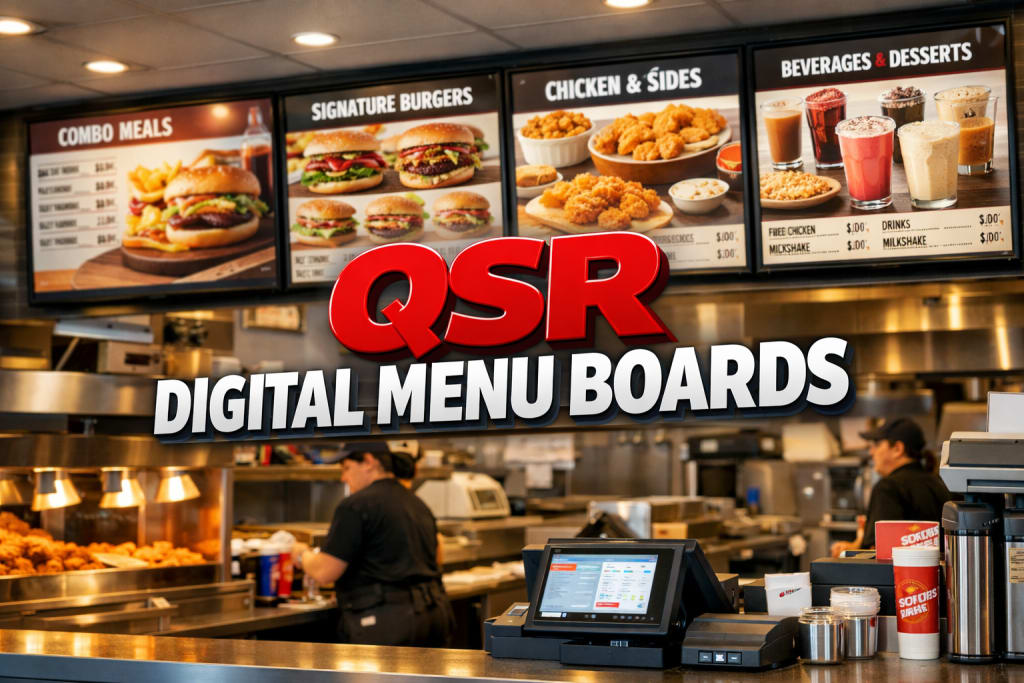
Quick-service restaurants operate on seconds.
Every delay at the counter compounds. Every pricing error affects margin. Every outdated promotion reduces revenue potential. In QSR environments, menu management is not a design decision, it is an operational system.
QSR Digital Menu Boards have become core infrastructure for fast food restaurants because they directly impact ordering speed, pricing control, and promotional agility. But not all systems deliver those benefits equally.
Choosing the right digital menu board system determines whether you gain efficiency or simply replace a printed board with a screen.
Why QSR Environments Demand More Than Basic Digital Displays
A digital board menu in a quick-service environment must do more than look modern. It must respond instantly to pricing updates, promotional shifts, and daypart transitions.
In fast food restaurants digital menu boards are responsible for:
- Breakfast-to-lunch transitions without staff intervention
- Real-time price adjustments
- Limited-time offers and combo swaps
- Regional pricing differences
- Multi-location synchronization
A digital menu board that cannot automate these changes introduces friction rather than removing it.
QSR operators should think of digital menu screens as operational control surfaces not advertising displays.
The Difference Between Screens And Systems
There is a difference between a digital menu board and a digital menu system.
A digital menu board for restaurant installations includes the physical display layer typically LCD or high-brightness screens mounted above counters or in drive-thru lanes.
A digital menu board system includes:
- Centralized software
- Remote scheduling
- Content management
- Multi-location synchronization
- Media player integration
Without the system layer, digital menus become static images on screens.
Restaurant digital menu boards that integrate with centralized digital menu software allow operators to update pricing across every location instantly. That is where real operational value appears.
Speed Is The Core Performance Metric
In QSR environments, speed equals revenue.
Digital menu boards for restaurants influence throughput by simplifying decision-making. Clear layout hierarchy, high-contrast pricing, and controlled animation reduce ordering hesitation.
When digital menus are cluttered, customers take longer to decide. When they are structured, ordering accelerates.
The purpose of a digital menu is not to entertain it is to shorten the path between attention and transaction.
Multi-Location Control Protects Margins
Fast food brands operating multiple locations require pricing accuracy across regions. A single outdated price on one digital board menu can create customer friction and operational inconsistency.
Digital menu for restaurants software ensures synchronized updates. A centralized digital menu system allows corporate teams to deploy promotions instantly, eliminating lag between locations.
Digital menus that support structured control prevent manual errors and protect profit margins at scale.
Daypart Automation Reduces Manual Work
One of the strongest advantages of QSR Digital Menu Boards is automated daypart management.
Breakfast items can disappear at exactly 10:30 a.m. Lunch combos can activate automatically. Seasonal promotions can be scheduled weeks in advance.
This removes reliance on staff remembering to switch boards manually.
In competitive QSR environments, automation is not optional it is expected.
International And Multilingual Considerations
In global markets, digital menu boards support language flexibility. Terms like digitale speisekarte reflect how digital menus are being adopted internationally across quick-service and fast-casual brands.
Electronic multilingual digital menus allow restaurants to rotate language displays based on region, improving accessibility without printing separate boards.
This flexibility becomes increasingly important in high-tourism areas.
Hardware Still Matters, But Only After Software
High-quality digital menu screens must provide consistent brightness, readability, and durability. Whether installed indoors or as part of drive-thru systems, display placement affects visibility.
However, hardware without strong digital menu board software is underutilized hardware.
The best QSR Digital Menu Boards combine:
- Reliable display hardware
- Stable centralized management
- Scalable multi-location control
- Remote content updates
Software determines long-term performance more than screen size.
Choosing The Right Platform For QSR Environments
When evaluating QSR Digital Menu Boards, operators should prioritize:
- Centralized remote control
- Stability during peak hours
- Scalable digital menu board system architecture
- Automated scheduling
- Multi-location synchronization
Platforms such as AIScreen are commonly used in QSR environments because they allow operators to manage digital menu systems across multiple restaurant locations while maintaining pricing accuracy and structured control.
In QSR, predictability is more valuable than novelty.
Key Takeaways
QSR Digital Menu Boards are not aesthetic upgrades. They are operational tools that directly influence throughput, pricing accuracy, and promotional agility.
Choosing the right digital menu board system means focusing on centralized software control, automation capabilities, and scalability across locations.
When implemented strategically, digital menus reduce friction, protect margins, and support faster service.
In modern quick-service environments, menus are no longer printed.
They are managed, scheduled, and synchronized in real time.
About the Creator
AIScreen
AIScreen is a reliable, easy-to-use cloud-based digital signage software for managing content across industries affordable, scalable, and trusted worldwide.
This Is What I Do When People Throw Rocks At Me
Rocks have been thrown at me for a greater part of my life. Some have been small and missed hitting me. When people don't get a reaction from me, they throw bigger rocks with a better aim. Many have been hurled at me with precision over the years. For a long time, I thought my only options were to dodge them or be crushed by them.
By Margaret Minnicks6 days ago in Confessions

Comments (1)
I liked how comprehensive this guide is — especially the focus on throughput and profitability, which are easy to overlook. QSR owners sometimes get dazzled by tech without thinking about long-term ROI, so this felt very grounded. Practical and useful for operators.