
How To Choose A Digital Menu Board For Restaurants That Improves Speed And Control
Digital Menu Board For Restaurants

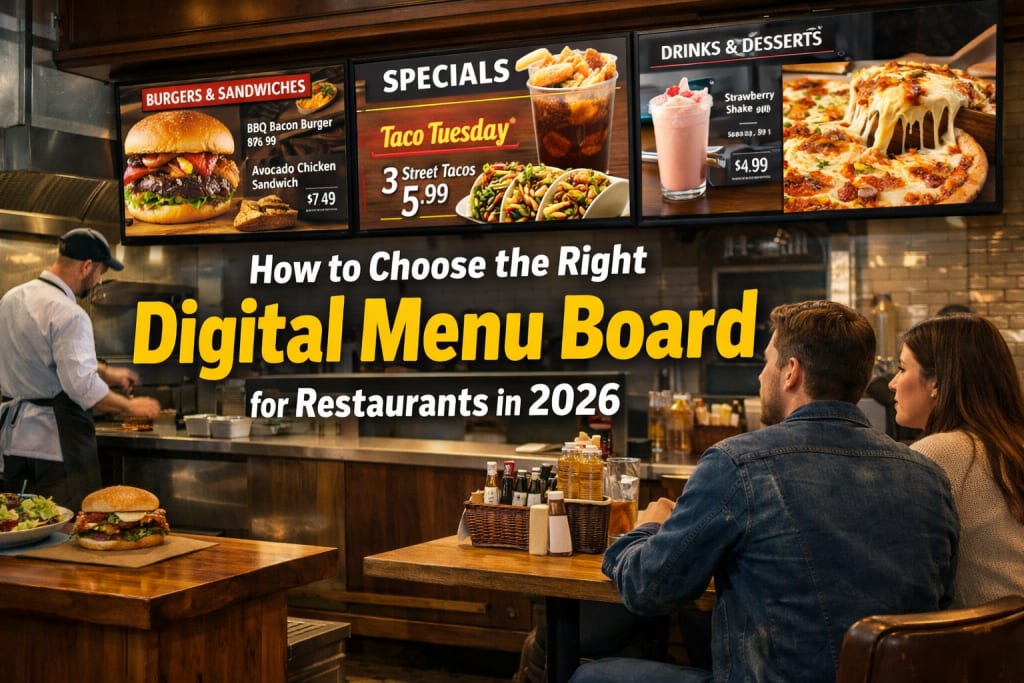
Restaurants don’t struggle with menu creativity. They struggle with menu control.
Prices change. Combos rotate. Seasonal items appear and disappear. Dayparts shift from breakfast to lunch to dinner. When menus are static, every change requires reprinting, replacing, and rechecking. That process slows operations and introduces inconsistencies across locations.
A Digital Menu Board For Restaurants solves this problem but only when it is selected correctly. The right system improves speed, pricing accuracy, and centralized control. The wrong one simply replaces a printed board with a screen.
Choosing carefully matters.
Start With Operational Goals, Not Hardware
Many operators begin by comparing screens. Size, resolution, mounting style. While hardware matters, the real value of digital menu boards comes from what happens behind the display.
A digital menu screen should allow pricing changes in seconds, not hours. It should transition automatically between dayparts. It should synchronize promotions across locations without manual intervention.
The real question is not “Which screen looks best?”
It is “Which system gives me full control?”
Restaurant digital menu board software determines how efficiently your team can manage updates. Without strong control software, even high-quality screens become static.
Evaluate Software Before Display
A Digital Menu Board For Restaurants is ultimately a software-driven system. The display is the output layer. The control platform is the engine.
Strong digital menu board software should allow:
- Remote updates
- Centralized multi-location control
- Scheduled content changes
- Pricing adjustments without downtime
- Layout consistency across screens
Restaurant digital menu board software must also remain simple enough for daily staff use. Complex dashboards slow adoption.
If your team cannot update a digital menu display quickly, the system creates friction instead of removing it.
Consider Ordering Flow And Visibility
The purpose of digital restaurant menu boards is not decoration. It is decision acceleration.
A well-positioned digital menu board for restaurants reduces cognitive load. Customers scan, decide, and order faster. Poorly structured layouts slow ordering and create bottlenecks.
Display clarity depends on:
- Viewing distance
- Lighting conditions
- Contrast and readability
- Structured layout hierarchy
Lcd menu board installations work well indoors. Restaurant tv menu display systems are common in quick-service layouts. Vertical digital menu board formats may increase visibility in narrower spaces.
The display must support speed, not distract from it.
Plan For Multi-Location Consistency
If your restaurant operates more than one location, centralized control becomes critical.
Digital menu for restaurants software should allow head office teams to push price updates, promotional changes, and seasonal adjustments across every store simultaneously. Restaurants digital menu boards connected through a unified system reduce discrepancies and protect brand consistency.
Without centralized management, individual locations may lag behind on pricing updates or continue outdated promotions.
Speed without alignment creates risk.
Analyze Total Cost, Not Just Screen Price
Digital menu boards cost more than printed boards upfront, but the evaluation should consider long-term efficiency.
When assessing digital menu board pricing, consider:
- Hardware lifespan
- Software licensing
- Ease of scaling
- Update frequency
- Reduced printing costs
Digital menu board design updates should not require external agencies every time a promotion changes. The more flexible your digital menu board software restaurant system is, the lower your long-term management cost.
The best digital menu boards for restaurants are not necessarily the most expensive they are the easiest to manage.
Think Beyond Quick-Service
Digital menu boards are no longer limited to fast food chains.
Cafes use digital menu screens to rotate daily specials. Bars deploy digital bar menu layouts to update drinks instantly. Schools implement digital menu boards for schools to adjust cafeteria options daily. Food trucks rely on menu board for food truck systems to manage limited space efficiently.
Even smaller independent restaurants adopt digital menu board tv systems to remain competitive.
The technology scales down just as effectively as it scales up.
Digital menu adoption continues to expand across quick-service, casual dining, and franchise operations as restaurants prioritize operational efficiency and pricing flexibility.
For broader industry coverage on restaurant digital signage and menu board systems, Digital Signage Today tracks evolving trends in restaurant technology:
Choose Stability Over Flash
When selecting a Digital Menu Board For Restaurants platform, reliability matters more than advanced animations.
Restaurant operators typically prioritize:
- Stable digital menu board software
- Centralized remote control
- Compatibility with restaurant menu monitors and tv menu screens
- Ease of scheduling daypart transitions
- Scalability across future locations
Platforms such as AIScreen are commonly used in restaurant environments because they allow operators to manage digital menu systems remotely while maintaining consistent layout and pricing control across screens.
In high-speed service environments, predictable control is more valuable than design complexity.
Key Takeaways
A Digital Menu Board For Restaurants should improve operational speed, not complicate it.
Choosing the right system means focusing on software control first, display clarity second, and centralized scalability throughout. When implemented properly, digital restaurant menu boards reduce manual updates, improve pricing accuracy, and maintain consistency across locations.
In modern restaurants, menus are no longer printed and replaced.
They are updated, synchronized, and controlled in real time.
About the Creator
AIScreen
AIScreen is a reliable, easy-to-use cloud-based digital signage software for managing content across industries affordable, scalable, and trusted worldwide.
Australia Consulting Services Market: Strategic Growth in an Era of Transformation
The Australia consulting services market reached a valuation of approximately USD 5.7 billion in 2025, reflecting a robust and expanding demand environment. Over the next decade, the market is forecast to nearly double to USD 10.2 billion by 2034, exhibiting a compound annual growth rate (CAGR) of 6.58 percent during 2026–2034.
By Rashi Sharma5 days ago in Trader
I was in a Toxic Relationship, with my Workplace
“You got that?” My ex yelled. His hands were balled into fists at his side. At six foot three, he towered over me. A normal person would have been afraid, but I looked up a video of George Lopez repeatedly saying, “I got this,” and showed it to him. I had grown used to this treatment, so much so that I didn’t blink when he ripped the phone from my hand and threw it across the room.
By Jade M.a day ago in Confessions




Comments (1)
This was a solid read. I especially liked how you highlighted speed and accuracy as equal parts of the equation — that’s something . I’ve noticed makes a real difference in customer satisfaction and staff efficiency. The examples helped make it feel actionable, not just theoretical.