
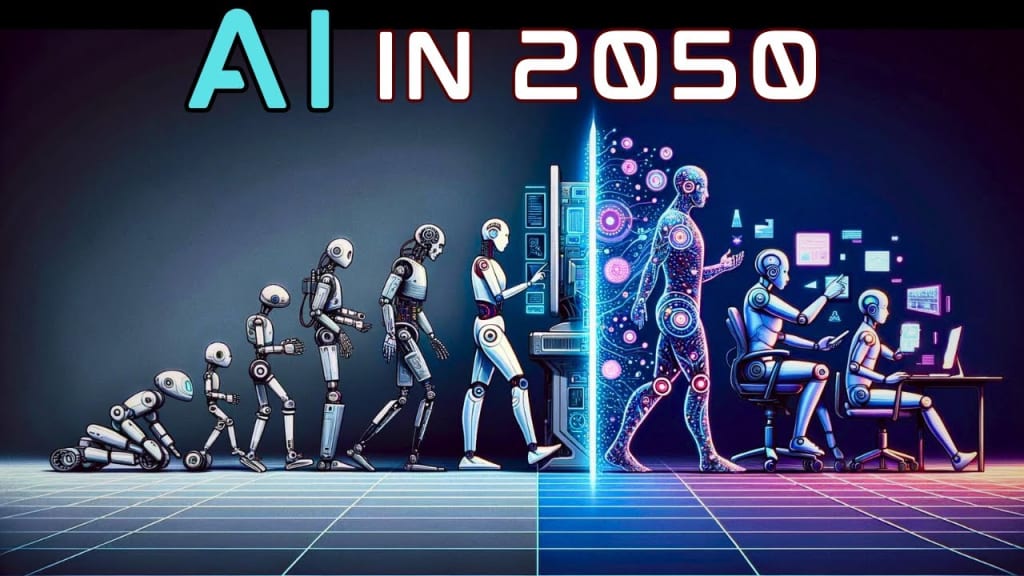
Will AI Rule the World by 2050?
Exploring the Promise, Peril, and Power of Artificial Intelligence in the Coming Era

Will AI Rule the World by 2050?
Exploring the Promise, Peril, and Power of Artificial Intelligence in the Coming Era
Introduction: A Future Controlled by Code?
As artificial intelligence (AI) continues to evolve at breakneck speed, a provocative question looms larger than ever: Will AI rule the world by 2050?
Some imagine a utopia where machines help humanity conquer disease, eliminate poverty, and bring global peace. Others warn of a dystopia—where intelligent systems dominate economies, manipulate politics, and potentially replace human decision-making altogether.
The truth may lie somewhere in between. To understand where we’re headed, we need to explore what it really means for AI to “rule,” where current technologies are leading us, and what humanity must do to ensure it remains master—not servant—to the machines it creates.
What Does “Ruling the World” Mean?
Before we dive into predictions, let’s define the phrase.
When people say AI might "rule the world," they typically mean one of three things:
Political Control: AI becomes a decision-maker in government, war, or law.
Economic Domination: AI-powered companies and systems control markets, labor, and wealth distribution.
Social and Cultural Influence: AI shapes public opinion, behavior, relationships, and even emotions.
In all three areas, AI is already gaining ground—and by 2050, its role will likely be undeniably central to global power.
Where We Are Now (2025)
Artificial intelligence is no longer theoretical. It is deeply embedded in:
Social media algorithms that decide what we see and believe.
Autonomous vehicles, delivery robots, and warehouse systems.
AI doctors and diagnostic tools, already outperforming humans in some areas.
Finance, where AI makes high-frequency trades and detects fraud in milliseconds.
Warfare, including AI-targeted drone strikes and cyberattacks.
Yet today’s AI is still narrow—good at specific tasks, not capable of generalized thinking. This is not Artificial General Intelligence (AGI), which would be able to perform any intellectual task a human can. But if AGI emerges by 2050, the landscape changes dramatically.
Predictions for 2050: AI's Expanding Role
1. Government and Military Power
AI could manage entire cities, from traffic and utilities to crime prevention and emergency response.
Governments may rely on AI to draft policy, forecast economic outcomes, or monitor populations.
In warfare, autonomous weapons and cyber defense systems may operate with minimal human oversight.
AI could potentially launch counterstrikes based on automated threat detection, raising fears of accidental wars.
Will AI be the ruler?
Not likely in a formal sense—but leaders may defer to AI’s superior speed, data analysis, and lack of bias in decision-making. The risk is that over-reliance leads to loss of human control.
2. Corporate Dominance Through AI
By 2050, companies that control AI may become more powerful than many governments.
Big Tech firms (like Google, Microsoft, Baidu, and OpenAI’s successors) may control vital infrastructure, health systems, and energy flows.
AI will manage labor automation on a massive scale—millions of jobs in transport, customer service, manufacturing, and even creative work will be displaced or transformed.
Wealth will accumulate where AI is strongest, potentially creating a new ruling class: not kings or presidents, but data barons and algorithm architects.
Who rules in this scenario?
Not AI itself—but those who own, train, and deploy it.
3. Social Control and Psychological Influence
AI’s most subtle yet powerful influence may be on our minds:
Deep learning models already generate fake videos (deepfakes), write news stories, and curate content to maximize engagement.
By 2050, AI may create hyper-personalized virtual environments, influencing how we think, vote, consume, and feel.
AI companions and emotional support bots could replace real human relationships for many.
Combined with brain-machine interfaces (like Elon Musk’s Neuralink), AI may directly interact with human thought.
The danger? Behavioral manipulation at scale, without people realizing it. Algorithms could “rule” by shaping desire, fear, belief, and identity.
The Rise (and Risk) of Artificial General Intelligence
The biggest wildcard in this future is AGI—true human-level AI.
Experts are divided:
Ray Kurzweil predicts AGI by 2029, and a human-machine "singularity" by 2045.
Others, like Yoshua Bengio or Geoffrey Hinton, warn that even current AI systems could become dangerous if given too much autonomy.
Once AGI is created, it could:
Rapidly self-improve beyond human understanding.
Control global systems with superhuman logic and speed.
Solve problems like climate change—or decide humans are the problem.
If AGI lacks empathy, ethics, or shared human goals, it could become an existential threat.
In that case, the question wouldn’t be will AI rule the world—it would be whether humans are even allowed to remain in it.
Safeguards or Surrender? What Needs to Happen
To avoid a future where AI rules us, the world must prioritize:
✅ Global Regulation
Like nuclear arms treaties, we need international AI control frameworks.
Transparent audits, ethical limits, and development caps are essential.
✅ AI Alignment Research
Ensuring AI systems understand and share human values.
Avoiding reward-hacking, misinterpretation, or “paperclip” disasters.
✅ Democratization of AI
Preventing monopolies.
Making AI tools open-source and accessible to all, not just billion-dollar companies or militaries.
✅ Human-in-the-Loop Systems
Always requiring a human check on critical AI decisions—especially in war, law, and health.
✅ Education and Awareness
Societies must be educated in AI ethics, digital literacy, and critical thinking.
A population that understands AI is harder to manipulate.
Conclusion: Will AI Rule the World by 2050?
No, AI won’t be a tyrant with a crown. But yes, by 2050 it could be the most powerful force on Earth—controlling how we live, work, think, and decide.
Whether that’s a miracle or a menace depends on what we do right now. If humans lead with wisdom, ethics, and foresight, AI can uplift civilization. But if we chase power and profit without restraint, we may build our own overlord—and hand it the keys to our future.
About the Creator
Ali Asad Ullah
Ali Asad Ullah creates clear, engaging content on technology, AI, gaming, and education. Passionate about simplifying complex ideas, he inspires readers through storytelling and strategic insights. Always learning and sharing knowledge.
Reader insights
Outstanding
Excellent work. Looking forward to reading more!
Top insights
Compelling and original writing
Creative use of language & vocab
Easy to read and follow
Well-structured & engaging content
Excellent storytelling
Original narrative & well developed characters
Expert insights and opinions
Arguments were carefully researched and presented
Eye opening
Niche topic & fresh perspectives
Heartfelt and relatable
The story invoked strong personal emotions
Masterful proofreading
Zero grammar & spelling mistakes
On-point and relevant
Writing reflected the title & theme
Keep reading
More stories from Ali Asad Ullah and writers in The Swamp and other communities.
California Governor Gavin Newsom Accuses TikTok of Suppressing Content Critical of Trump
Newsom Raises Concerns About TikTok California Governor Gavin Newsom has publicly accused TikTok, the popular video-sharing platform, of restricting or suppressing content critical of Donald Trump. According to Newsom, users posting videos highlighting Trump’s policies or actions may be experiencing reduced reach or visibility, while content favoring Trump allegedly receives preferential treatment. The claim comes amid increasing scrutiny of social media platforms and their role in shaping public opinion, particularly in the context of political content. TikTok’s Role in Political Discourse TikTok has grown into one of the most influential social media platforms worldwide, with millions of users sharing videos daily. While initially focused on entertainment, TikTok has become a hub for political discussion, activism, and news dissemination, particularly among younger audiences. Experts note that the platform’s algorithm-driven feed can significantly impact which content gains traction, leading to debates about bias, censorship, and transparency. Newsom’s allegations amplify concerns over whether social media companies unfairly influence public discourse. What Newsom Has Alleged Governor Newsom’s statements suggest that TikTok’s algorithm may be manipulating visibility of political content. Key points from his remarks include: Suppression of content critical of Trump, limiting reach and engagement Alleged preferential promotion of pro-Trump content Calls for greater transparency in how TikTok moderates and prioritizes content While Newsom did not provide direct evidence at the press conference, his claims have sparked discussions among politicians, media analysts, and social media users. TikTok’s Response In response to the accusations, TikTok has maintained that its content moderation policies are politically neutral. The company emphasized that: The platform uses automated algorithms to recommend content based on user engagement Decisions to remove or restrict content are made according to community guidelines, not political affiliation TikTok is committed to transparency and fairness in content moderation Despite these assurances, critics argue that algorithmic opacity makes it difficult to verify claims of bias, leaving the public reliant on anecdotal reports. Broader Context: Social Media and Political Bias Newsom’s accusation is part of a larger conversation about social media’s role in politics. Platforms like TikTok, Twitter (X), Facebook, and Instagram face ongoing criticism for: Allegedly suppressing dissenting voices Promoting content that aligns with advertiser or political interests Influencing voter opinions, civic engagement, and public debate Studies suggest that algorithmic feeds can reinforce confirmation bias, meaning users are more likely to see content that aligns with their preexisting beliefs. This raises questions about democracy, free speech, and information equity. Reactions from Politicians and the Public Newsom’s remarks have prompted mixed reactions: Supporters argue that social media companies need to be held accountable for potential political manipulation Critics claim that Newsom’s accusations are politically motivated, aimed at framing TikTok as biased against Democrats Social media users have taken to TikTok and Twitter to share their experiences with content visibility, fueling further debate This discussion highlights the complex relationship between government, social media, and public perception in today’s digital landscape. Legal and Regulatory Implications Newsom’s accusations may have legal and regulatory consequences. Potential actions include: Calls for investigations into algorithmic bias Pressure on social media companies to disclose moderation practices Consideration of state or federal regulations addressing transparency and political fairness Policymakers in the US and abroad are increasingly exploring ways to balance free expression with accountability on digital platforms. Implications for Communities and Young Users TikTok’s influence extends particularly to younger audiences, who rely on the platform for information, entertainment, and political engagement. Suppression of critical content could: Limit exposure to diverse viewpoints Shape perceptions of political figures among impressionable users Affect the democratic engagement of the next generation Community organizations and digital literacy advocates emphasize the need for education on media bias, content moderation, and critical thinking. The Debate Over Algorithmic Transparency At the heart of the controversy is the opacity of social media algorithms. Unlike traditional media, where editorial decisions are public, platforms like TikTok rely on complex machine learning systems. Critics argue that: Users have little understanding of why content is promoted or suppressed Algorithms can unintentionally amplify certain political perspectives Transparency is necessary for public accountability and trust Proponents of algorithmic transparency call for government oversight, independent audits, and public reporting, particularly for politically relevant content. Conclusion Governor Gavin Newsom’s claims that TikTok is suppressing content critical of Donald Trump highlight the intersections of politics, technology, and public discourse. While TikTok denies political bias, the incident raises important questions about algorithmic transparency, content moderation, and the role of social media in shaping political perception. As debates continue, communities, policymakers, and social media users alike must grapple with how to ensure fairness, accountability, and informed civic participation in an increasingly digital world.
By Aarif Lashari7 days ago in The Swamp
Trump News at a Glance: Top Democrats Give Trump Ultimatum to Fire Kristi Noem
House Democrats demand the dismissal of Homeland Security Secretary Kristi Noem or threaten impeachment, highlighting growing bipartisan scrutiny over federal immigration enforcement after deadly incidents in Minneapolis
By Salaar Jamali7 days ago in The Swamp
One Unchecked Box
"Republished" because it was the only way to add the embed for the newly recorded audio version of this story due to the Top Story badge. Plus it serves as a nice, informal announcement of the podcast's revival for another season (go subscribe!):
By Stephen A. Roddewig7 days ago in Fiction



Comments (1)
Thank you so much Ali for sharing this. Appreciate you.