
The Shock of the Obvious
Racism isn’t new in America and neither is the erasure that follows it

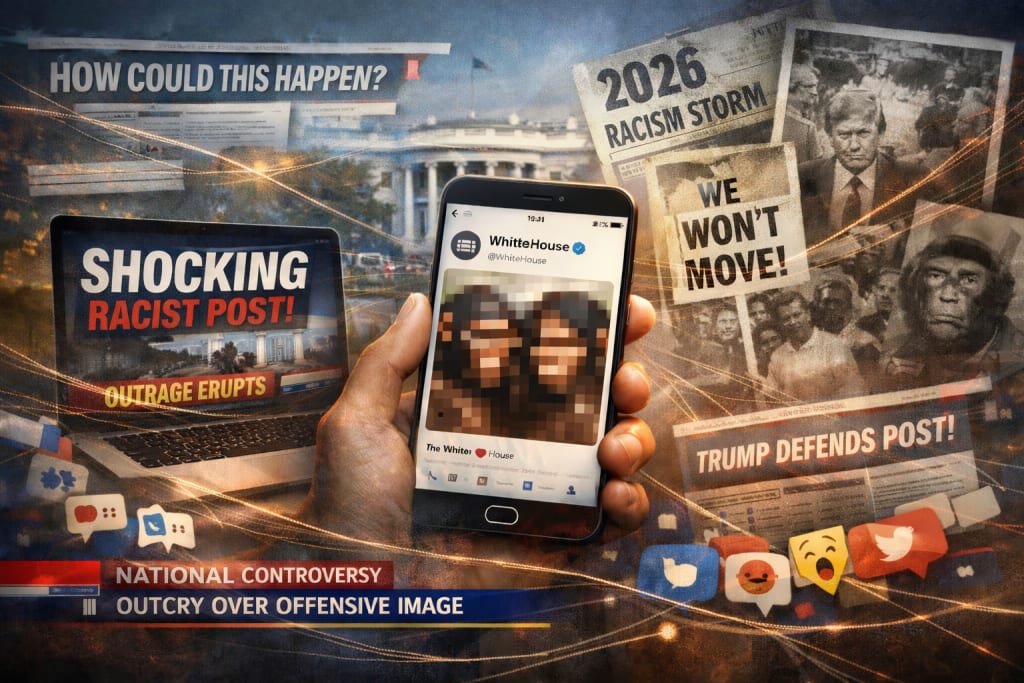
The internet and media erupted again as screenshots circulated of a post shared by The White House’s official account; an image depicting Barack and Michelle Obama as monkeys and one of the oldest and most vicious racist tropes in Western history. The reaction was swift outrage, disbelief, condemnation, and a wave of headlines asking how such a thing could happen in 2026. But for many people, especially those who have followed Trump’s public life for decades, the real surprise wasn’t the post itself. (https://abcnews.go.com/Politics/story?id=4918487&page=1)
The surprise was that anyone was surprised at all.
Because when you trace the arc of American history and Trump’s own public record; you begin to see a pattern. Not a sudden shift. Not a shocking aberration. But a continuous thread: dehumanization, displacement, denial, and eventually, forgetting. The same pattern that once erased entire communities of people of color from the map.
The illusion of “new” racism
Public reaction to the Obama post followed a familiar script where politicians condemned it, commentators expressed disbelief and supporters insisted it was being misinterpreted; but Trump’s racial controversies are not recent inventions.
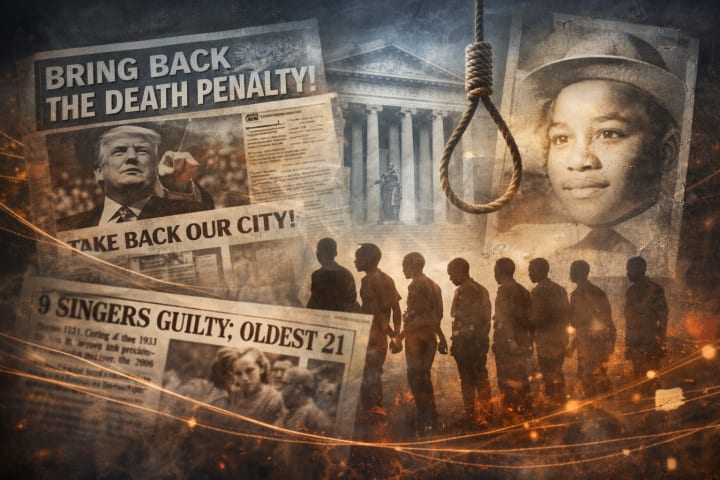
In 1989, during the Central Park jogger case, five Black and Latino teenagers were arrested and accused of a brutal assault. Before the trial had even begun, Trump spent about $85,000 on full-page newspaper ads calling for the reinstatement of the death penalty. Years later, DNA evidence proved another man committed the crime alone, and the convictions were vacated in 2002. https://www.theguardian.com/us-news/2016/feb/17/central-park-five-donald-trump-jogger-rape-case-new-york
Trump never apologized for the ads and later criticized the settlement the men received; as if false accusations didn’t get people of color killed over a lie…Emmett Till. Civil-rights lawyers involved in the case argued that his rhetoric helped poison public opinion before the trial even began; Scottsboro Boys where nine African American male teenagers were accused of raping a young white woman and a 17-year-old white girl in 1931; although exonerated for false accusations. https://www.aclutx.org/news/scottsboro-boys-exonerated-troubling-legacy-remains-black-men/
And this was not an isolated moment.
The housing discrimination case
Long before he was a political figure, Trump was already entangled in allegations of racial bias. In 1973, the U.S. Justice Department sued the Trump family’s real-estate company for discriminating against Black tenants. Both Donald and his father, Fred Trump, were named as defendants. https://www.politico.com/blogs/under-the-radar/2017/02/trump-fbi-files-discrimination-case-235067
Investigations found that Black applicants were turned away from certain properties, while white applicants were accepted. The case ended in a consent decree requiring the company to change its practices. This lawsuit marked one of Trump’s earliest public controversies and it was about ethnicity.
Erasing history in real time of Philadelphia, 2026
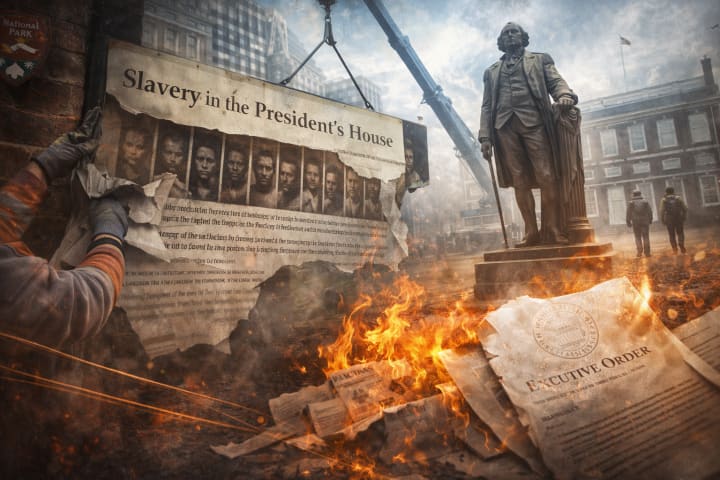
In early 2026, another controversy unfolded this time not about words, but about history itself. The city of Philadelphia filed a federal lawsuit after the National Park Service removed a slavery exhibit from the President’s House site in Independence National Historical Park. The exhibit had honored nine people enslaved by George Washington and explained the contradictions between American freedom and American slavery. https://www.cbsnews.com/amp/philadelphia/news/presidents-house-independence-mall-slavery-trump/
The removal followed an executive order aimed at reshaping how American history is presented in federal spaces. Critics said the move attempted to “whitewash” the nation’s past; which is not new to this country even starting with Christopher Columbus who was tried by the Queen for how the natives were described and treated. https://www.theguardian.com/world/2006/aug/07/books.spain and https://postalmuseum.si.edu/exhibition/celebrating-hispanic-heritage-exploration-christopher-columbus/columbus-imprisoned
City officials argued that dismantling the exhibit without notice undermined public understanding of slavery and violated agreements. The fight wasn’t just over a display. It was over memory.
What parts of history are preserved?
What parts are removed?
And who decides? Certainly not truth nor I.
This is not just about Trump. It would be easy and comforting to treat Trump as an anomaly, to believe that his rhetoric exists outside the broader American story. But the deeper truth is harder to face: the same logic behind racist caricatures is the logic that has shaped entire landscapes in the United States. The same logic that says some people are less worthy of dignity, land, or belonging; and if you look closely, you can see it in places we now consider ordinary or even beautiful.
Oscarville…the town beneath the water
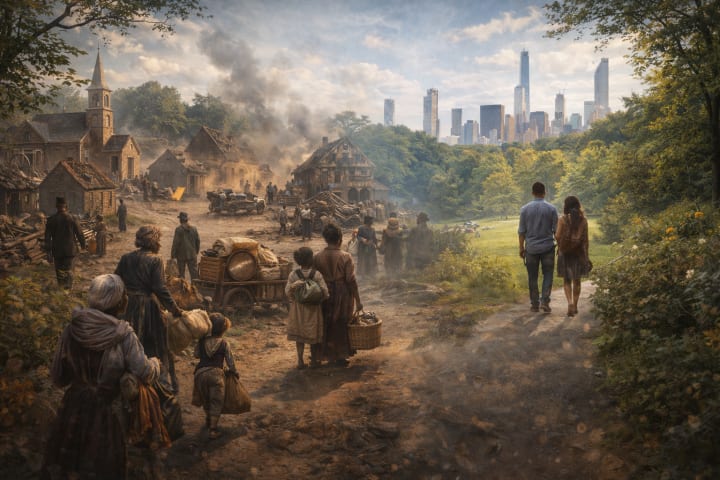
In Forsyth County, Georgia, a community called Oscarville once stood on the land that now lies beneath Lake Lanier. Oscarville formed after the Civil War as a Black farming community. Like many Reconstruction-era settlements, it represented something radical for its time: formerly enslaved people owning land, building churches, and establishing economic independence. https://digitalcommons.georgiasouthern.edu/cgi/viewcontent.cgi?article=1014&context=sspeach
But in 1912, a white woman was assaulted and killed. Several Black men were accused. One was lynched, others were executed after trials, and white mobs swept through the county. Homes were burned. Families were threatened. Within weeks, nearly all Black residents about a thousand people were driven out. For decades afterward, Forsyth County remained almost entirely white like most sundown towns (which still exist today).
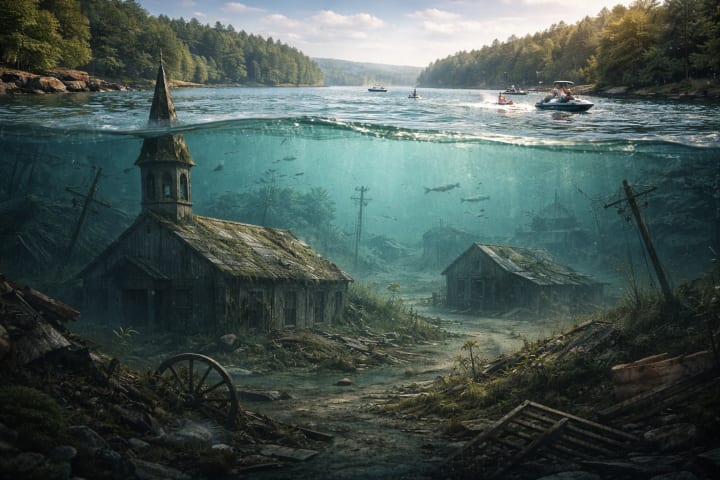
Years later, in the 1950s, the U.S. Army Corps of Engineers flooded the area to create Lake Lanier. The physical remains of Oscarville disappeared beneath the water. Today, the lake is a popular recreation site. Many people know it for boating accidents, ghost stories, and eerie rumors. Far fewer know about the community that once stood there or the violence that erased it.
Seneca Village…the town beneath Central Park
Long before Central Park became a symbol of New York City, another community existed on that land; it was called Seneca Village. Founded in 1825, it became one of the first significant communities of free Black property owners in Manhattan. By the mid-1850s, about 225 residents lived there roughly two-thirds Black and one-third Irish immigrants.
The village had 3 churches, a school, burial grounds, dozens of homes and high rates of Black land ownership. For many residents, it offered a rare escape from the overcrowded, discriminatory conditions of lower Manhattan; and then in the 1850s, the city decided to build Central Park. Through eminent domain, the government seized the land. Homes were demolished. The residents were forced to leave. The community was dispersed and largely forgotten for more than a century. Today, millions of people walk through Central Park every year without realizing that beneath the lawns and pathways once stood a thriving Black neighborhood.
The inventions that history forgot
Erasure did not only happen through violence or displacement. It also happened through silence. For generations, Black Americans contributed inventions that shaped everyday life you could easily not notice like Traffic Signals and Gas Masks (Garrett Morgan), Telephone Transmitters (Granville T. Woods), Blood Plasma Storage (Dr. Charles Drew), Street Sweeper (Charles Brooks), Urinalysis Machine (Dewey Sanderson), Door Stop and Door Knob (O. Dorsey), Postal Letter box (P. B. Downing), guitar (Robert Fleming Jr), golf tee (George F Grant), Eye Protection (P Johnson), Stair Climbing Wheelchair (Rufus J Weaver), Fire Escape Ladder (J. B. Winters), Air Conditioning Unit and Two Cycle Gas Engine and Internal Combustion Engine and Starter Generator and Refrigeration Controls (Fredrick M Jones), Toilet Commode (T. Elkins) and even components used in the space shuttle. Inventors like Garrett Morgan, Granville T. Woods, and Dr. Charles Drew helped build the modern world, even as segregation, discrimination, and patent barriers limited their ability to profit from their ideas.
https://library.ucsd.edu/dc/object/bb00695483/_1.pdf
https://www.housebeautiful.com/lifestyle/a35433071/famous-black-inventors/?utm_source=google&utm_medium=cpc&utm_campaign=mgu_ga_hbl_md_pmx_prog_org_us_281495960970879&gad_source=1&gad_campaignid=20977565922&gbraid=0AAAAACq-xMiCF3aNW8Gq3EJA-a8HnluDZ
https://guides.loc.gov/african-americans-in-business/businesses-industries/inventors-stem
https://www.tellcarole.com/caroles-blog/inventions-and-innovators-in-black-history
Historians have documented how systemic barriers including exclusion from patent systems, lack of capital, and discriminatory laws prevented many Black inventors from receiving recognition or financial benefit. Some innovations were attributed to white employers or business partners who had legal standing to patent them. The result was a quieter form of displacement. Not from land but from history itself. Communities were pushed out. Stories were removed and inventions were absorbed into the national narrative without the names of the people who created them.
Over time, a false myth emerged that Black Americans had contributed little to nothing to the nation’s progress; not because it was true but because so many contributions were buried.
Just like Oscarville.
Just like Seneca Village.
Just like the exhibit in Philadelphia.
The pattern of dehumanization, displacement, erasure
When these stories are placed side by side, a pattern becomes clear.
1. Dehumanization Black people portrayed as criminals, animals, or threats.
2. Displacement Communities driven out by mobs, by policy, or by development.
3. Intellectual erasure Inventions uncredited. Contributions ignored.
4. Historical erasure Exhibits removed. Communities forgotten.
5. Myth-making A haunted lake…A beautiful park…A patriotic monument.
The violence fades from memory.
The injustice becomes folklore.
The people disappear from the narrative.
And then, decades later, when racist imagery appears again, people ask “How could this happen?”
The real shock?
The Obama image.
The Central Park Five ads.
The housing discrimination lawsuit.
The removal of slavery exhibits.
The disappearance of Oscarville.
The destruction of Seneca Village.
The forgotten inventions.
These are not isolated moments.
They are chapters in the same story. The real shock is not that racism still surfaces in American politics. The real shock is how often the country pretends it’s seeing it for the first time because racism in America has rarely looked like a sudden explosion; more often, it looks like a slow, quiet process you get used to as a person of color…the kind of get used to that makes you lose faith and hope in humanity.
A family forced to leave.
A neighborhood demolished.
An exhibit taken down.
An invention uncredited.
A story forgotten.
Until all that remains is a park, a lake, or a monument and no memory of the people who once lived there.
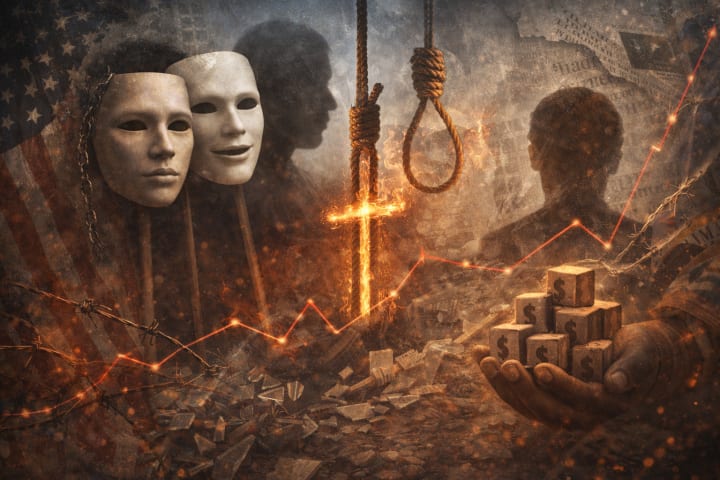
Some people now call the Obama image one of the most racist things they’ve ever seen. But for many, that isn’t true. What makes it feel shocking is not the image itself, but the fear that it reveals something people can no longer pretend isn’t there. Because racism has rarely depended on public slurs or cartoonish caricatures alone. You don’t have to post monkey photos of African Americans. You don’t have to mock accents, mock religions, or insist that clearly prejudiced policies were “taken out of context.” Not everything requires a burning cross or the modern-day equivalent of slave catchers.
If, deep down, you believe you are better than people of color simply because of the color of your skin, then denouncing these moments after the fact does not change the foundation underneath them. History shows that racism is not just one explosive act; it is a pattern, repeated quietly through microaggressions, systemic barriers, token gestures, and selective outrage. And when that pattern never truly disappears…only hides…then each new incident is not a shocking exception. It is just another thing you get used to.
About the Creator
Cadma
A sweetie pie with fire in her eyes
Instagram @CurlyCadma
TikTok @Cadmania
Www.YouTube.com/bittenappletv
Why Black History Matters in America?
The United States of America is celebrating their 250th anniversary in 2026. I'm proud to be an American and as someone who was born here, I wouldn't imagine myself living anywhere else. This is a country where opportunities are possible. Where anyone can be successful in anything they desire to do. Equality, community, and togetherness are the backbones of what America is and should be about. However, we have an administration who wants to erase and disregard those who have made positive, meaningful impacts in our country, specifically Black figures, such as Martin Luther King, Jr., Rosa Parks, and Maya Angelou. President Trump and his administration have been constantly complaining and fighting against what they call the "Woke agenda". They use this excuse as a distraction from other issues they refuse to address, such as the high cost of living, climate change, and inflation. That equality is dividing America, when in reality, it's bringing us together. Being woke is not tied to a specific political party. No matter where you stand on the political spectrum, you can still care about other people and their plights. Compassion and empathy for others isn't tied to a political party, either. We were taught as children to treat others the way we want to be treated and not judge others because they're different from us. Caring about others isn't a personal attack on your beliefs. It doesn't make you any less of a person. People who are easily offended over African American figures, past or present, or anything related to it, are grasping at straws. Current and future generations need to know who people like Harriet Tubman and Shirley Chisholm were, especially in the classroom. Black History is part of American History. It should be recognized, not hidden or forgotten. Besides, you can't shield children from everything, just because your feelings are easily hurt.
By Mark Wesley Pritchard 9 days ago in The Swamp
Buried for 33 Years: The Dream to Revive One of the Country’s Largest Gold Mines Is Back on the Map
For more than three decades, one of the country’s largest gold mines lay silent—its tunnels sealed, machinery rusting, and ambitions buried beneath layers of dust and political indecision. Once a symbol of industrial promise and national wealth, the mine was shut down 33 years ago amid falling gold prices, operational challenges, and unresolved ownership issues. Today, that long-dormant dream is back on the map. Driven by soaring global demand for gold, advances in mining technology, and renewed investor confidence, plans to revive the historic mine are gathering momentum.
By Sadaqat Alia day ago in The Swamp



Comments (2)
This was a really good article I knew some of these events but it’s just terrible about how much is forgotten or just not talked about the more I’ve been learning though your articles the more I’m realizing that racism never ends it just changes narrative and it’s sad that it’s like that. I wish for a world where things like this history of events like this would be used to hold those responsible accountable for their actions we shouldn’t have a leader who doesn’t look out for everyone’s interests and we shouldn’t have a leader who’s a racist bigot but it is what it is I guess. But for the story I really enjoyed how you covered everything and the how detailed it was with the sourced information was really handy for me to read up on those articles. I really enjoyed your work as always keep up the amazing writings 😊
Gosh, this is all so terrible! Sooo many people of colour were wrongly accused! And I can't believe that Trump supporters are saying that the Obama image was misinterpreted! How absurd!