history
Past politicians, legislation and political movements have changed the course of history in ways both big and small. Welcome to our blast to the past.
Globalization on Africa
Today I will be speaking on the topic of to what extent do the legacies of historical globalization affect the people of Africa. What does this mean? To what extent has the choices of Imperial powers and past African leaders affected the continent today. In many African countries, when imperial forces left, there was a massive power imbalance, poverty, and war. Before the scramble for Africa, people in Africa were doing fine. Were there still wars, yes, but it wouldn't be as gruesome as the ones we have today. When imperial powers conquered these countries, new technologies were introduced, groups would be granted special privileges due to their looks and their ideals. In my country, Sudan, before the imperial powers invaded, we saw a lot of Muslims due to the many Arab invasions, but when the British came, they tried to convert them to Christianity. That is a legacy by itself, and this is why we see such a mix of culture in Sudan and many other African countries. Languages were changed, perceptions were altered, government systems changed, and resources depleted. These are all consequences of historical globalization.
By Chris Adams6 years ago in The Swamp
Economic View
Kanes idea of an economy is more to the left as he wanted more government intervention while Hanyek wanted an economy where the economy would take care of it self. When globalization came about these two had began to advance their ideas and take it to a new level. How these new factors like travelling and new ways to trade. Hanyes thought that his new impact would damage their society as their society was fragile. WWII destroyed 20 mil lives, it laid a whole continent to waste. Hanyek was a participant in the first world war, he strived to make the world a better place, a capitalistic economy.In 1917, there was a russian revolution people were divided and people wanted to smash capitalism. Car; Marks idea was to make the working class rise up and this would make equalization which is the basic idea of communism. They tried to make Trade, commerce and private property criminal acts and they promised to end the economic exploitation of man. Kanes was the rival of Hanyek ideology wise. He spent the first world war advising the government. Kane thought that the money that the british were demanding from Germany was disgusting, so he resigned. The idea of socialism is the mixed between both governments. Fairness and equality in a society so that the poor don't have to stay poor and they can become rich. Libertarians believe in people's personal choice. They dont care its your choice, basically extreme freedom. In Moscow 1922, the state controlled the economy everyone was equal. Small business where allowed but anything big was controlled by the soviet government. In Vienna 1923, germany and austria were forced to pay more money for peace. This caused inflation. Hanyek even received 208 pay raises. Pay inflation would lead to people not having enough money and items would become a lot of money due to hyperinflation. Hitler later comes along and promises to make things better and hopefully put an end to Germany paying money. America cities would be spending a lot of money they would buy new cars and most importantly stocks. Stocks would bubble and later the bubble would burst and a lot of people would lose a lot of money and this would later hurt economies in a very big way. This would later lead to the great depression as prices would become a lot and people would become poor and a lot of people who were spending a lot of money would spiral downward. This along with banks and stores. People waiting to withdraw all of their money and this would hurt banks would later close down because of the mass disappearance of money. Pure ideologies would fail no matter what way they were taken. A government can’t be a pure capitalistic if so it would hurt the country and later fail. In washington 1933, Rosevelt would later help america get out of the great depression. It became a soliclism type of government because the government would intervene and help the people. New industries would be made and refined. Governments would help and intervene and make the aviation industry safer for people and would make it more stable. Kaynes made a book or a report on how to fix the great depression. He wanted governments to have a fund of money to prepare for the future. MORE GOVERNMENT INTERVENTION. In world war II, pearl harbor was bombed. The depression was finally gone as the people had to prepare for the war and make new items like uniforms and weapons. Hanyek thought that kanes was taking society in a big step backwards. He wrote the road to serfdom and how kanes economy can make people come back to old ages were people would be “enslaved” and the government would be the new “monarch” in that economy. In New Hampshire 1944, delegates come from all over the world to talk about post world events the later made the world bank and other Global institutions. The goal was to make the economy stable and prevent another depression and they did a great job as they are not as many depressions as there would be more if this didn’t happen. V-E Day in 1945, the war was finally over and the troops came back.
By Chris Adams6 years ago in The Swamp
Secret Societies: Who Were The Assassins?
The Assassins were a group so feared, and whose reach was so far, that their very name became synonymous with murder for political means. While most of their history was lost with the fall of their strongholds, we do know some things about this organization, its founder, and the actions of its followers. And while they didn't invent parkour (at least not officially), they were certainly the auteur geniuses who came up with using the constant threat of knives in the dark as a way to keep a populace in line.
By Neal Litherland6 years ago in The Swamp
Viola Desmond: The Story of "Canada's Rosa Parks" and How I Had No Idea Who She Was Until 2018
There are certain key historical moments one can point to when discussing the injustices countless faced during the fight for Civil Rights in the early 20th Century. The Tulsa race massacre, Emmett Till's grotesque murder, the Selma to Montgomery marches and Dr. King assassination are a few examples of these pivotal events.
By Ghezal Amiri6 years ago in The Swamp
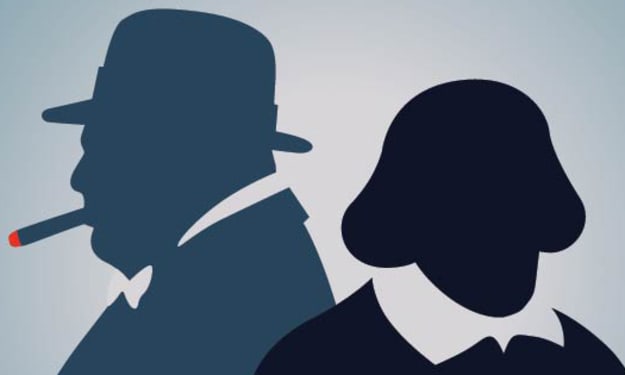
Uneasy Lies the Head that Wears the Homburg Hat
People say that the works of William Shakespeare are analyses and reflections of our human condition; whether of the story is about doomed love, political ambition turned to bloodshed, or situational humor which turned the simplistic things of life into the funniest of material. Yet, very rarely can people see such reflections of life in Shakespeare, which can also be made in real history. After all, Shakespeare himself was not a historian. He was a starving playwright who wrote propaganda pieces to entertain and (partially) educate the plebeians and royals of Elizabethan England. However, such characters such as Richard III, Marc Antony, and Prince Hal (King Henry V) can be reflected in terms of their styles of personality and leader ship in numerous figures throughout our history, whether if such people brandished a sword and crown or a cigar and glass of whiskey. The purpose of this essay is to examine how the leadership theory of how leaders are made, not born, can be seen in the works of British literature (The Henriad: Henry IV Part 1, Henry IV Part 2, & Henry V) and can also transcend into real figures of England’s history (Sir. Winston Churchill).
By Jacob Herr6 years ago in The Swamp
Memories (Public & Private) of America’s Infancy
To say that the American Revolution was a radical experiment to implicate democracy to the agitated populations of Britain’s colonies, is certainly a sensible statement. Yet, it cannot be shared by the private memories of those who participated in it. In Alfred Young’s book The Shoemaker and the Tea Party, the story of the Bostonian cobbler and patriot partisan, George Hewes, is one of how the ideals of what one may call the American Hypocrisy Story (land of the free, home of the brave, all are created equal, justice is blind, your vote counts, business is honest, the good guys win, law enforcement is on your side, your standard of living will never decline, etc.) emerged from this treasonous, ironic, and metaphorical middle finger to the world’s strongest superpower at the time. Alfred Young’s words apply to the memory of the Boston Tea Party and the experiences of George Hewes, in a manner which allows the reader to create their own understanding and conclusions about how the events leading up to and defining the American Revolution, ought to be remembered by current and future generations.
By Jacob Herr6 years ago in The Swamp
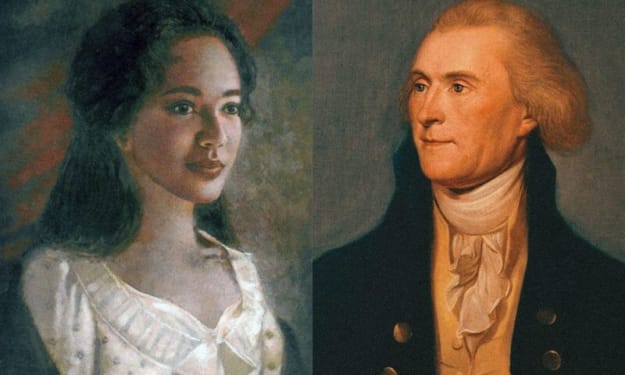
Thomas Jefferson Did More To Promote Domestic Slavery And Slave Breeding Than Any Other President And Got Rich Doing It
While the current trade war between Donald Trump and China keeps making the news. There’s another trade war guided by Thomas Jefferson we never heard about. That one led to protectionist pricing and massive exportation of what became Virginia’s greatest export, not tobacco but slaves.
By William Spivey6 years ago in The Swamp
Slave Deaths History Doesn't Talk About
There is a story told about Ella Sheppard, the matriarch of the Fisk University Jubilee Singers, where her mother, distraught that her owner wouldn’t allow Ella to be sold to her father; was ready to drown 3-year-old Ella that she might know freedom of another kind. In some stories, it was “Mammy Vinny” who cried out and stopped Sarah from killing her child; in another version, “Aunt Cherry” intervened, saying; “God’s got great work for this baby to do. She’s going to stand before Kings and Queens.”
By William Spivey6 years ago in The Swamp
America's Breeding Farms: What History Books Never Told You
In 1808, America banned the import of slaves from Africa and the West Indies. The impact on actual slavery in America was almost non-existent. There was still some limited smuggling of slaves but the majority of new slaves in America came from what Professor Eric Foner called, “natural increase.” One could reasonably ask, “Why ban slave imports and not slavery itself?” The answer is because, for many of the proponents of the prohibition including Thomas Jefferson, the reason was not based on humanitarian concerns but on economics. The South was producing and selling enough slaves internally that the slave trade was reducing prices for slaves and cutting into profits.
By William Spivey6 years ago in The Swamp
Wars that started for idiotic reasons
"War, war never changes", a quote from the famous video game series Fallout. While the tactics, technologies and mentality of war has changed over centuries, the idea of it never changes. Ever since man has roamed the Earth, conflict with our own species isn't a far fetched idea. From kingdoms, countries, empires, and tribes have gone to war with one of another due to ideology, religion, resources, and/or hatred for one of another. No war is worth it unless it threatens the citizen of their countries like WWII. However, there are wars that is a exaggerated response to an event that really motivated a country to get to that point. Heck not even because its their own species but animals as well. These are some the wars I know that fit in that category.
By Joshua Herrera6 years ago in The Swamp
King Henry III and Simon De Montfort: The accidental forefathers of Parliament in English Legal Systems
Imagine this: Your name is King Henry III. The year is 1216 and, at the age of nine years old, you have just been coronated as King of England. You are the fourth successive king directly from the House of Plantagenet which would one day become the greatest, and bloodiest, dynasty to ever rule England.
By Josh Firmin6 years ago in The Swamp
How Apartheid Almost Didn’t Happen
Someone once said that hindsight is a privilege. Nowhere is this more poignant than when looking into the past, and reflecting on the historical events that have shaped the world we live in today. From our present position we get to analyse and judge these events while at the same time theorizing on alternative worlds in the wake of even the slightest change in circumstances. The ‘what ifs’ abound with varying implications, but it can be safely said that in many instances, even the slightest change in events at any point in time, could have put us all on a different course to the one we currently navigate.
By Darren Ryan6 years ago in The Swamp