
British Jets in the Air in Defensive Action Over Middle East
RAF fighter jets are flying defensive missions over the Middle East as Britain reinforces regional security amid heightened tensions following U.S.–Israeli strikes on Iran.

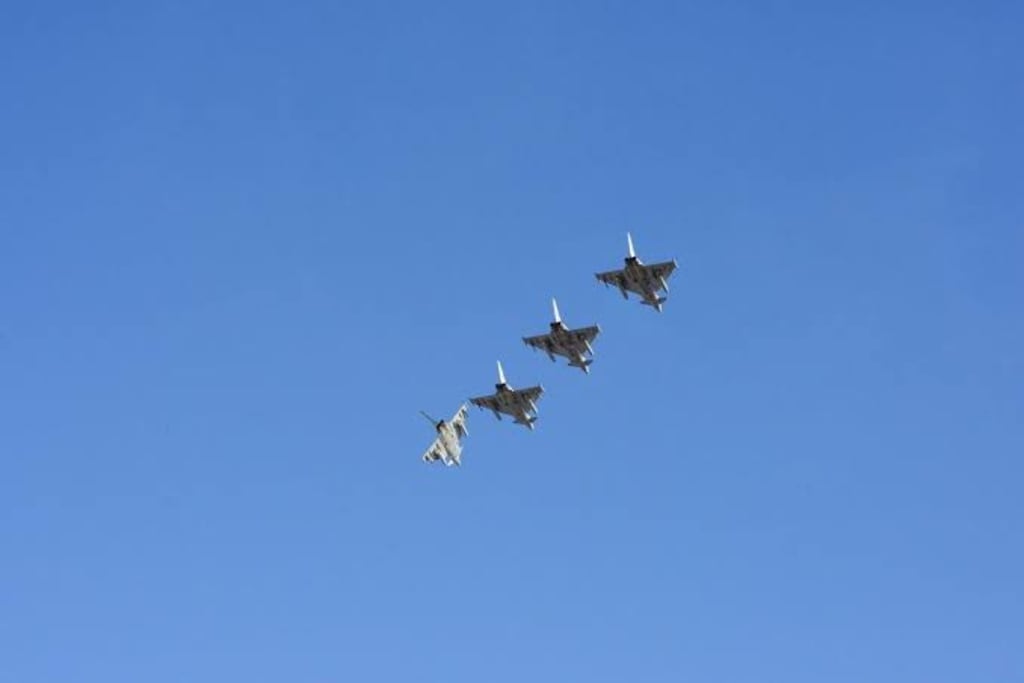
British fighter jets are actively flying defensive missions over the Middle East as part of regional security operations in response to escalating hostilities following recent military strikes on Iran by the United States and Israel, British officials have confirmed. The deployment marks a significant moment in London’s military posture in the region, underscoring both the strategic importance of allied defence cooperation and the intensifying security environment.
Prime Minister Keir Starmer announced on Feb. 28 that British military aircraft are “in the sky today” over the Middle East as part of “coordinated regional defensive operations” intended to protect British personnel, strategic interests, and allied partners. Starmer stressed that while the United Kingdom had not participated in the initial U.S.–Israeli strikes against Iranian targets, it was committed to safeguarding forces and installations in an increasingly volatile theatre.
What London Calls Defensive Operations
According to Starmer’s statement, British jets — understood to include Royal Air Force Typhoon and possibly F-35 aircraft — are engaged in patrols designed to deter and, if necessary, intercept hostile activity in the region. The operations follow a surge in tensions that began when U.S. and Israeli forces launched strikes inside Iran, reportedly targeting nuclear and missile infrastructure. Iran responded with widespread missile and drone attacks against U.S. and allied bases, prompting concerns about escalation.
Defence Secretary John Healey reiterated that the RAF jets are conducting defensive actions to protect British personnel and assets. “Force protection for British bases and personnel is at the highest levels,” he said, underscoring the precautionary posture being adopted across the region.
London has also elevated security measures at its bases in the Gulf and eastern Mediterranean, including enhanced anti-aircraft defences and alert levels for troops. Starmer’s government has further urged British nationals in Gulf Cooperation Council states — such as Bahrain, Qatar, and the United Arab Emirates — to shelter in place should further escalation occur.
Avoiding Direct Combat Involvement
Both Starmer and his defence chiefs have been careful to emphasise that British armed forces are not participating in offensive action against Iran, and have no role in the U.S.–Israeli strikes that triggered the latest round of hostilities. Instead, the RAF’s involvement is characterised as a defensive response to protect UK interests and allies from potential Iranian retaliation. This distinction seeks to keep Britain out of a direct combat role while acknowledging its commitments to NATO and regional securit
“Our forces are active and British planes are in the sky today as part of coordinated regional defensive operations to protect our people, our interests and our allies — as Britain has done before, in line with international law,” Starmer said in a televised address. He added that Iran “must refrain from further strikes” and urged a return to diplomatic negotiations to de-escalate the conflict
Diplomatic and Regional Concerns
The British government’s approach comes amid intense diplomatic pressure to prevent a wider regional conflict. Leaders in London, Paris, and Berlin have jointly called for restraint and emphasised the importance of pursuing diplomatic avenues to resolve the crisis. European officials have signalled alarm about the potential for spillover violence that could threaten global energy supplies, disrupt trade routes, and destabilise neighbouring states.
Starmer’s administration has underscored that Britain’s priority is the safety of its forces and citizens, and that UK involvement will remain defensive unless broader alliance commitments dictate otherwise. He also reiterated the long-standing British position that Iran should not be allowed to develop nuclear weapons, framing that as a key element both of the current response and of broader Middle East strategy.
Public and Parliamentary Reaction
The deployment has sparked debate domestically in the UK. Some lawmakers and commentators argue that Britain must avoid becoming entangled in a larger conflict, while others support the government’s decision to protect personnel and demonstrate solidarity with regional allies. Opposition voices have also highlighted the need for a clear legal framework for involvement in overseas military activity, especially in what may not yet be a formal state of war.
Looking Ahead
With British jets actively patrolling Middle East skies, the situation remains fluid. Military planners in London are monitoring developments closely, including potential expansions of defensive missions or adjustments to force postures should Iranian retaliation intensify. For now, the British government’s messaging prioritises deterrence and protection over offensive engagement, even as concerns about wider conflict persist.
About the Creator
Fiaz Ahmed
I am Fiaz Ahmed. I am a passionate writer. I love covering trending topics and breaking news. With a sharp eye for what’s happening around the world, and crafts timely and engaging stories that keep readers informed and updated.
Keep reading
More stories from Fiaz Ahmed and writers in The Swamp and other communities.
Sirens Expected Across Central Israel Amid New Iranian Missile Attack
Central Israel braced for potential air-raid sirens and heightened alert after Tehran launched a fresh missile attack targeting Israeli territory, in what Israeli officials called a “significant escalation” in a conflict that has drawn the two adversaries into direct confrontation. The incident underscores the increasing risk of a wider regional war and has prompted intensified military readiness, emergency preparations, and diplomatic alarm from capitals around the world. The reported missile barrage late Tuesday was confirmed by both Israeli and Iranian sources, with the Iranian government claiming the strikes were retaliation for recent attacks on Iranian territory and “acts of aggression” attributed to Israel. According to state media in Iran, multiple ballistic missiles and long-range cruise systems were fired toward targets inside central Israel, including near urban population centres. Israeli defence officials, while remaining cautious about public disclosures, acknowledged that air-defence systems had detected incoming threats and that civil defence sirens could be expected across central districts, including in and around Tel Aviv and Jerusalem. The Israeli military stressed that interception efforts were underway and urged civilians to follow protective instructions from authorities. Details of the Attack Iranian state television released video footage purportedly showing ballistic missiles being launched from bases in central Iran, accompanied by statements from Iranian military officials claiming the operation was precise and intended to strike military infrastructure. Tehran asserted that its forces had successfully launched multiple projectiles that crossed neighbouring airspace and entered Israeli defensive zones. Israeli air-defence batteries, including the Iron Dome and longer-range anti-missile systems, were reported to have engaged the incoming missiles to protect population centres and critical infrastructure. Early reports suggested that several intercepts had occurred, though assessments of resulting damage were still being compiled as of early Wednesday. Casualty and Damage Assessments At the time of the report, Israeli authorities had not confirmed civilian casualties but described some structural impacts in outlying areas near military installations. Hospitals in central districts were placed on emergency standby, and authorities mobilised additional medical and civil-defence personnel to prepare for potential civilian injuries. Local news outlets broadcast footage of residents taking shelter in protected areas, while official civil-defence channels advised families to remain indoors, stay near reinforced areas, and avoid unnecessary travel until the alert was lifted. Escalatory Context The missile exchange comes amid months of intensifying hostilities between Iran and Israel. The two countries, which have long engaged indirectly through proxies and covert operations, have escalated to overt strikes in recent weeks. Israel has targeted Iranian missile and nuclear facilities, claiming that Tehran’s efforts to expand its nuclear programme and long-range strike capabilities pose an existential threat. Iran, in turn, has justified its actions as defensive, framing them as retaliation for apparent aggression by Israeli forces. The attacks mark a significant shift from earlier phases of tension, which were primarily conducted through proxy forces in Syria, Lebanon (via **Hezbollah), and Palestinian territories. Analysts say direct missile exchanges between Tehran and Jerusalem increase the risk of miscalculation and could draw in other regional actors. Military and Civil Responses In Israel, the military — known as the Israel Defense Forces — placed key units on heightened alert and prepared fighter squadrons, air defence batteries, and reserve forces. Defence Minister Yoav Gallant emphasised that Israel would defend its citizens and sovereignty “with full force and resolve,” vowing that any attacks on Israeli civilians or territory would be met with decisive response. Prime Minister Benjamin Netanyahu addressed the nation, urging calm and unity. “Our enemies seek to sow fear, but we will protect our people and our land,” he said in a televised statement. “We call on all residents to remain vigilant and heed instructions from civil-defence authorities.” Global Diplomatic Reactions International reaction to the escalation was swift. Western capitals, including the United States Department of State, called for restraint, urging both sides to step back from further military confrontation. The United Nations Security Council convened an emergency session to address the crisis, with diplomats warning that unchecked escalation could destabilise the Middle East and disrupt global economic and security interests. European leaders expressed concern about the safety of civilians and called for an immediate de-escalation. Several countries emphasised support for Israel’s right to self-defence while also criticising the use of long-range missile strikes against population centres. Economic and Regional Impacts Markets reacted to the news of the missile strikes, with energy prices rising amid fears of wider disruption in the region, which contains some of the world’s most critical oil-export infrastructure. Shipping corridors, including access to the Strait of Hormuz, were closely monitored amid concerns about disruptions. Regional neighbours, including Jordan, Egypt, and Gulf Cooperation Council members, heightened their own security postures and appealed for de-escalation. Looking Ahead With sirens and alerts expected across central Israel, the immediate focus remains on civilian protection and intercepting any further missile threats. The broader geopolitical implications — from defence postures to diplomatic negotiations — continue to evolve rapidly. As both Tehran and Jerusalem stand firm, analysts warn that without diplomatic intervention, the exchange of strikes risks drawing the region into a broader conflict that could have far-reaching consequences for security and economic stability across the Middle East and beyond.
By Fiaz Ahmed 4 days ago in The Swamp
A Gathering of Evil Bosses
“I’m the queen of chin jutting while I smooth my hair, attacking, insulting, and deflecting to protect my appointer.” “Oh, please, Blondi, my hair is curled, highlighted, and longer than yours. I feature television commercials telling immigrants that we will give them a free plane ride home, and if they voluntarily turn themselves in, they will be allowed to legally apply for re-entry. It runs everywhere, and I look good in it! You can’t compete because of your blond hair. Mine is nicer, and my lips are prettier than yours.”
By Andrea Corwin 14 days ago in The Swamp
Britain Arrests a Lawmaker’s Husband on Suspicion of Spying for China
The arrest of a British lawmaker’s husband on suspicion of spying for China has sent shockwaves through the United Kingdom’s political establishment. The case, which intersects national security, diplomatic tensions, and domestic politics, underscores the increasingly complex relationship between Britain and Beijing. As authorities investigate the allegations, the development raises serious questions about foreign influence, intelligence operations, and the safeguards surrounding democratic institutions.
By Jameel Jamaliabout 3 hours ago in The Swamp
This Is What I Do When People Throw Rocks At Me
Rocks have been thrown at me for a greater part of my life. Some have been small and missed hitting me. When people don't get a reaction from me, they throw bigger rocks with a better aim. Many have been hurled at me with precision over the years. For a long time, I thought my only options were to dodge them or be crushed by them.
By Margaret Minnicks7 days ago in Confessions



Comments
There are no comments for this story
Be the first to respond and start the conversation.