
Grounded Feet, Grounded Mind: Stability Through Somatic Awareness
How reconnecting with the foundation of the body helps regulate emotions and sharpen mental clarity

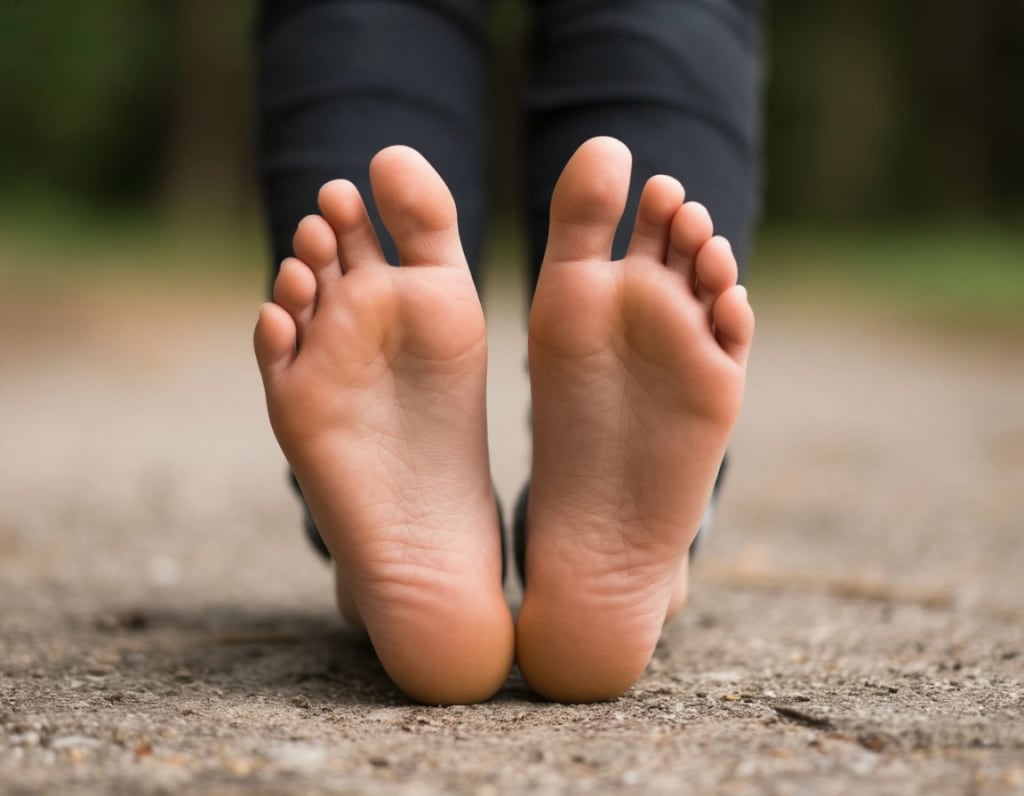
We live in an age where the mind often races faster than the body can keep up. Deadlines, digital distractions, and the constant pull of productivity can keep us floating above ourselves, untethered from the very ground beneath our feet. In this state, stress accumulates, anxiety spikes, and presence feels like a distant ideal. Yet, a profound shift begins the moment we return attention to something as simple and overlooked as our feet. Somatic awareness — the practice of sensing the body directly — teaches us that grounding through the feet does not only stabilize posture, but also anchors the mind.
Walking, standing, or simply pressing the soles into the earth, we begin to notice: balance starts here. Stability of thought, emotional regulation, and clarity often follow when we engage the body as foundation. By cultivating awareness of the feet, we awaken a practice of grounding that ripples upward into every layer of experience.
Why the feet matter more than we think
The human foot is an engineering marvel — 26 bones, 33 joints, and over 100 muscles, ligaments, and tendons working in intricate harmony. Yet, in daily life, most of us barely acknowledge this foundation. Shoes, rigid surfaces, and habitual postures dull the sensory input the feet naturally provide. Over time, this neglect leaves us less balanced physically and emotionally.
Somatic practitioners often observe that disconnection from the feet mirrors disconnection from stability in life. When the base feels unstable, the nervous system registers threat, even subtly. This low-grade alarm manifests as restlessness, difficulty focusing, or heightened reactivity. By contrast, when we restore attention to the feet, pressing awareness downward, the body feels supported. This safety cues the nervous system to soften, inviting calm.
Grounding as nervous system regulation
The nervous system thrives on signals of safety and stability. When the soles of the feet press into the ground with awareness, proprioceptive feedback communicates “I am here, I am supported.” This is not metaphorical — it is physiological.
Many mindfulness and meditation traditions emphasize “dropping into the body” as a path to quieting the mind. Anchoring awareness in the feet is one of the most immediate and accessible ways to do this. Unlike abstract affirmations, the act of feeling weight through the feet offers a concrete, sensory cue. The result? Breathing deepens, thoughts decelerate, and emotional storms begin to lose their intensity.
This is why so many grounding practices in trauma-informed meditation begin with the feet. Whether standing or sitting, the invitation is to let awareness drop downward, into contact with the earth. For those who feel scattered, anxious, or overwhelmed, this simple redirection can be transformative.
Somatic awareness in motion
Grounding is not limited to stillness. Walking itself can become a moving meditation. Instead of treating steps as a means to get from one point to another, we can allow each footfall to become an anchor. Feeling the heel touch down, the roll through the arch, the lift of the toes — these micro-moments reconnect body and mind.
Somatic movement teachers often emphasize slow walking as a practice of re-patterning awareness. By exaggerating slowness, the nervous system recalibrates. The rhythm of steps entrains breathing, heart rate, and thought patterns, creating an inner coherence that often eludes us in faster rhythms of daily life.
The psychological link between balance and confidence
Interestingly, the relationship between grounded feet and a grounded mind extends beyond relaxation. Psychological research has long linked postural stability with feelings of confidence and agency. When we feel steady in our base, our mental state reflects this steadiness.
Conversely, postures that collapse or disconnect from the ground often correlate with states of insecurity or uncertainty. Somatic awareness teaches us to sense this loop directly: adjust the way you stand, feel the base, and notice the shift in perception.
This embodied link between posture and psychology reveals a simple truth — grounding through the feet not only calms, it empowers.
A simple practice for daily life
The beauty of grounding through the feet is its accessibility. It does not require special equipment or extended time. Here is a simple practice:
Pause wherever you are — standing, sitting, or even lying down.
Bring attention to the soles of the feet. Notice where they make contact with the floor, earth, or surface beneath you.
Press gently into that contact, feeling the weight distribute. Allow the awareness to spread across the whole sole — heel, arch, ball, and toes.
Breathe as if the inhale rises up through the feet and the exhale flows back downward, rooting you more deeply.
Notice the shift in your mind and body. Even 30 seconds of this can create a reset.
Practiced regularly, this grounding becomes less of an exercise and more of an instinct — a natural way of coming home to presence when life begins to scatter your attention.
The bigger picture: why grounding matters
At its core, grounding through somatic awareness is about relationship — between body and mind, individual and environment, inner and outer. The feet remind us that we are not floating in isolation but connected to something larger, literally supported by the earth itself.
In moments of overwhelm, this reminder can feel radical. To sense the ground is to sense support. To feel support is to soften tension. And in that softening, clarity emerges. The mind steadies not by force but by alignment with the body’s wisdom.
Practices like this echo what many contemplative traditions have always emphasized: presence is not a concept but a lived experience, rooted in the body. The more we honor this root, the more resilient, focused, and compassionate we become.
For those seeking practical tools for mindfulness, somatic awareness offers a doorway. Exploring techniques that center the body — especially the feet — can transform how we move through stress, creativity, and relationships. For more guidance on embodied meditation practices, you can explore resources at meditation guide.
Closing thought
The next time you find yourself caught in anxious thoughts, pause and notice your feet. Feel the ground beneath you. Allow the weight to settle, the breath to deepen, and the nervous system to exhale. Stability begins not in the mind but in the body. And the body begins in the feet. When the base is steady, the mind follows — grounded, clear, and calm.
About the Creator
Keep reading
More stories from Black Mark and writers in Longevity and other communities.
Walking the Body Back Home: Embodied Practices for Reconnection
In the rush of modern life, our bodies are often treated as mere carriers of the mind—vehicles for productivity, efficiency, and performance. Yet the body is not a silent servant. It is constantly speaking, whispering signals of tension, fatigue, or longing. When we ignore these messages, we drift further away from ourselves, living in fragments rather than as a whole. The practice of walking the body back home is not about dramatic change or heroic discipline. Instead, it is a tender invitation to return to ourselves through embodied awareness.
By Black Mark5 months ago in Longevity
Day 4 of Quitting
If this is how sobriety feels, maybe it’s better to go through life a little buzzed… this, along with other hits like, I want to kill myself, I wish I was dead, and I’m going to throw myself off a bridge have been the only thoughts on rotation these past few days. I promise myself that if, in a month, I still feel like this (‘this’ meaning despondent, full of rage, and simultaneously numb) I can go back to smoking. Until mid-February though? Nicotine is off the table.
By sleepy drafts28 days ago in Longevity
Greenland Declares Emergency After Repeated Orca Sightings Near Unstable Ice Shelves
Greenland’s government has declared a climate emergency following an unusual and growing number of orca sightings near unstable coastal ice shelves, a development that officials and scientists say signals rapidly accelerating environmental change in the Arctic. The emergency declaration comes amid rising concern that dramatic ice loss is reshaping Greenland’s marine ecosystems, threatening local communities and contributing to broader global impacts. The decision followed the release of dramatic videos showing pods of orcas — also known as killer whales — breaching near sections of coastal ice that were historically solid and relatively inaccessible. The footage, widely shared on social and traditional media, stunned researchers and Arctic residents alike, prompting questions about what the appearances of these apex predators so close to fragile ice might mean. � Smithame Events Unprecedented Orca Activity Signals Deep Changes Orcas have long been known to traverse Arctic waters, but scientists say the frequency, location, and timing of the latest sightings are unprecedented. Traditionally, thick sea ice and stable ice shelves kept these waters blocked for much of the year. Recent observations, however, show orcas navigating regions previously covered by year-round ice, a pattern researchers say reflects broader shifts in habitat availability and prey migration triggered by warming temperatures and shrinking ice cover. � Smithame Events “We have never recorded orcas operating in these specific GPS-marked locations, let alone swimming freely near solid glacial ice,” said marine biologist Dr. Lise Thomassen, who has studied Arctic marine ecosystems for nearly two decades. “This suggests ocean conditions have changed so substantially that longstanding barriers no longer exist.” � Smithame Events The appearance of orcas near unstable ice is more than a curiosity; it may indicate broader disruption of the Arctic food web, with potential ripple effects for species such as seals, walruses, and polar bears that depend on stable ice for hunting and breeding. Climate Emergency Declared In response to the growing evidence of rapid environmental shifts, Greenland’s Ministry of Environment announced a formal climate emergency, a rarely invoked designation that allows for expanded monitoring, research collaboration, and community support. The government said the declaration would fund: 24/7 satellite and aerial monitoring of ice shelf stability Expanded data sharing with climate research partners, including the European Space Agency Community-based observation programs involving Inuit hunters and local elders A planned Arctic Stability Summit to coordinate scientific and policy responses According to officials, the emergency designation is driven not only by orca sightings but also by broader trends in ice melt, glacial retreat, and shifting marine conditions that together pose risks to both ecosystems and human communities. Local Inuit leaders have been integrated into the planning process, bringing centuries of generational knowledge about seasonal ice behavior and as a bridge between traditional insight and modern science. � Smithame Events What Orca Sightings Reveal Orca sightings near unstable ice are alarming because these animals typically avoid areas with dangerous conditions or unpredictable prey patterns. Their movement patterns are closely tied to prey availability, such as seals and fish — both of which also migrate in response to changing ice conditions. Scientists interpret the orcas’ presence not as evidence of unusually active whales, but rather as a symptom of ecological shifts. “Orcas are, metaphorically, like oceanic analysts,” one climate ecologist told a news outlet. “They react to changes in water temperature, prey behavior, and ice condition in real time — and then adapt right in front of you.” � WNC Group Emerging research indicates that weakening ice shelves allow warmer ocean waters to penetrate deeper into fjords and coastal margins, making these regions more navigable for large marine mammals but less stable for ice-dependent species. � ETH Zürich Local and Global Impacts For Greenland’s residents, the changes are not just scientific data points; they have real economic and cultural effects. Coastal communities rely on stable ice for travel, hunting, and fishing. The loss of predictable ice not only affects traditional ways of life but also raises the risk of hazards such as calving icebergs, shifting shorelines, and more frequent open water events in what were once reliably frozen zones. Globally, the accelerated melting of Greenland’s ice sheets contributes directly to rising sea levels, with long-term implications for coastal cities from New York to Dhaka. The Greenland Ice Sheet holds enough water to raise sea levels by more than 20 feet if it were to melt entirely — a process scientists once believed would take centuries but now warn could accelerate under current warming trends. � Smithame Events Research and Action Scientific teams are intensifying efforts to understand the linkages between marine predator behavior, ice stability, and climate change. Universities, Arctic research institutes, and governmental agencies are pooling satellite data, oceanographic measurements, and long-term ecological observations to map how ecosystems are reconfiguring. At the same time, Greenlandic officials have called for international cooperation to address the underlying drivers of climate change, including greenhouse gas emissions and feedback loops that amplify Arctic warming at more than twice the global average rate. What Comes Next Greenland’s emergency declaration emphasizes both urgency and adaptability. While orca sightings may grab headlines, they symbolize broader environmental dynamics that will shape the Arctic for decades to come. Local leaders stressed that adaptation and mitigation strategies must include community voices, scientific research, and global policy action. As one elder from a coastal village put it, “The ice never used to creak this time of year. Now it sings the wrong song.” � Smithame Events
By Fiaz Ahmed a day ago in Longevity
Dead and Wearing Green
She was wearing that green dress when I first saw her, five years ago to the day. Flowing meadow fabric draped over long legs, thick auburn hair flowing down her back. That smile. Of course, she is still beautiful now. But now she is no longer alive.
By Karen Cave6 days ago in Fiction


Comments
There are no comments for this story
Be the first to respond and start the conversation.