Latest Stories
Most recently published stories on Vocal.
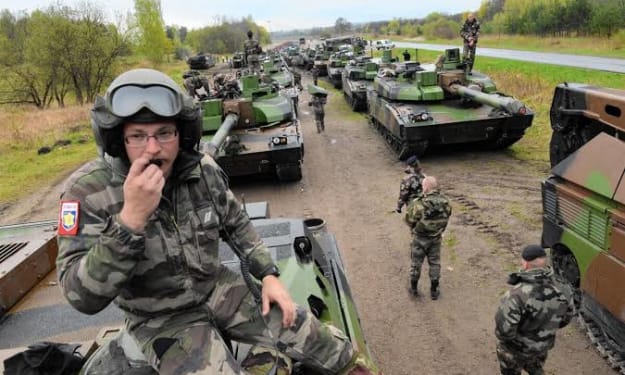
The NATO Soldiers Training to Defend Europe Against Putin. AI-Generated.
Across forests in Poland, frozen plains in the Baltics, and military bases in Germany and Romania, thousands of NATO soldiers are preparing for a scenario that until recently seemed unthinkable: a direct confrontation with Russia. Since Moscow’s invasion of Ukraine, the alliance has transformed its training programs to focus on defending Europe’s eastern flank against what it sees as a long-term and growing threat from President Vladimir Putin’s military ambitions. These exercises are no longer symbolic displays of unity. They are large-scale, realistic war games designed to test how NATO forces would respond if Russia attempted to expand the conflict beyond Ukraine. Tanks thunder across muddy fields, fighter jets practice coordinated strikes, and cyber units simulate attacks on communication networks. The message is clear: NATO is shifting from decades of crisis management to full territorial defense. A New Era of Training For years after the Cold War, NATO focused its military training on counterterrorism missions and overseas operations in places like Afghanistan and Iraq. That changed dramatically in 2022. Today, alliance planners are rebuilding skills needed for high-intensity warfare between powerful armies. In Poland, multinational battalions made up of troops from the United States, Britain, Germany, and other allies conduct joint drills near the border with Belarus. These soldiers practice rapid deployment, air defense coordination, and battlefield medicine under conditions meant to mirror real combat. Officers say the goal is to ensure that forces from different countries can fight as one unit if a crisis erupts. “This is about deterrence,” said a senior NATO commander overseeing exercises in Eastern Europe. “We want to make it absolutely clear that any attack on one ally will be met with a united and prepared response.” Learning From Ukraine Much of the training now draws lessons directly from the war in Ukraine. The widespread use of drones, electronic warfare, and long-range artillery has reshaped how soldiers prepare for combat. NATO troops are learning how to operate under constant surveillance and how to protect themselves from missile strikes and cyber disruptions. In Germany, training centers have introduced simulations that replicate urban combat similar to the battles seen in cities like Mariupol and Bakhmut. Soldiers practice moving through destroyed buildings, evacuating civilians, and coordinating with intelligence units that track enemy movements in real time. The emphasis is also on logistics. Ukraine’s war has shown that supply lines can determine the outcome of battles. NATO forces are now rehearsing how to move fuel, ammunition, and medical supplies quickly across borders, overcoming bureaucratic and infrastructure obstacles that once slowed deployments. Expanding the Eastern Front Since Russia’s invasion, NATO has increased its troop presence in Eastern Europe from about 40,000 to more than 100,000 at peak readiness. New battlegroups have been established in countries such as Slovakia, Hungary, Bulgaria, and Romania, in addition to existing deployments in the Baltic states and Poland. These units are not only defensive but also symbolic. They demonstrate that an attack on any one of these countries would immediately involve multiple NATO members. For soldiers from smaller nations, training alongside major military powers provides reassurance that they are not alone. A Lithuanian officer participating in joint exercises said the cooperation has transformed the region’s security outlook. “We used to worry about how fast help would arrive,” he said. “Now help is already here.” Psychological Readiness Beyond weapons and tactics, NATO is also focusing on the mental preparedness of its soldiers. The possibility of conflict with Russia carries enormous political and emotional weight. Commanders say troops must be ready for a long-term standoff, not just a short deployment. Many soldiers speak openly about the seriousness of their mission. A British infantryman stationed in Estonia said the training feels different from previous exercises. “You know this isn’t theoretical,” he said. “You’re training for something that could actually happen.” NATO has also increased cooperation with civilian authorities, rehearsing responses to hybrid threats such as sabotage, disinformation campaigns, and attacks on critical infrastructure like power grids and railways. Russia Watches Closely Moscow has repeatedly condemned NATO’s military buildup near its borders, calling it provocative and dangerous. Russian officials argue that the alliance’s expansion and exercises are proof that the West is preparing for confrontation. NATO leaders reject that accusation, insisting their actions are purely defensive. They point out that Russia’s invasion of Ukraine forced the alliance to reconsider its posture. Finland and Sweden’s decision to join NATO further underlines how security calculations across Europe have shifted. Military analysts warn that this new phase of deterrence carries risks. Large-scale exercises and troop movements increase the chances of misunderstandings or accidents. That makes communication channels between NATO and Russia more important than ever, even as political relations remain deeply strained. Preparing for the Long Term NATO’s training programs are expected to continue expanding in the coming years. Member states are increasing defense budgets and investing in modern equipment, including missile defense systems, advanced aircraft, and cyber capabilities. The alliance is also developing new response plans for different types of threats, from conventional invasions to cyberattacks and space-based warfare. For the soldiers on the ground, the focus remains practical: be ready, work together, and deter aggression before it starts. Exercises may end after a few weeks, but the message they send is constant. As one NATO general put it, “We train so we never have to fight. But if we must fight, we will not be unprepared.” The soldiers training across Europe today represent a continent reshaping its defenses for an uncertain future. Whether their presence prevents conflict or merely postpones it remains unknown. What is certain is that NATO is signaling its determination to defend every inch of its territory against any challenge from Moscow — and to ensure that the lessons of Ukraine are not ignored.
By Fiaz Ahmed 18 days ago in The Swamp
Australia Biosimilar Market Set for Explosive Growth as Affordable Biologics Gain Traction. AI-Generated.
The Australia biosimilar market is on a remarkable growth trajectory, driven by increasing demand for cost effective biologic therapies, supportive government frameworks, and broader healthcare adoption. According to IMARC Group, the market was valued at USD 741.6 million in 2024 and is forecast to reach USD 5,512.5 million by 2033, reflecting a robust compound annual growth rate (CAGR) of 22.20% between 2025 and 2033.
By Rashi Sharma18 days ago in Trader
Casie Hynes and the Push to Redefine Mathematics Education. AI-Generated.
Mathematics has always played a central role in education, yet it remains one of the most polarizing subjects students encounter. Some learners feel empowered by numbers and patterns, while others experience frustration and self-doubt early in their academic journey. Despite decades of discussion about reform, many math classrooms still rely on methods that emphasize memorization and speed over understanding and curiosity. In a world shaped by data, technology, and constant change, this approach no longer meets the needs of today’s students.
By Casie Hynes18 days ago in Education
Egypt Online Food Delivery Market Trends: Growth Drivers & Future Prospects. AI-Generated.
According to IMARC Group's latest research publication, Egypt online food delivery market size reached USD 542.9 Million in 2025. The market is projected to reach USD 827.2 Million by 2034, exhibiting a growth rate (CAGR) of 4.55% during 2026-2034.
By Abhay Rajput18 days ago in Futurism
Does The 'Wonder Man' Ending Set Up A 'Shang-Chi' Sequel?
WARNING! SPOILERS for Wonder Man. Wonder Man, the MCU's latest TV series, has proven a hit with audiences. The series follows the growing friendship between struggling actors Simon Williams and Trevor Slattery as they vie for roles in famous Director Von Kovak's Wonder Man movie. Meanwhile, Trevor is reluctantly working undercover for the Department of Damage Control, gathering information on the secretly superpowered Simon.
By Kristy Anderson18 days ago in Geeks
Egypt Banking Market Insights: Growth Drivers and Key Trends. AI-Generated.
According to IMARC Group's latest research publication, Egypt banking market size reached USD 141.1 Million in 2025. The market is projected to reach USD 442.7 Million by 2034, exhibiting a growth rate (CAGR) of 12.87% during 2026-2034.
By Abhay Rajput18 days ago in Futurism
Still Missing: Savannah Guthrie’s Mother Nancy, FBI Offers $50,000 Reward in Urgent Search
Savannah Guthrie, the familiar face of NBC’s Today show, has been thrust into a deeply personal crisis as her 84-year-old mother, Nancy Guthrie, remains missing in Tucson, Arizona. Authorities and family members alike are urging anyone with information to come forward, emphasizing the urgency of the situation given Nancy’s fragile health.
By Story Prism18 days ago in Criminal
North America Dietary Supplement Market Size and Forecast 2025–2033. AI-Generated.
North America Dietary Supplement Market Outlook The North America Dietary Supplement Market is entering a powerful growth phase, reflecting a broader shift in how consumers approach health, wellness, and preventive care. According to Renub Research, the market was valued at around US$ 40.32 billion in 2024 and is forecast to reach approximately US$ 67.05 billion by 2033, expanding at a compound annual growth rate (CAGR) of 5.82% during 2025–2033.
By Sakshi Sharma18 days ago in Trader
Europe Vitamin Fortified and Mineral Enriched Food & Beverage Market Size and Forecast 2025–2033. AI-Generated.
Europe’s Fortified Foods Boom: A Market Built on Health, Science, and Smart Consumption The Europe Vitamin Fortified and Mineral Enriched Food & Beverage Market is entering a decisive growth phase, driven by a powerful combination of health awareness, demographic change, and evolving consumer expectations. According to Renub Research, the market was valued at USD 22.8 billion in 2024 and is projected to reach USD 31.11 billion by 2033, expanding at a compound annual growth rate (CAGR) of 3.52% during the forecast period 2025–2033.
By Sakshi Sharma18 days ago in Trader