
The 8% Surge Powering the Biochemical Reagents Boom
How the Biochemical Reagents Market Is Quietly Reshaping Global Healthcare and Research
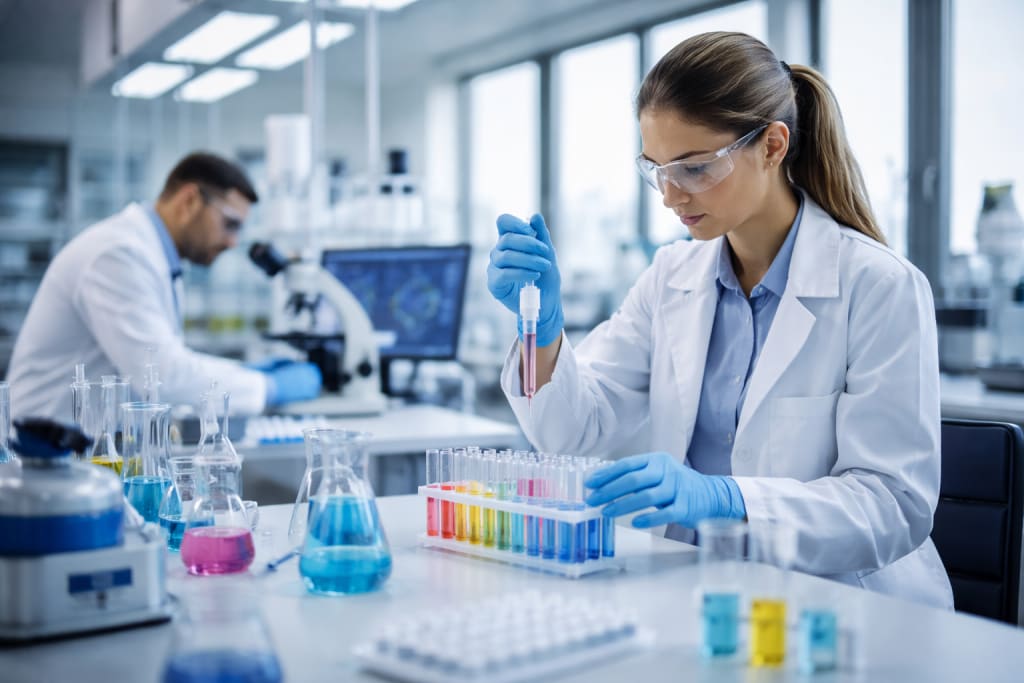
The lab is silent except for the hum of refrigeration units and the rhythmic click of pipettes. A researcher leans over a sterile bench, transferring a droplet of transparent liquid into a small reaction chamber. Within seconds, a digital monitor flickers with new data — numbers that may determine the course of a disease diagnosis, a drug discovery breakthrough, or a genetic analysis that could save a life.
Invisible to most of the world, biochemical reagents are working behind the scenes. They don’t trend on social media. They don’t dominate headlines. But without them, modern medicine would stall.
And right now, the global Biochemical Reagents Market size is projected to rise from USD 44.27 billion in 2025 to USD 46.92 billion in 2026, and further expand to USD 66.34 billion by 2031, registering a CAGR of 7.17% during the 2026–2031 forecast period, according to Mordor Intelligence. That single data point signals something profound: laboratories across the world are accelerating their pace of discovery.
What is driving this growth? Why are biochemical reagents becoming more critical than ever? And how does this impact everyday lives in ways most people never realize?
The Invisible Backbone of Modern Medicine
If you’ve ever searched online for:
- “What are biochemical reagents used for?”
- “How do diagnostic labs test diseases?”
- “What powers molecular biology research?”
The answer, again and again, leads back to biochemical reagents.
These specialized chemical substances enable reactions essential in:
- Clinical diagnostics
- Drug discovery and development
- Molecular biology
- Genetic sequencing
- Disease detection
- Academic research
Every COVID-19 PCR test relied on reagents. Every blood chemistry panel in a hospital lab depends on reagents. Every pharmaceutical breakthrough starts with reagent-based experimentation.
The steady 7.17% CAGR projected for the market reflects increasing global demand for diagnostic accuracy and advanced research capabilities. As healthcare systems expand and precision medicine gains traction, laboratories require higher volumes of specialized reagents tailored to specific biochemical reactions.
This growth isn’t explosive — it’s sustainable. And that’s what makes it powerful.
Unlike hype-driven industries that spike and crash, the biochemical reagents sector grows because science keeps advancing. New diseases emerge. Personalized medicine becomes standard. Genomic research deepens. With every scientific leap, reagents remain foundational.
A Surge Fueled by Precision and Prevention
Walk into any advanced hospital laboratory today and you’ll see automation systems, robotic arms, and AI-powered analytics. But beneath all the digital sophistication lies a simple truth: reactions still need to happen at the molecular level.
Reagents are the catalysts of clarity.
In an era increasingly focused on early detection and preventive healthcare, diagnostic testing volumes continue to rise. From metabolic panels to cancer markers and infectious disease screenings, laboratories are processing more samples than ever before.
This demand directly influences the Biochemical Reagents Market, reinforcing its projected 7.17% CAGR growth trajectory.
The reason is straightforward:
Preventive healthcare requires routine testing.
Routine testing requires reagents.
Advanced testing requires specialized reagents.
As governments and healthcare providers prioritize early diagnosis over late-stage treatment, the volume of biochemical assays expands accordingly.
Simultaneously, biotechnology companies and pharmaceutical firms are investing heavily in research and development. Drug discovery pipelines rely extensively on reagents for screening, validation, and experimentation. Each experimental pathway requires precise chemical interactions — and those interactions depend on high-quality reagents.
The growth isn’t just about volume. It’s about complexity.
Modern reagents are becoming more refined, more targeted, and more specialized. The era of one-size-fits-all laboratory chemicals is fading. Today’s market thrives on specificity — enzyme reagents, buffers, substrates, and assay kits engineered for exact molecular pathways.
That sophistication sustains long-term demand.
Beyond the Lab: A Global Ripple Effect
It’s easy to imagine biochemical reagents confined to research institutions. But their influence stretches far beyond sterile benches and microscopes.
Consider this:
- A rural clinic running blood tests for early diabetes detection.
- A cancer center analyzing tumor biomarkers for targeted therapy.
- A biotech startup sequencing genetic material to identify rare mutations.
- A public health laboratory monitoring infectious outbreaks.
- Each scenario depends on biochemical reagents.
The projected 7.17% CAGR signals expanding global accessibility to diagnostic and research infrastructure. Emerging economies are strengthening healthcare systems, building new laboratories, and increasing investment in biotechnology.
This isn’t just a scientific trend — it’s a public health transformation.
Moreover, the shift toward precision medicine — tailoring treatment to individual genetic profiles — amplifies reagent demand. Genetic analysis and molecular diagnostics require highly specific reagents capable of producing accurate, reproducible results.
When someone searches:
- “Why is molecular diagnostics growing?”
- “How does precision medicine work?”
- “What drives laboratory reagent demand?”
The answer circles back to the same ecosystem: growing diagnostic needs, expanding biotech research, and increasing healthcare awareness worldwide.
Even educational institutions contribute to this expansion. Universities and research centers train the next generation of scientists using reagent-based experimentation. As academic research broadens, consumption patterns follow.
This layered demand — clinical, commercial, academic, and public health — stabilizes market growth and reinforces the steady CAGR forecast.
The Human Story Behind the Statistics
An 7.17% growth rate might look like a financial metric on paper. But behind that number are real stories.
A pathologist receives clearer diagnostic results because advanced reagents improved assay sensitivity.
A pharmaceutical researcher shortens development time because high-quality reagents deliver reproducible outcomes.
A patient receives earlier detection of disease because laboratory systems processed samples efficiently.
These aren’t abstract benefits. They’re tangible outcomes shaped by invisible chemistry.
The biochemical reagents industry represents a rare intersection of science, healthcare, and global development. Its steady growth suggests sustained innovation, continuous research funding, and expanding diagnostic capabilities.
Unlike volatile technology sectors, the biochemical reagents space grows alongside humanity’s need for answers — about disease, genetics, biology, and longevity.
And perhaps that’s why it remains evergreen.
As long as scientists ask questions, reagents will be required to find answers.
Why This Market Matters Now More Than Ever
Search trends show increasing curiosity around:
- “Future of diagnostic testing”
- “Growth of biotechnology industry”
- “Global laboratory reagent demand”
- “Healthcare testing market growth rate”
Each query reflects broader awareness of how science shapes society.
The projected 7.17% CAGR of the Biochemical Reagents Market, according to Mordor Intelligence, isn’t just a business statistic. It’s a barometer of global scientific momentum.
Healthcare systems are expanding. Research pipelines are deepening. Diagnostic technologies are advancing.
And quietly, steadily, biochemical reagents continue to enable it all.
In a world obsessed with visible innovation — AI breakthroughs, robotics, flashy biotech headlines — the most critical components often remain unseen.
A drop of reagent in a test tube can alter the trajectory of a life.
That reality deserves attention.
As laboratories grow more sophisticated and healthcare becomes more proactive, one question remains:
Are we fully recognizing the silent infrastructure powering medical progress — or are we still overlooking the chemistry that keeps humanity moving forward?
What do you think will shape the next decade of diagnostic and research innovation?
About the Creator
~ Fired ~
— Ai Intrusion ~ Are you Next ~ Is Ai Evolution after your job? — Few workplaces haven't been affected. Ai is in supermarkets, at doctors' offices, and even monitoring farms. I just can't think of anything this machine is not getting into, can you? For instance: Education ~ Law and Tech jobs will one day have a major influence or be taken over by these inanimate machines, with accuracy and vigor. From mechanics' diagnoses to a wide variety of everyday jobs, including fast food workers, with this input having the ability to cut their unnecessary work hours. I'm certain all of us have been touched by this with our short stories and colorful headings, have you? Even comments are very questionable 'Non-Robot' insertions.
By Jay Kantor27 days ago in Journal




Comments
There are no comments for this story
Be the first to respond and start the conversation.