art
Artistic, musical, creative, and entertaining topics in Journal's workplace sphere.
Improving Art Skills Quickly
Everybody has their own reasons to take up art. From learning a new hobby to a whole skillset for a career. For example, you see a classic bowl of fruit painting for sale on eBay for $500 dollars. And then your inspired to make a painting of a kitten in a rose garden. Why? Because you have a healthy touch of artistic talent and want to make some extra cash from it. You draft out a 6 or 9 square grid on your canvas. And start working on the basic shape of the kitten. But you end up stopping because the resulting kitten sketch doesn't look right to you. So you erase and redraw again and again. Then end up scribbling all over the canvas with your pencil out of stress. It can be discouraging if your piece isn't matching up with your desired results. Especially if your just starting out as an artist. Cause most artists often spend years honing their skills and talents. And they usually spend hours and hours of practice every single day. Then you end up giving up because you don't want to spend years and years just to create one eye pleasing painting. But here's the good news, you don't have to. It's possible to build up your art skills within weeks or months. So take a moment to step back and rethink your own approach on art. A good start is to work on the basic drawing skills. There is a way to make the process easier and less stressful. You'll be learning some tips and tricks to help refine your skills and techniques. And that'll involve making good use of tools and resources. It might sound like cheating. But it will help you when your doing both practicing and working on a whole art project. Whether you're attending art school or becoming a self taught artist. Either way, expect to do a healthy amount of hard work. So make yourself comfortable. This post might be a bit long.
By Matthew Sposato5 years ago in Journal
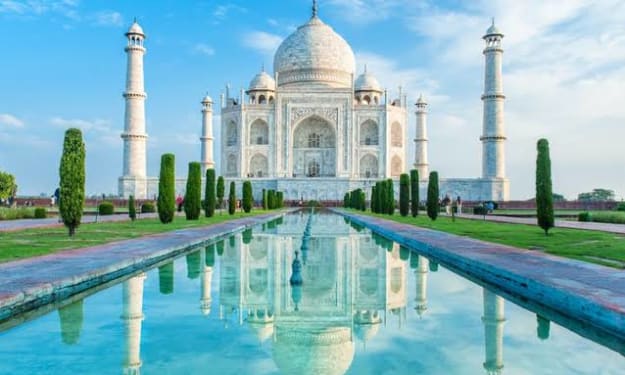
TAJMAHAL
Start writing... An immense mausoleum of white marble, built in Agra between 1631 and 1648 by order of the Mughal emperor Shah Jahan in memory of his favourite wife, the Taj Mahal is the jewel of Muslim art in India and one of the universally admired masterpieces of the world's heritage.Outstanding Universal Value.Brief synthesis.The Taj Mahal is located on the right bank of the Yamuna River in a vast Mughal garden that encompasses nearly 17 hectares, in the Agra District in Uttar Pradesh. It was built by Mughal Emperor Shah Jahan in memory of his wife Mumtaz Mahal with construction starting in 1632 AD and completed in 1648 AD, with the mosque, the guest house and the main gateway on the south, the outer courtyard and its cloisters were added subsequently and completed in 1653 AD. The existence of several historical and Quaranic inscriptions in Arabic script have facilitated setting the chronology of Taj Mahal. For its construction, masons, stone-cutters,The fund provided by the federal government is adequate for the buffer areas. The fund provided by the federal government is adequate for the overall conservation, preservation and maintenance of the complex to supervise activities at the site under the guidance of the Superintending Archaeologist of the Agra Circle. The implementation of an Integrated Management plan is necessary to ensure that the property maintains the existing conditions, particularly in the light of significant pressures derived from visitation that will need to be adequately managed. The Management plan should also prescribe adequate guidelines for proposed infrastructure development and establish a comprehensive Public Use plan. , carvers, painters, calligraphers, dome builders and other artisans were requisitioned from the whole of the empire and also from the Central Asia and Iran. Ustad-Ahmad Lahori was the main architect of the Taj Mahal.The Taj Mahal is considered to be the greatest architectural achievement in the whole range of Indo-Islamic architecture. Its recognised architectonic beauty has a rhythmic combination of solids and voids, concave and convex and light shadow; such as arches and domes further increases the aesthetic aspect. The colour combination of lush green scape reddish pathway and blue sky over it show cases the monument in ever changing tints and moods. The relief work in marble and inlay with precious and semi precious stones make it a monument apart. The uniqueness of Taj Mahal lies in some truly remarkable innovations carried out by the horticulture planners and architects of Shah Jahan. One such genius planning is the placing of tomb at one end of the quadripartite garden rather than in the exact centre, which added rich depth and perspective to the distant view of the monument. It is also, one of the best examples of raised tomb variety. The tomb is further raised on a square platform with the four sides of the octagonal base of the minarets extended beyond the square at the corners. The top of the platform is reached through a lateral flight of steps provided in the centre of the southern side. The ground plan of the Taj Mahal is in perfect balance of composition, the octagonal tomb chamber in the centre, encompassed by the portal halls and the four corner rooms. The plan is repeated on the upper floor. The exterior of the tomb is square in plan, with chamfered corners. The large double storied domed chamber, which houses the cenotaphs of Mumtaz Mahal and Shah Jahan, is a perfect octagon in plan. The exquisite octagonal marble lattice screen encircling both cenotaphs is a piece of superb workmanship. It is highly polished and richly decorated with inlay work. The borders of the frames are inlaid with precious stones representing flowers executed with wonderful perfection. The hues and the shades of the stones used to make the leaves and the flowers appear almost real. The cenotaph of Mumtaz Mahal is in perfect centre of the tomb chamber, placed on a rectangular platform decorated with inlaid flower plant motifs. The cenotaph of Shah Jahan is greater than Mumtaz Mahal and installed more than thirty years later by the side of the latter on its west. The upper cenotaphs are only illusory and the real graves are in the lower tomb chamber (crypt), a practice adopted in the imperial Mughal tombs.The four free-standing minarets at the corners of the platform added a hitherto unknown dimension to the Mughal architecture. The four minarets provide not only a kind of spatial reference to the monument but also give a three dimensional effect to the edifice.The most impressive in the Taj Mahal complex next to the tomb, is the main gate which stands majestically in the centre of the southern wall of the forecourt. The gate is flanked on the north front by double arcade galleries. The garden in front of the galleries is subdivided into four quarters by two main walk-ways and each quarters in turn subdivided by the narrower cross-axial walkways, on the Timid-Persian scheme of the walled in garden. The enclosure walls on the east and west have a pavilion at the centre.The Taj Mahal is a perfect symmetrical planned building, with an emphasis of bilateral symmetry along a central axis on which the main features are placed. The building material used is brick-in-lime mortar veneered with red sandstone and marble and inlay work of precious/semi precious stones. The mosque and the guest house in the Taj Mahal complex are built of red sandstone in contrast to the marble tomb in the centre. Both the buildings have a large platform over the terrace at their front. Both the mosque and the guest house are the identical structures. They have an oblong massive prayer hall consist of three vaulted bays arranged in a row with central dominant portal. The frame of the portal arches and the spandrels are veneered in white marble. The spandrels are filled with flowery arabesques of stone intarsia and the arches bordered with rope molding.Criterion (i): Taj Mahal represents the finest architectural and artistic achievement through perfect harmony and excellent craftsmanship in a whole range of Indo-Islamic sepulchral architecture. It is a masterpiece of architectural style in conception, treatment and execution and has unique aesthetic qualities in balance, symmetry and harmonious blending of various elements.Integrity.Integrity is maintained in the intactness of tomb, mosque, guest house, main gate and the whole Taj Mahal complex. The physical fabric is in good condition and structural stability, nature of foundation, verticality of the minarets and other constructional aspects of Taj Mahal have been studied and continue to be monitored. To control the impact of deterioration due for atmospheric pollutants, an air control monitoring station is installed to constantly monitor air quality and control decay factors as they arise. To ensure the protection of the setting, the adequate management and enforcement of regulations in the extended buffer zone is needed. In addition, future development for tourist facilities will need to ensure that the functional and visual integrity of the property is maintained, particularly in the relationship with the Agra Fort.Authenticity.The tomb, mosque, guest house, main gate and the overall Taj Mahal complex have maintained the conditions of authenticity at the time of inscription. Although an important amount of repairs and conservation works have been carried out right from the British period in India these have not compromised to the original qualities of the buildings. Future conservation work will need to follow guidelines that ensure that qualities such as form and design continue to be preserved.Protection and management requirements.The management of Taj Mahal complex is carried out by the Archaeological Survey of India and the legal protection of the monument and the control over the regulated area around the monument is through the various legislative and regulatory frameworks that have been established, including the Ancient Monument and Archaeological Sites and Remains Act 1958 and Rules 1959 Ancient Monuments and Archaeological Sites and Remains (Amendment and Validation); which is adequate to the overall administration of the property and buffer areas. Additional supplementary laws ensure the protection of the property in terms of development in the surroundings.An area of 10,400 sq km around the Taj Mahal is defined to protect the monument from pollution. The Supreme Court of India in December, 1996, delivered a ruling banning use of coal/coke in industries located in the Taj Trapezium Zone (TTZ) and switching over to natural gas or relocating them outside the TTZ. The TTZ comprises of 40 protected monuments including three World Heritage Sites - Taj Mahal, Agra Fort and Fatehpur Sikri.The fund provided by the federal government is adequate for the buffer areas. The fund provided by the federal government is adequate for the overall conservation, preservation and maintenance of the complex to supervise activities at the site under the guidance of the Superintending Archaeologist of the Agra Circle. The implementation of an Integrated Management plan is necessary to ensure that the property maintains the existing conditions, particularly in the light of significant pressures derived from visitation that will need to be adequately managed. The Management plan should also prescribe adequate guidelines for proposed infrastructure development and establish a comprehensive Public Use plan.
By Zarinabanu Zarinabanu5 years ago in Journal
trigger finger
I see you again. I thought I buried you deep enough to forget. We both knew you would never stop didn't we? Those nights I would tear into you. All I knew was hatred and the need to feed the violence. How could you not be broken by such a vicious cycle? You would scream frantic lyrics of finding god in the mud. I just kept your head under water. What would it truly take to kill you?
By Samuel Bitner5 years ago in Journal
Why I use a Pen Name
"That's so Fake." "You'd be lying to your readers." "How can we judge you if we don't know who you are?" These are various, and rather valid reasons people have for hating pseudonyms. Some people won't even read a book unless they know some personal things about the Author. When getting intimate with someone the first thing you will want them to know is your real name. Even knowing all of this, and completely agreeing with the above mentioned criticism, why do I still use a fake name?
By Kacey Lovesick5 years ago in Journal
Devised Theatre for The Youth and Facilitator, Sarah Tan
Holding space for people to heal through art is nature's medicine as much as any homeopathic remedy.Theatre is such an immersive experience; one that in witnessing allows us to process our understanding of what we want to see in our world.How we can step into our power and empower others on a grander scale than we could possibly imagine. When witnessing, we can feel the empathy and patience for the characters that we should really be mindful of feeling more when witnessing each other. Devised Theatre aka Collective Creation is a collaborative experience that embarks the artists on a journey that encourages inclusively allowing for the playful, delightful, enlightening, and insightful creative process to emerge from its soil and blossom into the finished product. Devised theatre and youth fuse for an artist worthy of the spotlight, Sarah Tan.
By Chasity Flores5 years ago in Journal
10 Graphic Design Rules You Should Never Break
If you want to be a successful graphic designer here are 10 graphic design rules you should never break. The graphic design sectors like ecommerce image editing and photo retouching assume an extremely huge role in the extension of any business as of now.
By Ram Bhowmik5 years ago in Journal
Bothered
“Catherine, stay close.” Catherine and Eliza followed the natural pace of the crowd, the one set by museum and travel tour guides, by tourists, by art fanatics, and by students doing their assignments. The two girls were all and none of those things. They loved art, were tourists, were students, but they were not there for assignments. They were there for jobs.
By Noémi Blom5 years ago in Journal
Rarible NFT Artist Spotlight
Maybe you've heard the news, Non-Fungible Tokens are the wild new craze, and they're selling like hotcakes! Platforms such as Rarible and Opensea are now making headlines, with an already booming market between buyers and creators. Celebrities and artists around the world are getting involved in NFT's with stars like the Wu-Tang Clan, The Kings of Leon, and even Lindsay Lohan making waves.
By Terrance A. Phillips5 years ago in Journal
Art in the Suburbs
Staten Island, New York is a short ferry ride from the fast paced world of New York City, but it seems like a world away. It's known for being the hometown of one of the Jersey Shore cast members. It's not exactly known as a cultural Mecca. Despite this reputation, there are small pockets of the island where the arts thrive. One of these places is very dear to my heart.
By MATTHEW FLICK5 years ago in Journal