
Fake Deepfake Video Links Modi and Netanyahu to Afghan Taliban Support
No joint press conference took place — viral AI propaganda misleads social media users in Pakistan and beyond.

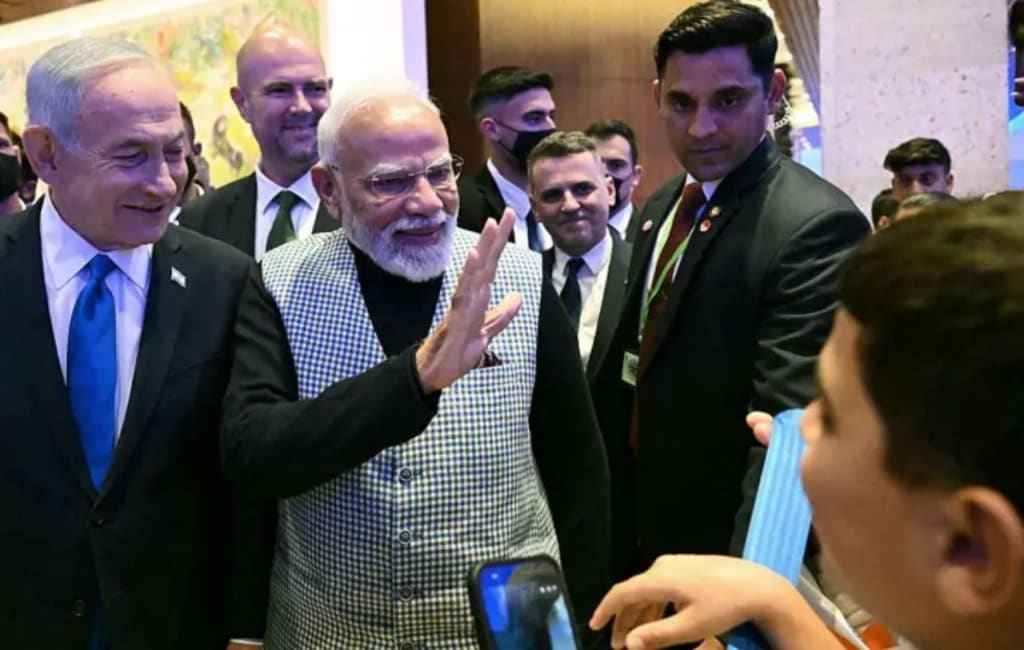
A fake video of Israeli Prime Minister Benjamin Netanyahu has gone viral during Indian Prime Minister Narendra Modi’s visit to Israel, in which he is allegedly heard saying that India and Israel will provide every possible support to the Afghan Taliban.
Some journalists and social media users shared this video clip, portraying it as evidence of an India-Israel alliance in the context of ongoing tensions between Pakistan and the Afghan Taliban. It was also claimed that Netanyahu expressed these views during a joint press conference with Prime Minister Modi.
In the deepfake AI video, the Israeli Prime Minister was also attributed with saying that at the request of the Indian Prime Minister, Israel was announcing a special aid package for the Afghan Taliban.
However, it later emerged that the Indian Prime Minister did not hold any joint press conference with the Israeli Prime Minister. Both leaders addressed the Israeli parliament separately, and in his speech, the Israeli Prime Minister did not mention Afghanistan, the Taliban, or Pakistan at all.
It is worth noting that during his two-day visit to Israel, the Indian Prime Minister addressed the Israeli parliament on Wednesday, where Netanyahu was also present. According to the Indian Prime Minister’s Office, this was the first time any Indian Prime Minister had addressed the Israeli parliament, and in his speech, Prime Minister Modi emphasized strengthening relations between the two countries.
In reality, the Israeli Prime Minister stated in his speech that “Israel is at the forefront of the fight against radical Islam.” Without naming any country, he said that extremism is the root of problems in the Middle East.
In the deepfake video, Indian Prime Minister Narendra Modi was also shown mentioning Afghan Taliban Supreme Leader Mullah Haibatullah and announcing billions of dollars in aid for Afghanistan. In reality, Modi made no such mention in his speech.
According to the Indian Prime Minister’s Office, Modi said in his address that there is a need for a sustained and coordinated global response to combat terrorism. He added that India supports all efforts that contribute to lasting peace and regional stability.
The AI video is being used for propaganda
In Pakistan, these video clips were rapidly going viral on social media, and some journalists were also sharing them, calling it a new challenge for Pakistan.
However, since no credible media outlet or official statements from either Prime Minister mentioned such remarks, social media users also began labeling it as a deepfake video.
Earlier, when the clips were going viral, Pakistani users had expressed concern, saying that India and Israel were supporting the Afghan Taliban against Pakistan.
A user named Sameer Mujahid wrote that Netanyahu did not announce any support for the Afghan Taliban government, nor did he deliver any joint address with Modi, as no credible report confirms this.
Another user, Asif Ali, wrote that the videos are AI-generated, but indirectly or directly, India and Israel’s alignment regarding regional realities is no secret.
Pakistani journalist Ahmed Noorani, based in the United States, also said that this is an AI-generated video being used as propaganda.
Afghan journalist Sami Yousafzai wrote that this is a fake video, and the pain of those accounts sharing it is understandable. Losing Afghanistan is not an easy strategic loss. It is a deep wound that many will feel for a long time.
India and Israel’s policy regarding the Afghan Taliban
Recently, relations between India and the Afghan Taliban have improved, and last year Afghan Foreign Minister Amir Muttaqi visited India. However, India has not officially recognized the Afghan Taliban government.
On the other hand, Israel’s stance toward the Afghan Taliban has always been strict, describing it as a hardline extremist group.
During the Indian Prime Minister’s visit, Israeli parliament member Amit Halevi told the Afghan newspaper Afghanistan International in an interview that the Afghan Taliban should not be recognized internationally.
He also said that India should withdraw its support for the Afghan Taliban and instead support its opposing factions.
When asked about India’s policy toward the Taliban, Halevi said that New Delhi should reassess its strategy, as this policy could pose security risks for India.
How can a deepfake video be identified?
This is not the first time a deepfake video has caused a stir on social media. Previously, a deepfake video of Russian President Vladimir Putin also went viral, prompting the Russian embassy to issue a clarification.
A video was circulating on social media showing the Russian President threatening Pakistan in the context of tensions between Pakistan and Afghanistan.
In the deepfake video, the Russian President was shown saying that “Pakistan should refrain from any kind of aggression against Afghanistan.
In the fake video, the Russian President was also shown saying that if Afghanistan were attacked, the response would not only come from Kabul.
The video also showed the Russian President offering full support to the Afghan Taliban and assistance in dealing with any external threats.
After the video went viral, it was shared by several verified accounts expressing concern. Later, the Russian embassy in Islamabad declared it fake.
Simply put, deepfake is a technology through which one person’s face and voice can be superimposed onto another person.
Many people wonder whether Photoshop and other editing software do the same thing, and whether they are also considered deepfakes.
The answer is no.
With software like Photoshop, we manually edit an image ourselves. In deepfake technology, however, artificial intelligence enables software to learn from provided data—typically in the form of images and videos to perform such manipulation.
For example, if someone creates a deepfake video of Michael Jackson, they would gather numerous images and videos of him. The deepfake software would analyze his facial movements and expressions.
When someone applies Michael Jackson’s face onto their own, deepfake technology not only replaces the face but also adjusts facial movements and expressions to resemble Michael Jackson’s.
The longer the video, the greater the likelihood of AI glitches.
You can combine multiple AI-generated videos together, but you may notice cuts every eight seconds or so.
Two other factors are resolution and quality. They are related but different.
Resolution refers to the number or size of pixels in an image, while compression is a process that reduces file size by removing detail. This often results in blocky patterns and blurred edges in videos.
Is this conversation helpful so far?
About the Creator
Keep reading
More stories from Real content and writers in Journal and other communities.
Jobs in Antarctica 2026: Work at British and US Research Stations – Chefs, Carpenters, Electricians Wanted No Science Degree Needed
Britain and the United States are both looking for new employees for their research stations in Antarctica. You don’t have to be a scientist to get a job there, as they also need carpenters, electricians, chefs, and even barbers.
By Real content3 days ago in Journal
~ Fired ~
— Ai Intrusion ~ Are you Next ~ Is Ai Evolution after your job? — Few workplaces haven't been affected. Ai is in supermarkets, at doctors' offices, and even monitoring farms. I just can't think of anything this machine is not getting into, can you? For instance: Education ~ Law and Tech jobs will one day have a major influence or be taken over by these inanimate machines, with accuracy and vigor. From mechanics' diagnoses to a wide variety of everyday jobs, including fast food workers, with this input having the ability to cut their unnecessary work hours. I'm certain all of us have been touched by this with our short stories and colorful headings, have you? Even comments are very questionable 'Non-Robot' insertions.
By Jay Kantor26 days ago in Journal



Comments
There are no comments for this story
Be the first to respond and start the conversation.