
Evaluating Structural Support for Double Girder Overhead Cranes
Ensuring Safety and Stability for Optimal Crane Performance
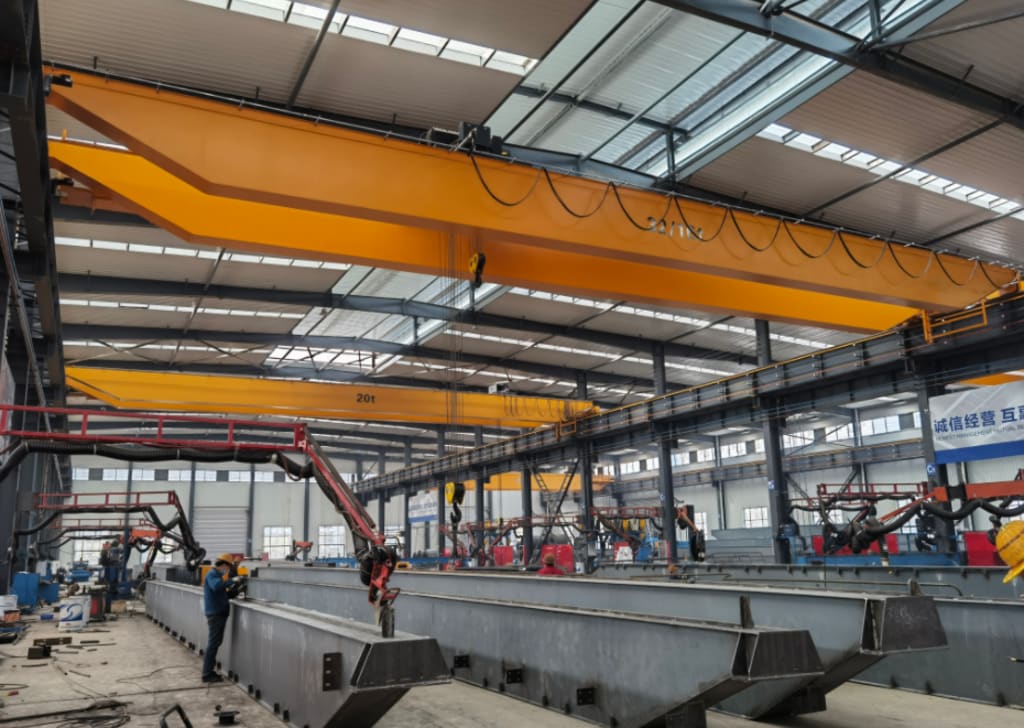
Double girder overhead cranes are widely used in industrial facilities, warehouses, steel plants, and manufacturing units due to their ability to lift heavy loads with precision and efficiency. Unlike single girder cranes, double girder cranes offer higher lifting capacities, longer spans, and improved operational stability. However, one critical aspect that often determines their safe and reliable operation is the structural support system. Evaluating structural support for double girder overhead cranes is essential to ensure the crane performs optimally, reduces downtime, and maintains safety standards.
Understanding Structural Support Requirements
Structural support refers to the framework - usually consisting of beams, columns, or gantries - on which the crane operates. For a double girder overhead crane, the load is distributed across two parallel bridge girders, which themselves run on end trucks that travel along runway rails. This design allows for handling heavier loads and achieving longer spans compared to single girder cranes. However, the higher load-carrying capacity demands rigorous evaluation of the supporting structure to prevent failures, excessive deflection, or unsafe operations.
The key structural support elements for a double girder overhead crane include:
Runway Beams: These are horizontal beams that carry the crane end trucks. They must be designed to bear both the static and dynamic loads imposed by the crane during operation.
Columns or Supports: Vertical supports carry the weight of the runway beams and the crane. These need sufficient strength, rigidity, and anchorage to withstand bending, shear, and torsional stresses.
Connections and Anchors: Bolted or welded connections, along with proper foundation anchoring, are essential to transfer loads safely from the crane to the building or ground foundation.
Crane Rails: Rails mounted on the runway beams guide the crane along its travel path. Rail alignment and structural support underneath play a critical role in smooth crane operation.
Factors to Consider in Structural Evaluation
1. Load Analysis
The first step in evaluating structural support is understanding the crane’s load profile. This includes:
Rated Load Capacity: The maximum load the crane is designed to lift. For double girder cranes, this can range from 10 tons to over 500 tons, depending on industrial requirements.
Dynamic Effects: Loads imposed during acceleration, deceleration, and sudden movements of the crane can be significantly higher than the rated static load. This dynamic factor must be accounted for in structural design.
Impact and Shock Loads: Lifting and moving heavy loads may induce impact forces, which are concentrated stresses that the support structure must withstand without failure.
2. Runway Beam Selection
Runway beams are often the most critical structural elements in crane support. The evaluation should include:
Beam Size and Material: Steel beams are most common, but their size and grade must match the load and span requirements. Factors such as bending moment, shear force, and deflection criteria dictate the proper beam section.
Span Length: Longer spans require deeper or stronger beams, or intermediate supports, to minimize deflection and bending stresses.
Deflection Limits: Excessive deflection can lead to misalignment of the crane rails, operational inefficiency, and potential safety hazards. Industry standards often specify maximum allowable deflection ratios.
3. Column and Support Design
The columns supporting the runway beams must be carefully evaluated:
Strength and Stability: Columns must resist both axial loads from the crane weight and lateral forces generated during crane operation.
Buckling Prevention: Slender columns can buckle under compressive forces. Proper sizing, bracing, or the use of reinforced concrete or steel sections can mitigate this risk.
Foundation Interface: Columns should be anchored to foundations capable of handling combined vertical and horizontal forces. Foundation design must consider soil conditions, bearing capacity, and seismic considerations if applicable.
4. Connection and Joint Integrity
Connections between runway beams, columns, and crane rails are potential weak points in the structural system:
Bolted vs. Welded Joints: Bolted joints offer ease of assembly and maintenance but may require periodic torque checks. Welded joints provide rigidity but demand high-quality workmanship to prevent cracks.
Stress Concentration: Joints can concentrate stresses. Designers must evaluate welds and bolts for fatigue under repetitive crane movements.
5. Rail Alignment and Mounting
Crane rails are mounted on the runway beams, and their support directly affects crane performance:
Rail Type and Size: Depending on the crane’s load, rails are selected with appropriate section sizes and hardness ratings to minimize wear and deformation.
Rail Alignment: Misaligned rails can induce uneven load distribution, premature wear, and derailment risks. Proper surveying and alignment procedures must be followed.
Rail Fastening: Rails are typically fastened with clips, welds, or bolts, ensuring minimal movement during crane operation.
6. Vibration and Fatigue Analysis
Double girder cranes generate dynamic vibrations during operation. Structural evaluation must consider:
Natural Frequencies: Structural elements should avoid resonance with the crane’s operational frequencies to prevent amplified vibrations.
Fatigue Life: Repeated loading cycles can cause micro-cracks in steel beams or welds. Evaluating fatigue life ensures long-term structural integrity.
7. Compliance with Standards
Several international and regional standards govern crane structural support design:
ISO 4301-1: Classification of cranes and general design criteria.
DIN 15018: European standard for overhead crane design, including runway and structural requirements.
ASME B30.2: North American standard covering crane safety and structural considerations.
Local Building Codes: Must be considered for seismic, wind, and load-bearing requirements.
Evaluation Process
Step 1: Site Inspection
Before installation, the existing building or foundation must be assessed for compatibility with the crane. Inspections focus on:
Foundation strength and soil bearing capacity.
Existing structural members for retrofitting or reinforcement.
Space and clearances for crane travel and maintenance.
Step 2: Structural Calculations
Engineers perform calculations to determine:
Beam bending moments and shear forces.
Column axial and lateral load capacities.
Maximum deflections under load.
Dynamic load effects and impact factors.
Finite element analysis (FEA) is often used for complex structures to simulate stresses, deflection, and vibration behavior.
Step 3: Reinforcement and Modification
If the existing structure is insufficient, reinforcement may include:
Adding additional beams or columns.
Using higher-grade steel or thicker beams.
Installing bracing to improve lateral stability.
Step 4: Installation and Verification
During installation:
Cranes are positioned, and rail alignment is checked with precision instruments.
Load testing may be conducted to verify structural performance.
Any deviations from design tolerances are corrected immediately.
Conclusion
Evaluating structural support for double girder eot cranes is a multifaceted process that requires careful consideration of load capacities, beam and column strength, connections, rail alignment, vibration effects, and compliance with standards. Proper structural evaluation ensures safe crane operation, minimizes downtime, and extends the service life of both the crane and the supporting infrastructure. Failure to adequately assess or reinforce structural supports can lead to costly accidents, equipment damage, and operational inefficiencies.
Ultimately, the success of a double girder overhead crane installation depends as much on the strength and integrity of its structural support as on the crane itself. Industrial facilities that prioritize thorough structural evaluations gain a competitive advantage by maintaining safety, reliability, and productivity in their lifting operations.
About the Creator
Aicrane01
Welcome to the Aicrane Blog, your practical guide to lifting solutions. Discover articles covering overhead cranes, gantry cranes, winches, steel structures, boat lifts, and more.
Website: https://steelmillcranes.com/
~ Fired ~
— Ai Intrusion ~ Are you Next ~ Is Ai Evolution after your job? — Few workplaces haven't been affected. Ai is in supermarkets, at doctors' offices, and even monitoring farms. I just can't think of anything this machine is not getting into, can you? For instance: Education ~ Law and Tech jobs will one day have a major influence or be taken over by these inanimate machines, with accuracy and vigor. From mechanics' diagnoses to a wide variety of everyday jobs, including fast food workers, with this input having the ability to cut their unnecessary work hours. I'm certain all of us have been touched by this with our short stories and colorful headings, have you? Even comments are very questionable 'Non-Robot' insertions.
By Jay Kantor4 days ago in Journal
How Much to Invest Before Opening Day
Introduction Determining how much to invest before opening day is one of the most important decisions for any new business owner. Underestimating startup investment can lead to cash flow problems, delayed operations, or early closure, while overinvesting can strain finances unnecessarily. Pre-opening investment must cover not only setup costs but also the period before consistent revenue begins. A strategic approach ensures the business launches smoothly, meets legal and operational requirements, and remains financially stable during its early stages. Careful planning allows owners to open with confidence rather than financial pressure.
By Abdul Mueedabout 18 hours ago in Journal
A Love Forboding
The chipped stone slope caused unbearable footing. I slid, skirting on my heels. I cast my shield, relinquishing my guard to stay upright. Left with my double-edge and a prayer to the maker, I skated toward my objective. The earthly stubble gave way to solid ground. I found myself restored, a trail of dust in my wake.
By James U. Rizzi5 days ago in Fiction




Comments (1)
This piece showcases a rare balance between engineering depth and readability. The section on dynamic load effects and vibration resonance highlights a deep understanding of safety-critical design.