
Why Your Hand Hits Your Neck
Stress, touch, thinking

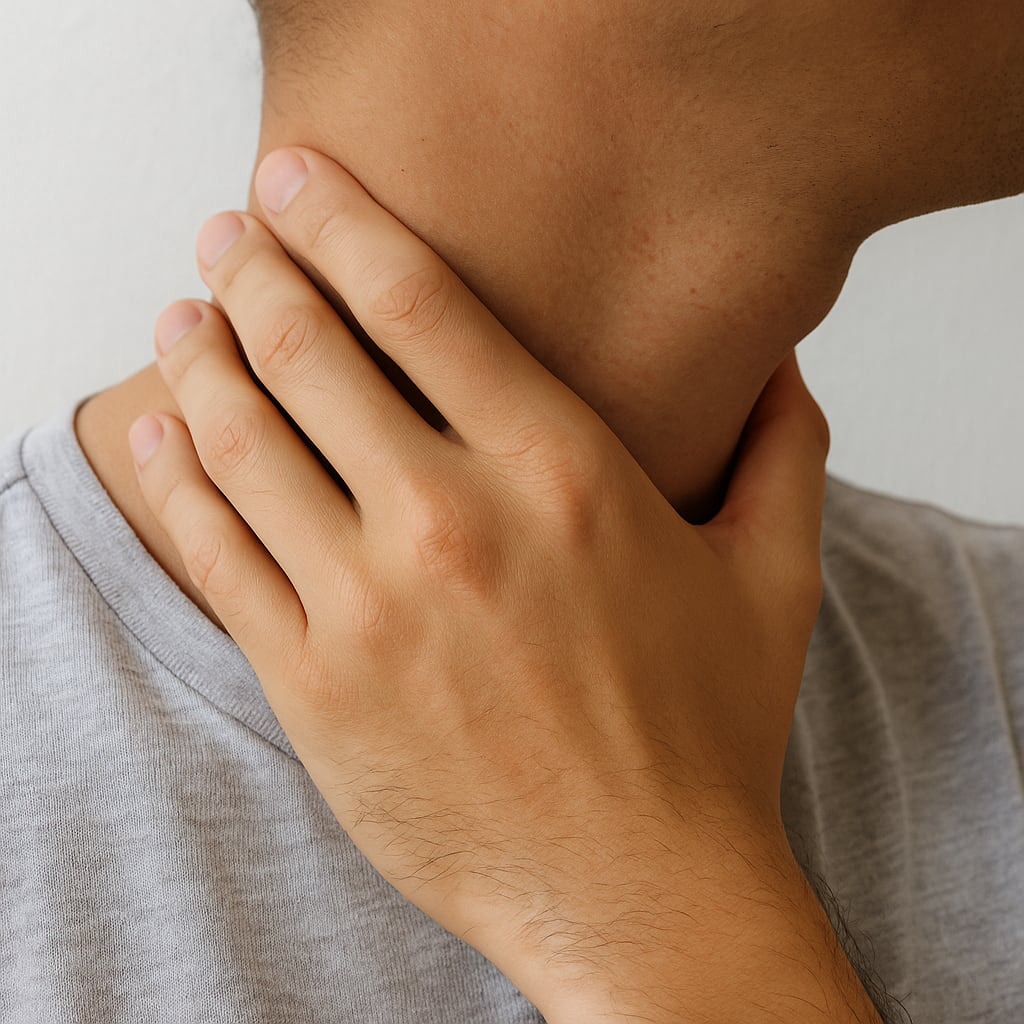
People reach for the head and neck when upset. You see it in waiting rooms, court corridors, kitchens after a hard call, and the driver’s seat in a quiet parking lot. It reads like worry. In the body it is specific.
- Arousal rises,
- breathing goes shallow,
- large muscles prepare for action, and
- executive thinking narrows.
The hand goes to skin because touch is a fast lever on the nervous system when words do not work.
There is a common claim that blood “leaves the brain” for the limbs during fight or flight. The picture is a bit more nuanced than that.
The stress response redistributes blood toward big muscle groups and away from low priority tasks like digestion and peripheral skin. The brain maintains its own supply through tight controls, but the parts that handle planning and restraint downshift under high arousal. That state is called hypofrontality. From the inside it feels like the mind is blank and the body is fast. So the hand reaches for the nearest dial that promises relief. For many people that dial is the neck, jawline, temple, or scalp.
Touch helps because it speaks the language of the vagus. Light contact along the side of the neck, jaw, or upper chest can help the parasympathetic system come back online. Gentle pressure near the carotid sinus can nudge the baroreflex. When baroreceptors sense pressure, heart rate often eases and the body drops a notch. Touch across the face and scalp floods dense sensory pathways that can quiet amygdala heat and steady breath. Even palm to forehead works as a crude ground that increases internal awareness and slows the spin. This is not a hack or a trend. It is basic neuroanatomy paired with learning.
There is a social history under it. Humans are contact regulated from the beginning.
- A hand to the back of the neck,
- a palm sweeping hair from the face,
- a steady hold at the jawline
— these are caregiver moves that tell a child they are held and safe.
The body later repeats the program for itself. Under strain, adults reach for the same anchors. None of this proves guilt, deceit, or weakness. It marks internal load.
You can see categories in the field.
- A neck rub or collar pull when heat and heart rate climb.
- Fingers to the temple when the person is trying to hold a task in working memory while another part wants to bolt.
- Palm over mouth when words are about to jump without permission.
- Throat clear and quick neck wipe in a hot room where temp and noise add friction.
The gesture by itself is never a verdict. It is a timing cue. The right move is to note what you just asked, what topic name was spoken, what detail was requested, and how quickly the person settles once pace and tone ease.
Trauma changes the frequency but not the logic. Survivors of interpersonal violence often guard the throat or jaw when startled. These structures are vulnerable and carry threat memory. Covering or rubbing is the body saying, I feel exposed. The ethical response is to return control to the person. Offer choice points. Slow the pace. Keep the room temperate and quiet. Heat and noise raise error rates. When safety lands you can see the jaw soften, shoulders drop, breath deepen, and sometimes a yawn or sigh. Those are green lights to continue.
There is a cognitive angle that matters for anyone who writes, interviews, teaches, or leads. Self-touch during stress is the body’s attempt to lift the brake on thinking. As arousal rises, working memory shrinks. The mind loops on the threat cue and loses space to track details. A steadying hand at the neck while you ask one precise question can widen that space just enough. It is not magic. It is enough. In high-stakes rooms, that difference changes outcomes.
Use this in practice without theatrics.
- Do not overread a single gesture.
- Watch clusters and sequence.
- Pair what you see with what was just said.
- Trade long monologues for short, concrete questions; specific recall stabilizes a drifting mind.
- Offer water sooner than you think. Swallowing and slow breathing are cheap parasympathetic triggers.
- Keep your own tone steady. Humans entrain. If you are calm, their system has a target to match.
There is also a self-care version that does not look strange in public. If you feel your hand climbing to your neck, treat it as a cue rather than a flaw.
- Place two fingers lightly along the side of the throat just below the jaw.
- Breathe in for four, out for six, three cycles.
- Unhook the jaw and swallow once.
- If you prefer, trace a small circle at the temple while you name the feeling in plain words — angry, sad, embarrassed, scared. Labeling trims noise.
This is not about erasing feeling. It is about buying back enough frontal control to decide what happens next.
For readers who study behavior, keep the ethics straight. Touch is data about load, not a shortcut to motive. A single rub or collar pull does not identify deception. Deception lives in mini patterns inside a larger fact pattern. If the person repeatedly touches head or neck around one topic, then avoids detail on the same topic, then corrects themselves only after you supply the timeline, you are now seeing something meaningful. Without the pattern, you are watching a human try to stay steady.
The short version is simple. Head and neck touching under stress is a built-in, mostly helpful attempt to settle a system that wants to run. It's a form of self-soothing. Blood is not abandoning the brain as flippantly as you may see or hear online, but the parts used for judgment are downshifted. The hand comes up to ask the body to stand down. When that works, language returns, options widen, and the person in front of you — whether that is you or someone you care about — becomes reachable again.
Sources That Don’t Suck:
American Psychological Association, emotion regulation and self-soothing research
Robert Sapolsky, Stanford University, work on stress hormones and behavior
Lisa Feldman Barrett, affect, interoception, and constructed emotion
Stephen Porges, autonomic regulation and social engagement
James J. Gross, process model of emotion regulation
Dacher Keltner, social touch and soothing research
About the Creator
Dr. Mozelle Martin
Behavioral analyst and investigative writer examining how people, institutions, and narratives behave under pressure—and what remains when systems fail.
Keep reading
More stories from Dr. Mozelle Martin and writers in Humans and other communities.
The Angry Man in Your House
"If you grow up with an angry man in your house, there will always be an angry man in your house" This statement has caused plenty of controversy online, people say its a statement that blames victims while also undermining those who break traumatic cycles to form health relationships... but if I'm honest now that I'm in my 30s it makes more sense to me than ever, and I'd argue that its not just about fathers and uncles.
By S. A. Crawford5 days ago in Humans
Dating Red Flags Local Singles Should Watch For On The First Meeting
It is thrilling to meet people for the first time in the neighborhood, yet you will need to be aware and pay attention. Initial interactions can be very revealing as regards one personal character, motives, and emotional temperament. Although attraction and chemistry do count, it is possible to avoid emotional stress, wastage of time, and unsafe situations at the initial stage of recognition of the possible red flags. Most unmarried people do not pay attention to warning signs due to excitement or the possibility of connection. Education is essential to recognize problematic behaviors and make wise choices and focus on personal emotions. Consciousness in the initial contacts will make dating in the locality secure, respectful, and concentrated on the formation of authentic relationships.
By Tiana Alexandra3 days ago in Humans




Comments