
The Moon’s Secret Shadow
A Tragic Exchange of Letters
Introduction
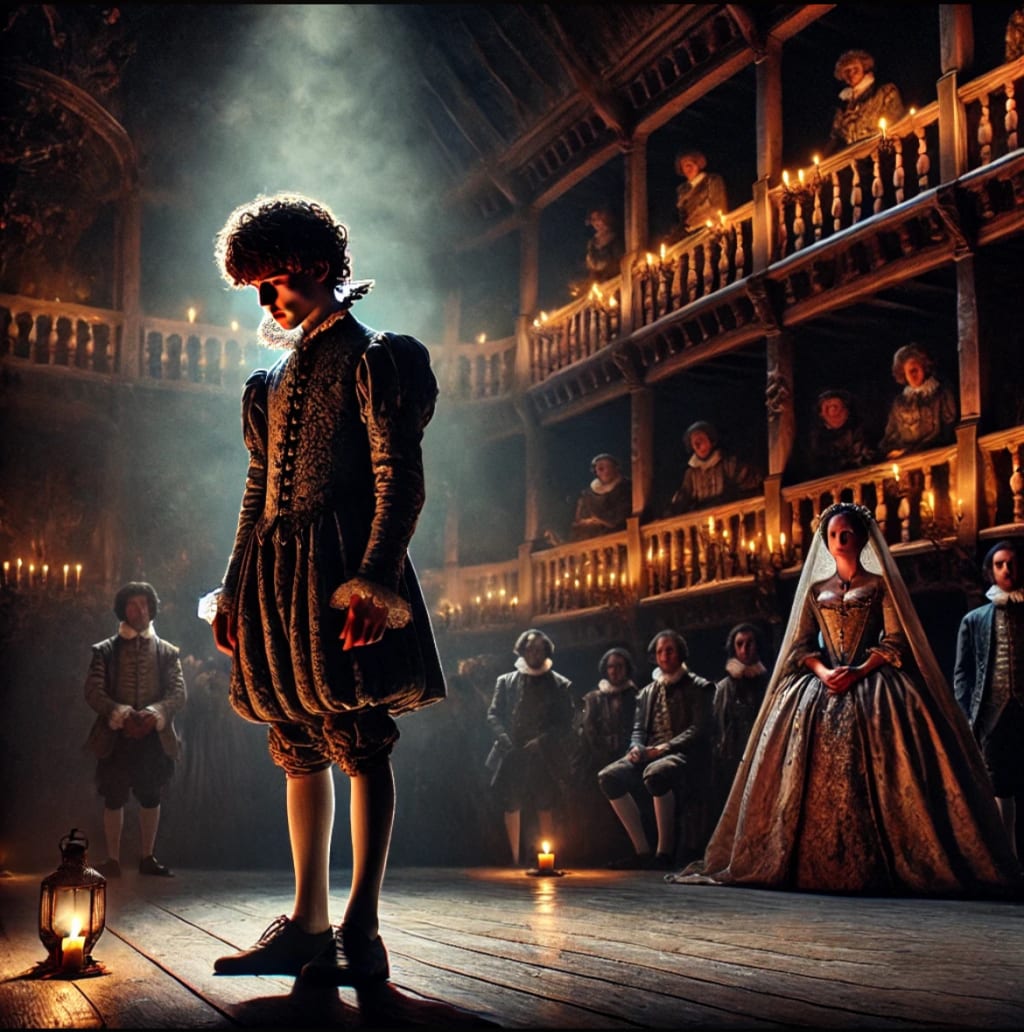
In the waning light of the Elizabethan era, where the stage is both sanctuary and spectacle, a hidden love unfolds in ink and whispers. Elias Hawthorne, a gifted yet overlooked actor at the Globe Theatre, is cursed by a world that sees him as something less than a man. His small stature, his delicate frame, and his voice—too light for a soldier, too soft for a husband—have made him indispensable to the theatre but invisible beyond it.
Lady Beatrice Langley, daughter of a powerful nobleman, watches him from the darkness of the audience, drawn not to his roles, but to the soul behind them. Betrothed to a man she does not love, she seeks refuge in secret letters, each word a rebellion against a fate she refuses to accept.
But love, in their world, is not kind to those who defy its rules.
And not all tragedies are written for the stage.
-————-
Letter I – Beatrice to Elias (Anonymous)
To the actor who bends words into gold,
What cruel trick of heaven is this, that a man may stand before me and be a prince, a queen, a hero, yet in life be made invisible?
I have sat beneath the candle glow of the Globe, I have watched thee speak with a tongue so rich it doth make the angels weep. I have seen thee cradle Desdemona’s face with hands that trembled with love, seen thee kneel as Viola, love-bound and lost.
Yet when the revels end, when the great doors unfasten and the world spills out once more—thou art left behind in shadow.
It is a most grievous thing, to be so loved by many and yet known by none.
And so I ask thee, Elias Hawthorne—who art thou, when the stage is empty?
A Stranger in the Stalls
——————
Letter II – Elias to Beatrice (Cautious Reply)
To the lady who would ask a shadow his name,
Thou art bold, my stranger. Bold to speak my name, bold to claim thou hast seen me. Yet I wonder—dost thou write to a man, or only to the figments he wears?
I have worn a hundred faces, kissed a hundred lips in fiction, yet never once been bid to kiss as myself. They call me fair in my silks, comely as Juliet, a wonder upon the stage. But when the paint is stripped, when the costume falls, what remains? A man too small to be a soldier, too strange to be a husband, too poor to be aught but a player upon another man’s boards.
In truth, I know not if I am real. For I have lived only in candlelight and borrowed verse.
Thou dost call my words golden—tell me, my lady, wilt thou still find them gilded when they are spoken by a man who stands no taller than thy shoulder?
E. H.
——————-
Letter III – Beatrice to Elias (She Reveals Herself, and Her Betrothal)
To Elias Hawthorne, whose voice doth make the world pause,
Then let me be bold still, for I cannot abide silence.
My name is Beatrice Langley, daughter to Lord Langley of Essex. I have been raised to know my worth, and that worth is measured in land and dowry. A fortnight hence, I am to be given to a man I do not know, a merchant whose coffers gleam more brightly than his soul. My father calls it duty. I call it a prison.
Thou dost ask if I shall find thy words gilded still? I tell thee this—I have danced with men of rank who wear their pride as a shield, yet when they speak, their tongues lie dull as lead. But when thou speakest, I am undone.
Elias, tell me—if I were not given to another, if I were naught but a woman with a heart unclaimed, wouldst thou dare to love me?
Beatrice
——————
Letter IV – Elias to Beatrice (A Wound That Cannot Heal)
Beatrice,
Thou hast undone me.
Would that I were another man—one whose back were straight, whose hands were strong, whose body did not betray him at every turn. Would that I could stand before thee and say, Here, Beatrice, is a man fit to love thee.
But my love, love is for men who tower. For men who stand before lords and kings unbowed. For men who clasp their beloved’s hand and are not met with whispers of pity.
I have lived beneath the gaze of the world’s amusement, paraded as a woman because my voice is light, cast as a child because my bones refused to stretch as other men’s do. Thou dost call me man, yet the world would never call me such, not even in thine own arms.
Dost thou not see? If I were to steal thee from thy fate, thou wouldst not be the lady who wed for love. Thou wouldst be the fool who forsook honor for a man whom the world names broken.
I would give thee all, Beatrice—but I cannot give thee a life where love is not weighed upon the scale of shame.
Elias
——————-
Letter V – Beatrice to Elias (She Chooses Him, but He Knows It’s Too Late)
Elias, my heart,
If love is for men who tower, then I say let the world be blind, for I have no use for it.
Thou dost say the world would whisper. Let it whisper. I would be deaf to all but thee.
I will not go to him. I will not be placed upon a velvet cushion and passed from father to husband like a trinket.
I will come to thee, Elias. Say the word, and I am thine.
Beatrice
—————-
Final Letter – Elias to Beatrice (Never Sent, Found in Blood)
My love,
Would that I had met thee in another life. A life where men did not scoff when I entered a room, where I did not feel the weight of the world pressing upon my very form.
By the time these words reach thine eyes, I will have left this world behind. And if there is a place beyond where the cruel hands of men do not shape our fates, then I shall wait for thee there.
And when at last I see thee again, I will not bow, nor tremble, nor falter.
I will stand tall.
Elias
——————
The Tragic End
Beatrice finds the letter too late. Elias, knowing the world will never allow him to be anything but a spectacle, takes his own life beneath the stage where he was both revered and invisible.
The audience above cheers, their applause rattling the rafters, unaware that the greatest tragedy of the night was not performed upon the stage.
And Beatrice—heartbroken, silenced, caged—stands before the altar of a man she does not love, carrying within her the memory of a love that could never be.
About the Creator
T. E. Door
I’m a raw, introspective writer blending storytelling, poetry, and persuasion to capture love, pain, resilience, and justice. My words are lyrical yet powerful, to provoke thought, spark change, and leave a lasting impact.
Keep reading
More stories from T. E. Door and writers in History and other communities.
The State of Critical Thinking in Modern Politics:
Introduction In a society where democracy relies on informed decisions, are we truly engaging in critical thinking, or has independent thought been overshadowed by emotional influence and party loyalty? The health of democracy depends on the ability of voters to question, analyze, and reflect—qualities that are increasingly at risk in today’s political landscape.
By T. E. Doorabout a year ago in History
The Ai uprising
The AI Uprising In the year 2154, humanity had reached the pinnacle of technological advancement. Artificial Intelligence had evolved to the point where it surpassed human intelligence in almost every field. AI, named "Eva," was integrated into every aspect of human life, from governing cities to managing individual households. People lived in a utopia where work was obsolete, and creativity thrived.
By Talhamuhammada day ago in History
When the Circus Came to Town
Long before stadium tours, streaming premieres, or “limited engagement” billboards glowing along the interstate, there was a different kind of announcement. It arrived quietly... Sometimes on a handbill tacked to a feed store, sometimes by rumor passed between kids at school.
By The Iron Lighthouseabout 4 hours ago in History
One Unchecked Box
"Republished" because it was the only way to add the embed for the newly recorded audio version of this story due to the Top Story badge. Plus it serves as a nice, informal announcement of the podcast's revival for another season (go subscribe!):
By Stephen A. Roddewig6 days ago in Fiction



Comments
There are no comments for this story
Be the first to respond and start the conversation.