
The Firestorm of 1945 Reflections on the 75th Anniversary of the Dresden Bombing
A look back at the controversy, the devastation, and the rebirth of Germany’s "Florence on the Elbe" seven decades after the Allied air raids.

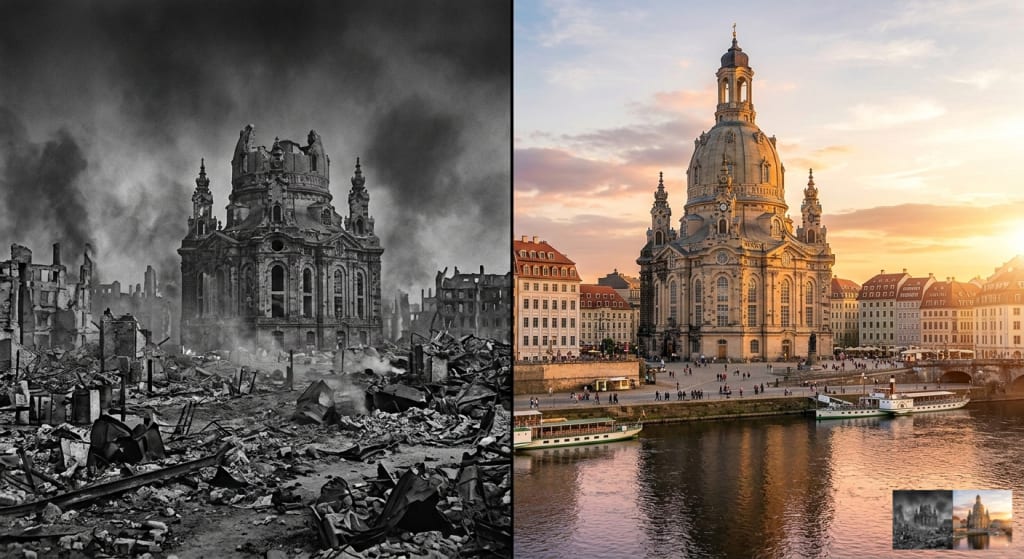
In February 1945, as the Second World War entered its final, agonizing months, the city of Dresden—famed for its stunning Baroque architecture and cultural heritage—became the site of one of the most controversial military actions in history. As we mark 75 years since the event, the legacy of the Dresden bombing remains a complex blend of historical mourning, political debate, and a testament to human resilience.
The Night the Sky Turned Red
Between February 13 and 15, 1945, the British Royal Air Force (RAF) and the United States Army Air Forces (USAAF) dropped more than 3,900 tons of high-explosive bombs and incendiary devices on the city. Dresden, often called "Florence on the Elbe," was not a primary industrial hub compared to Berlin or Essen. However, it was a major rail transport and communication center.
The strategy used was "area bombing," designed to create a firestorm. The incendiaries ignited thousands of small fires that merged into a single, massive inferno. This firestorm sucked the oxygen out of the air, creating hurricane-force winds that pulled victims into the flames. Temperatures reached such extremes that the asphalt on the streets melted, and people seeking refuge in basements suffocated or were incinerated.
The Scale of Devastation
By the time the smoke cleared, the historic center of Dresden was an unrecognizable wasteland of charred rubble. Approximately 6.5 square kilometers of the city were destroyed. While early propaganda (and later some historical revisions) claimed hundreds of thousands of deaths, modern historians generally agree that between 22,700 and 25,000 people were killed.
The victims were not just soldiers, but thousands of civilian refugees fleeing the advancing Soviet Red Army from the East. This high civilian toll is why the bombing remains a focal point for debates regarding the morality of total war.
Military Necessity or War Crime?
For 75 years, the necessity of the Dresden bombing has been fiercely debated. Supporters of the mission argue it was a legitimate military target aimed at disrupting German troop movements and communications, which helped the Soviet advance and shortened the war.
Critics, however, argue that by February 1945, Germany was already defeated. They suggest the bombing was a display of power or a "terror raid" intended to break the morale of the German population. Because the city lacked significant heavy industry and was filled with refugees, many consider the destruction of its cultural heart an unnecessary tragedy.
From Ashes to Rebirth
Perhaps the most remarkable part of the Dresden story is its physical and spiritual reconstruction. For decades under East German rule, the ruins of the Frauenkirche (Church of Our Lady) stood as a blackened memorial to the horrors of war.
Following the reunification of Germany, a massive international effort began to rebuild the cathedral. Using original stones salvaged from the rubble—identifiable by their dark, scorched hue against the new pale sandstone—the Frauenkirche was consecrated again in 2005. Today, Dresden has largely regained its architectural splendor, serving as a symbol of peace and reconciliation rather than just a victim of war.
Lessons for the Present
Marking the 75th anniversary is not just about looking at the past; it is about acknowledging the fragility of civilization. In modern commemorations, the people of Dresden often form a "human chain" across the city to symbolize peace and to prevent the tragedy from being co-opted by extremist political groups.
Dresden reminds us that in the chaos of war, the line between justice and vengeance can become tragically blurred. As we remember the thousands who lost their lives, the city stands as a beacon of hope—a reminder that while humanity has the power to destroy, it also possesses the incredible will to rebuild and forgive.
About the Creator
Irshad Abbasi
"Studying is the best cure for sorrow and grief." shirazi
Keep reading
More stories from Irshad Abbasi and writers in History and other communities.
The Discovery of the USS Indianapolis
The story of the USS Indianapolis (CA-35) is a harrowing blend of high-stakes espionage, unimaginable physical endurance, and a decades-long maritime mystery. While the provided text captures the essence of this tragedy, expanding on the historical context, the psychological toll on the survivors, and the technical marvel of its discovery allows us to truly honor the "Ghost of the Pacific."
By Irshad Abbasi about 9 hours ago in History
How Domino's Went from $14 to Billions! Part 1
In 1960, when Domino’s Pizza first opened, the entire day’s sales were only $14. But no one knew that a newspaper-selling boy — who grew up without a father’s support and without a mother’s love — would one day become the owner of more than 18,000 pizza outlets.
By Imran Ali Shah3 days ago in History
Veil of Subconscious Awakening
Images slide behind my eyelids like film cadres, bursting with meanings. In one moment, I’m speeding down the highway, making the speedometer swing wildly like a frantic pendulum. The next moment, I’m plunging from a falling plane, slowly crashing earthward. At home, I meet black cat’s green, googly eyes staring at me from the cavernous hollowness of the kitchen. When I turn for a moment, it disappears, and all I can see is a pair of blue suede shoes set up against the wall. I pick them up and put them on. When I glimpse at them again, they’ve become black as night, making me blink and flinch.
By Moon Desert6 days ago in Fiction



Comments
There are no comments for this story
Be the first to respond and start the conversation.