
The Discovery of the USS Indianapolis
Unveiling the final resting place of the ship that delivered the atomic age

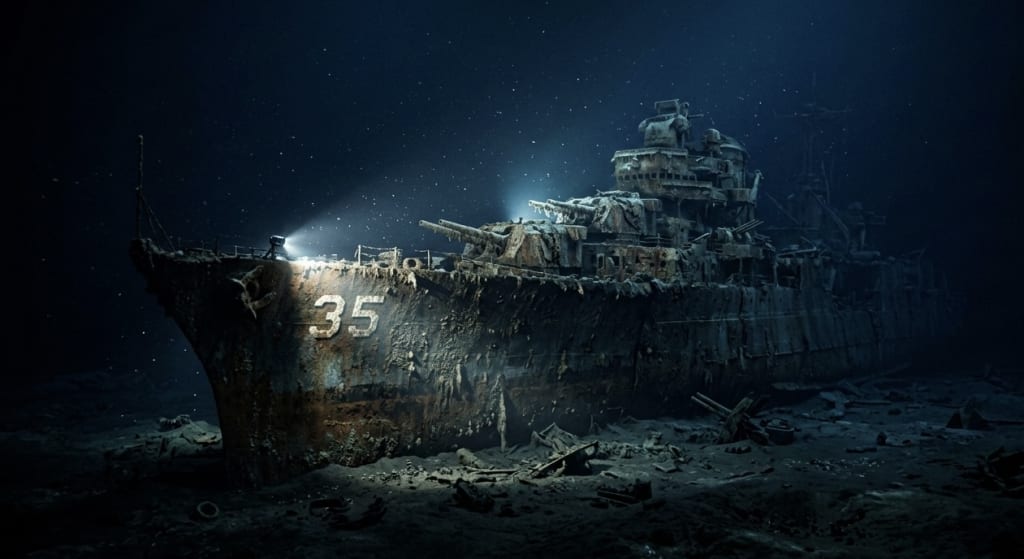
The story of the USS Indianapolis (CA-35) is a harrowing blend of high-stakes espionage, unimaginable physical endurance, and a decades-long maritime mystery. While the provided text captures the essence of this tragedy, expanding on the historical context, the psychological toll on the survivors, and the technical marvel of its discovery allows us to truly honor the "Ghost of the Pacific."
The Secret Cargo: A Catalyst for the Nuclear Age
In the sweltering July of 1945, the crew of the USS Indianapolis found themselves at the center of a mission that would alter the trajectory of human civilization. The ship was chosen for its speed, tasked with transporting a lead-lined crate and a mysterious metal cylinder from San Francisco to the island of Tinian.
The contents were the components of "Little Boy," the first atomic bomb used in warfare. The mission was so classified that the ship sailed without an escort, and the crew was kept in the dark about their cargo. Having successfully delivered the components that would lead to the end of World War II, the cruiser departed for Leyte Gulf. They never reached their destination.
Twelve Minutes to Chaos
On the night of July 30, 1945, the Japanese submarine I-58 spotted the silhouette of the Indianapolis. Two torpedoes struck the starboard side, tearing through the hull. The damage was catastrophic; the ship’s electrical system failed, preventing a distress signal from being successfully broadcast. In a mere 12 minutes, the 610-foot cruiser vanished beneath the waves of the Philippine Sea.
Of the roughly 1,196 men on board, approximately 900 made it into the water. Most had no lifeboats and only a few cork life jackets. They were left floating in the vast, indifferent darkness of the Pacific, unaware that because of the secrecy of their mission and a series of bureaucratic blunders, the Navy didn't even know they were gone.
The Four-Day Purgatory
What followed is widely regarded as the most terrifying survival story in naval history. For four days, the men battled a trifecta of horrors:
1. Dehydration and Salt Poisoning: Under the blistering tropical sun, men became delirious. Some, driven mad by thirst, drank the salt water, which only accelerated their demise.
2. Exposure: The nights were freezing, and the days were scorching. Without fresh water or food, the sailors’ skin began to peel and blister.
3. The Predators: Attracted by the noise and the blood, hundreds of oceanic whitetip sharks converged on the survivors. It is estimated that dozens, if not hundreds, of sailors were lost to shark attacks—the largest mass shark attack in recorded history.
By the time Lieutenant Wilbur Gwinn, piloting a PV-1 Ventura on a routine patrol, spotted the oil slick and the bobbing heads of the survivors by "pure accident," only 316 men were left alive.
The Abyss Yields Its Secrets
For 72 years, the USS Indianapolis sat in a silent, pressurized grave. Many expeditions failed to locate it due to the extreme depth and the inaccuracy of the last reported coordinates. However, in 2017, Microsoft co-founder Paul Allen and his team aboard the Research Vessel Petrel utilized advanced sonar and Remotely Operated Vehicles (ROVs) to scan the seabed.
They found the wreckage at a staggering depth of 18,000 feet (5.5 kilometers)—deeper than the Titanic. The freezing, low-oxygen environment had acted as a time capsule. The hull was remarkably intact, with the number "35" still visible through the silt. The discovery provided a profound sense of closure for the remaining survivors, who had spent a lifetime haunted by the sounds of that night.
A Legacy Written in the Deep
The USS Indianapolis remains a protected war memorial, a site where the souls of over 800 sailors find their final rest. It stands as a testament to the "Greatest Generation"—men who faced the dual shadows of a secret nuclear mission and the primal terrors of the deep sea.
The discovery of the wreck ensures that the "Indy" is no longer a lost ghost. Instead, it serves as a permanent monument to the bravery of those who endured the unthinkable so that the world might find peace.
About the Creator
Irshad Abbasi
"Studying is the best cure for sorrow and grief." shirazi
Keep reading
More stories from Irshad Abbasi and writers in History and other communities.
Why Nagasaki Was Chosen for the Atomic Bomb
The atomic bombing of Nagasaki on August 9, 1945, remains one of the most tragic and controversial events in human history. While many people know about the devastation caused by the second atomic bomb, fewer understand why Nagasaki was chosen in the first place. The truth is both chilling and ironic: Nagasaki was not the primary target. Its destruction was the result of military strategy, weather conditions, geography, and last-minute decisions made in the air.
By Irshad Abbasi about 4 hours ago in History
Worst Mid-Air Crash in Aviation History part 1
It was evening over Delhi when two aircraft carrying a total of 349 people were moving toward each other in the sky. One of them was preparing to land at Delhi Airport, while the other had just taken off from Delhi. Both pilots were receiving instructions from the same air traffic controller, and a vertical separation of 1,000 feet had been maintained between them.
By Imran Ali Shah3 days ago in History
Belle of the Bayou
Bad move, cher. Not just the slip of her kitten heel on the rainy February cobblestones in the Fourth Ward. She got caught snooping. Detective Deleon clucked and strutted like a rooster in his rush to clear her from the scene, waving cigar smoke to and fro as he gesticulated amid the thick air of the speak easy. An experienced crime reporter, Marie knew better than to let the coppers catch her on the wrong side of the line, but curiosity had gotten the better of her.
By Maia Gadwall the metAlchemist5 days ago in Fiction



Comments
There are no comments for this story
Be the first to respond and start the conversation.