Narratives
J. Robert Oppenheimer: The Genius, the Bomb, and the Ethical Conundrum
J. Robert Oppenheimer, a brilliant physicist of the 20th century, is best known for his instrumental role in leading the development of the nuclear bomb during World War II. Although he never won a Nobel Prize, his impact on the world far surpassed that of many laureates. This article delves into Oppenheimer's life, his contributions to science, and the ethical implications of his work on nuclear weapons.
By Thene van Schalkwyk3 years ago in History
Aristotle
The subject of political science has evolved by questioning the nature and importance of concepts like state, constitution, citizenship, laws, and governments. Aristotle, famously referred to as the father of political science, had laid the bricks of the subject. In this blog, you will read about his understanding of the state, classification of constitutions and the cycle of governments. The first man to distinguish between various branches of knowledge had been Aristotle. He differentiated between meteorology, poetics, logic, biology, ethics, natural history, aesthetics, physics, rhetoric, metaphysics and even wrote extensively on these subjects. He did not only lay the foundation stone of political science but also contributed significantly to its elaboration as well. "Politics", "Ethics", and "Rhetoric" are few among many of his works that hold discussions on questions of law, equality, justice, etc. According to Aristotle, political science is a master science. He gives credit to political science as a master-art because, unlike other sciences that serve as a means to an end, political science pertains to the ends of human existence in itself. Aristotle, thus viewed political science as the end to human existence rather than as a means to it. In his book, The Nicomachean Ethics, Aristotle writes, "The supreme good... must be the object of the most authoritative of the sciences - some science which is a master craft. But such is manifestly the science of politics, for it is this that ordains which of the sciences are to exist in states, and what branches of knowledge the different classes of citizens are to learn, and up to what point." His view demonstrates that political science dominates all other sciences. It explains his "Hierarchy of Ends", implying that each branch of knowledge is merely a means and would ultimately serve the end of leading a good life. Note here that Greek philosophers and their view of politics share one common notion. They believe that the state comes into existence for the sake of life and continues for the sake of good life. Aristotle doesn't differ on this notion and is hence considered to view the science of politics as supreme to other sciences.
By Syed Ammar3 years ago in History
Aristotle
Aristotle draws a relation between organ and organism. Each organ of a living being performs a specific function; each individual performs different responsibilities in society. The body consists of different organs performing varied functions, and the body ensures harmony in its functioning. Similarly, the state ensures the communion of various individuals, where the division of labour ensures cooperation and harmony in society. Aristotle and his classification of governments and constitutions are as
By Syed Ammar3 years ago in History
The Amphibious Invasion of Sicily. Content Warning.
In today's video, we'll delve into the intriguing historical event known as the Amphibious Invasion of Sicily. This daring military operation took place during World War II and was proposed by Prime Minister Winston Churchill and the British Chiefs of Staff. The ambitious plan aimed to be the first large-scale offensive operation on the European mainland since the fall of France in 1940. Initially met with astonishment and skepticism, this pivotal campaign played a crucial role in reshaping the course of the war. In this article, we will explore the strategic planning, the challenges faced, and the decisive outcomes of Operation Husky.
By Malik Sarparah3 years ago in History
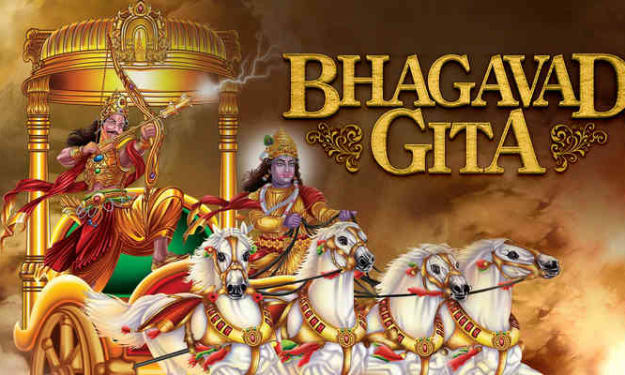
"The Bhagavad Gita: Wisdom and Guidance for Spiritual Seekers"
The Bhagavad Gita, also known as the Gita, is a sacred Hindu scripture that contains a conversation between Prince Arjuna and the god Krishna, who serves as his charioteer. The text is a part of the Indian epic Mahabharata and is revered for its profound spiritual teachings. Here is a summary of the Bhagavad Gita without any plagiarism:
By Go With Trend3 years ago in History
Socrates Was Right: Embracing the Value of Intellectual Inquiry. Content Warning.
Throughout history, many great minds have left an indelible mark on human civilization, shaping the way we think and perceive the world. Among these luminaries, Socrates, the ancient Greek philosopher, stands tall as a paragon of wisdom and intellectual pursuit. Socrates' method of relentless questioning and emphasis on self-examination have not only influenced philosophical thought but also have enduring relevance in our contemporary world. In this essay, we will explore some of the core aspects of Socratic philosophy and demonstrate why Socrates was right in advocating for the importance of critical thinking, self-awareness, and the pursuit of knowledge.
By Asim hussain3 years ago in History
Nelson Mandela. Content Warning.
Title: Nelson Mandela: The Iconic Symbol of Freedom and Equality Introduction Nelson Mandela, a revered global leader and an embodiment of courage, resilience, and forgiveness, stands as an everlasting symbol of hope and justice. Through his unwavering commitment to ending apartheid in South Africa and his lifelong struggle for human rights, Mandela became an iconic figure, inspiring generations across the globe. This blog explores the extraordinary life and achievements of Nelson Mandela, highlighting his pivotal role in dismantling racial segregation and fostering unity in a nation torn apart by discrimination.
By Openee Article 3 years ago in History