General
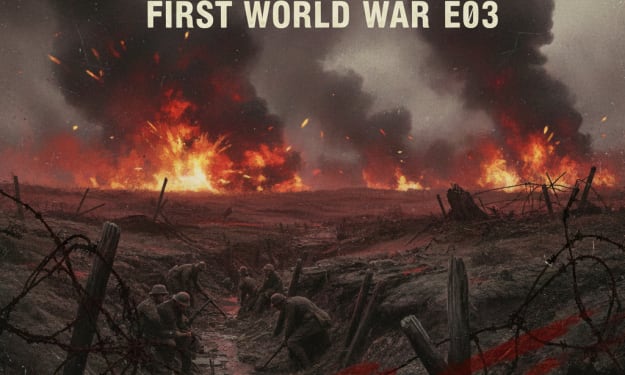
First world war E03,The Battle of Verdun
Introduction The Battle of Verdun stands as one of the most brutal and symbolic conflicts of the First World War. Fought between Germany and France from February to December 1916, this battle became the longest engagement of the war, lasting 302 days. Verdun was not just a military confrontation; it was a test of endurance, national pride, and human survival. Germany’s attempt to break French resistance ultimately failed, but the human cost was staggering.
By Muhammad waqas2 months ago in History
First world war E02,the Eastern Front and Gallipoli
Introduction While World War I is often remembered for trench warfare on the Western Front, some of the most dramatic and decisive events unfolded far from Paris and the English Channel. On the Eastern Front and at Gallipoli, Germany and the Ottoman Empire faced overwhelming enemies but achieved astonishing victories. From the crushing defeat of Russia at the Battle of Tannenberg to the Ottoman resistance against Britain and France at Gallipoli, these campaigns reshaped the balance of power in the First World War.
By Muhammad waqas2 months ago in History
First World War E01 Why Did WWI Start?
In July 1914, Europe stood at the edge of what its rulers believed would be a short and routine conflict. The German and Russian Empires prepared for war with optimism, assuming victory would come within weeks. German Emperor Kaiser Wilhelm II famously told his soldiers they would return home before the leaves fell from the trees. Russian commanders shared similar confidence.
By Muhammad waqas2 months ago in History
"How Did a 10-Day Shift in 1582 Change Christmas Forever?"
The Hidden History of Christmas and the Calendar Shift Christmas is one of the most celebrated holidays in the world, but its association with December 25th was not always so simple. While we take it for granted today, did you know that Christmas, for a time, wasn’t universally celebrated on the same day? This wasn’t due to some quirky holiday tradition, but because of an error in how time was calculated.
By Daily Motivation2 months ago in History
Achilles & Patroclus: A Sapphic Epitaph. AI-Generated.
The story of Achilles and Patroclus remains one of the most compelling and tragic narratives of Greek mythology. Immortalized in Homer’s Iliad, their bond transcends mere friendship or camaraderie on the battlefield. It is a story of devotion, love, loss, and remembrance—a story that resonates with readers across cultures and centuries. By exploring their relationship through the lens of a Sapphic epitaph, we uncover layers of intimacy, grief, and the human desire to memorialize love in the face of mortality. The Friendship and Beyond Achilles, the greatest Greek warrior of the Trojan War, and Patroclus, his steadfast companion, were inseparable. While many have debated the exact nature of their bond, classical sources portray a connection that blends loyalty, affection, and profound emotional intimacy. In Homer, Patroclus’ death becomes the catalyst for Achilles’ ultimate transformation. The grief that consumes Achilles is not merely the sorrow of losing a comrade—it is the anguish of losing someone irreplaceable, someone whose presence defined his life both on and off the battlefield. A Sapphic epitaph, traditionally a poetic tribute to the dead, often explores love, devotion, and the fragility of life. Applying this framework to Achilles and Patroclus highlights the depth of their relationship: it is love memorialized in poetic and elegiac form. Sapphic Poetry and Mourning Sappho, the ancient Greek poetess, was celebrated for her ability to capture passion, tenderness, and melancholy within the constraints of her lyrical form. Her epitaphs often focused on the enduring power of memory and the impossibility of fully expressing the loss of someone beloved. By framing Patroclus’ death in a Sapphic lens, we recognize the silent lamentations of Achilles. Every act of mourning—be it in tearing his garments, refusing sustenance, or venturing into battle with unparalleled fury—can be seen as part of a poetic elegy in motion. Achilles’ grief is simultaneously private and performative, blending heroism with heartbreak, a duality mirrored in Sappho’s verses. Immortality Through Memory One of the striking themes in using a Sapphic perspective is the pursuit of immortality through remembrance. While humans are mortal, the act of memorializing someone in poetry or in ritual creates a form of eternal life. Patroclus, though killed in battle, lives on through Achilles’ actions. His name is invoked in oaths, in mourning rituals, and in the relentless pursuit of vengeance against Hector. In Sapphic tradition, love and grief are intertwined with memory—the dead are kept alive not through flesh but through devotion and remembrance. Thus, the Sapphic epitaph for Patroclus might not merely recount his death; it would celebrate his virtues, his gentleness, his courage, and the immeasurable impact he had on Achilles’ life. The Intersection of Heroism and Love Achilles’ rage following Patroclus’ death is legendary. It underscores the interplay of heroism and emotional vulnerability. In the Greek heroic code, warriors are defined by physical strength, courage, and honor. Yet the loss of Patroclus reveals Achilles’ emotional core—a profound capacity for love and grief that complicates the archetype of the stoic hero. In writing a Sapphic epitaph for Patroclus, one does not merely mourn the fallen hero; one honors the intertwining of martial prowess with emotional depth. It is a reminder that even the mightiest warriors are capable of tender devotion. Literary Legacy Throughout centuries, scholars, poets, and writers have revisited Achilles and Patroclus’ relationship. From medieval retellings to modern interpretations, their story has been viewed through various lenses: romantic, platonic, and even homoerotic. A Sapphic approach emphasizes the intimate, elegiac dimension of their bond. It invites readers to consider how grief and love coexist in the aftermath of loss, and how human relationships are immortalized through words, ritual, and remembrance. The beauty of the Sapphic lens lies in its subtlety. Unlike grand epics or heroic eulogies, it dwells in the quiet spaces—the unspoken words, the shared glances, the tender memories that survive beyond death. Conclusion: Love, Loss, and Eternal Memory In examining Achilles and Patroclus through a Sapphic epitaph, we see a narrative that is timeless, universal, and profoundly human. Their story reminds us that love is not always loud or performative. Sometimes, it is quiet, enduring, and immortalized in grief. Through the loss of Patroclus, Achilles embodies the duality of human existence: strength and vulnerability, rage and tenderness, mortality and the desire for remembrance. A Sapphic epitaph does not merely mourn; it immortalizes, giving voice to the eternal bond that transcends death itself. In the end, Achilles and Patroclus remain emblematic not only of heroic valor but of love’s enduring power—a power that survives through memory, poetry, and the quiet eternity of the heart.
By Zahid Hussain2 months ago in History
The Disappearance of the Flannan Isles Keepers: Food on the Table and an Empty Room. AI-Generated.
Deadly Silence and an Unfinished Meal December 26, 1900. The steamer *Hesperus* sliced through the black swells, its iron groaning against the oppressive silence of the North Atlantic. No beam of light pierced the dark; no distress signal rose. The Flannan Isles lighthouse stood like a severed transmission tower, as silent as a deactivated server.
By Mohammad Hammash2 months ago in History