Books
Top 20 most terrifying mysteries that were finally solved
Today we're counting down our picks for the top 20 most terrifying mysteries that were finally solved For this list, we're looking at perplexing crimes and historical events that were finally solved. Are you pleased with these answers?
By Francis Dami3 years ago in History
Pompeii (Italy)
In the shadow of the mighty Mount Vesuvius, nestled in the Italian countryside, lies the ancient Roman city of Pompeii. Once a bustling metropolis, it was frozen in time on that fateful day in 79 AD when the volcano unleashed its fury, burying the city under layers of volcanic ash. Pompeii's tragic tale remained hidden for centuries until its rediscovery in the 18th century brought its haunting past back to life.
By Pravin Avhad3 years ago in History
Rosetta Stone (Egypt)
In the year 1799, in the midst of Napoleon Bonaparte's military campaign in Egypt, a group of French soldiers stumbled upon a peculiar stone slab while excavating the ruins of Fort Julien near the town of Rosetta. Little did they know that this chance discovery would hold the key to unraveling the mysteries of ancient Egypt and revolutionize our understanding of its enigmatic hieroglyphic script.
By Pravin Avhad3 years ago in History
Machu Picchu (Peru)
In the heart of the Peruvian Andes, shrouded by mist and nestled amidst lush green mountains, lies the magnificent citadel of Machu Picchu. This awe-inspiring archaeological site, with its imposing stone structures and breath taking panoramic views, is a testament to the remarkable achievements of the ancient Inca civilization. However, for centuries, Machu Picchu remained concealed, its existence known only to the locals who lived in its shadow.
By Pravin Avhad3 years ago in History
Terracotta Army (China)
In the heartland of ancient China, nestled near the city of Xi'an, a remarkable archaeological discovery was made in 1974—a discovery that would captivate the world and shed light on the grandeur of an empire lost to time. The unearthing of the Terracotta Army forever changed our understanding of ancient China and introduced us to an army of silent guardians—captivating life-sized clay sculptures that depict the warriors of the first Emperor of China, Qin Shi Huang.
By Pravin Avhad3 years ago in History
The Living Goddess. Content Warning.
In the vibrant tapestry of Hindu culture and mythology, the concept of Kumari Devi, the living goddess, stands as a captivating symbol of divinity and feminine power. For centuries, Nepal has held this tradition close to its heart, honoring a young girl who embodies the essence of the goddess Durga. Join me on a mystical journey as we delve into the enchanting world of Kumari Devi and uncover the significance she holds in the hearts of the Nepalese people.
By Naruto Uzumaki3 years ago in History
ascient wisdom for well-being
Explo Ancient healing practices have long been revered for their profound wisdom and effectiveness in promoting well-being and balance. These traditional systems of medicine, developed over centuries by civilizations around the world, offer invaluable insights into the holistic nature of health and the interconnection between the body, mind, and spirit.
By Clinton Patrick3 years ago in History
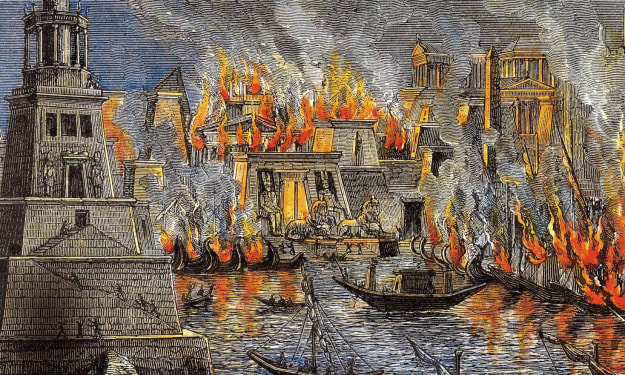
The Library of Alexandria: A Lost Oasis of Knowledge
I. The establishment and significance of the Library of Alexandria In the third century BCE, the city of Alexandria in Egypt stood as a beacon of intellectual enlightenment. At the heart of this flourishing center of learning was the legendary Library of Alexandria, a grand institution that housed an awe-inspiring collection of ancient literature. Established by Ptolemy I, it quickly became the most renowned library of the ancient world, attracting scholars, philosophers, and thinkers from far and wide.
By Huzaifa Mehmood3 years ago in History
The Irreplaceable Loss: The Destruction of Ancient Literature
Introduction: Throughout human history, literature has played a pivotal role in preserving and transmitting knowledge, culture, and ideas across generations. From the ancient epics of Homer to the philosophical treatises of Aristotle, these timeless works have shaped civilizations and provided profound insights into the human experience. However, the world has witnessed numerous instances where invaluable ancient literature has been irretrievably lost due to various forms of destruction. This article delves into the heartbreaking consequences of the destruction of ancient literature and the impact it has on our understanding of the past.
By Huzaifa Mehmood3 years ago in History
From Freedom of Religion to Freedom of Thought: How "American" Literature Both Evolved and Stagnated Throughout the Centuries
The following essay is a final analysis for my American Lit course in University. While American Literature is one of my least favorites, it is also a fascinating evolution throughout history, and is my inaugural submission to the newest history community (my least favorite subject). I have adapted this essay to be slightly more pleasant to read in digital format. It is a long read, but it received an A from my professor, so maybe there is something worthwhile within (;
By Lena Beana3 years ago in History