
Salahuddin Ayyubi: The Unifier of the Muslim World
Uniting a Divided Muslim World Against the Crusaders

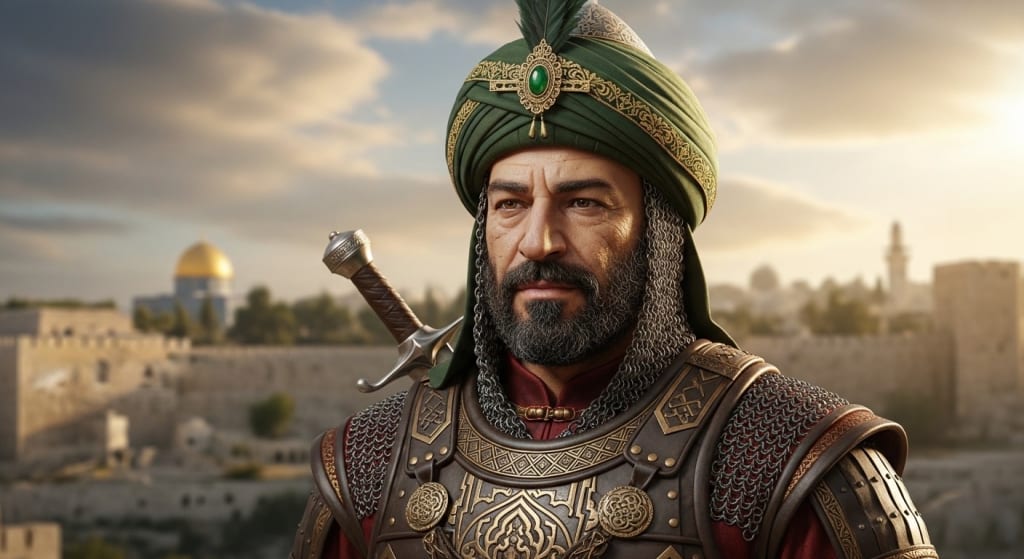
**Title:**
**Salahuddin Ayyubi: The Unifier of the Muslim World**
**Subtitle:**
*How Saladin Overcame Internal Division, Mastered Strategy, and Reclaimed Jerusalem Through Wisdom and Unity*
---
Salahuddin Ayyubi (Saladin) was a great Muslim military commander and ruler of the twelfth century, known for uniting the Muslim world and leading a successful struggle against the Crusaders. However, his greatest challenge was not only the Crusaders themselves, but also certain Muslim rulers who, in order to protect their personal interests and hold on to power, formed alliances with the Crusaders. This situation weakened and divided the Muslim world, and the Crusader powers took advantage of this division. The political fragmentation of the era meant that cities like Damascus, Aleppo, Mosul, and Cairo often operated as independent principalities, each with its own agenda, making coordinated defense nearly impossible.
During that period, the Muslim world was not politically united. Separate Muslim rulers governed Egypt, Syria, Iraq, and other regions. Many of these rulers conspired against one another, and at times even sought help from the Crusaders. These Crusader-Muslim alliances worked against Saladin because the basic goal of the Crusaders was to occupy Muslim lands and maintain their control over Jerusalem. Due to this division, Muslims were unable to mount an effective resistance against the Crusaders. For instance, some Zengid princes in Syria preferred Crusader support against rival Muslim factions rather than joining a unified front—a reality that Saladin had to navigate with both military force and diplomatic finesse.
Saladin began his political and military career in Egypt, which at that time was under the rule of the Fatimid Caliphate. The Fatimid Caliphate had become weak and was suffering from internal conflicts, sectarian tensions between Sunni and Shia communities, and economic decline. With wisdom and strategic planning, Saladin ended the Fatimid Caliphate in 1171, peacefully restoring Sunni Islam as the state creed and pledging allegiance to the Abbasid Caliph in Baghdad. This step transformed Egypt into a strong and unified Muslim state, which later played a central role in the war against the Crusaders. He also invested in building Cairo's defenses, establishing madrasas to promote learning, and strengthening the economy—foundations that would sustain his military campaigns for years to come.
After strengthening Egypt, Saladin turned his attention toward Syria. At that time, Syria was ruled by several small Muslim leaders, some of whom had peace treaties or alliances with the Crusaders. Saladin defeated these rulers and brought important Syrian cities such as Damascus, Aleppo, Homs, and Hama under his control. The purpose of these conquests was not to gain personal power, but to unite the Muslim world and establish a strong front against the Crusaders. He often preferred negotiation over bloodshed, offering generous terms to rivals who submitted peacefully—a strategy that minimized internal resentment and preserved resources for the larger struggle ahead.
Saladin's strategy was to first build internal unity and bring Muslim territories together under a single authority. When both Egypt and Syria came under his control, a strong and well-organized Muslim army was formed. With this united force, he became capable of effectively confronting the Crusaders. He reformed military logistics, established supply lines across the desert, and trained troops in coordinated maneuvers. Had the Muslim world remained divided, defeating the Crusaders would have been extremely difficult. His ability to mobilize resources from the Nile Valley to the Euphrates gave him a strategic depth that the fragmented Crusader states could not match.
Finally, in 1187, Saladin achieved a decisive victory over the Crusader army in the Battle of Hattin. This battle is considered one of the most important fights in history. By cutting off the Crusaders' access to water near the Horns of Hattin and using superior mobility, Saladin's forces exhausted and overwhelmed their opponents. After this victory, the power of the Crusaders weakened, and Saladin reclaimed Jerusalem for the Muslims. This was a great achievement because Jerusalem is a sacred city for Muslims, Christians, and Jews alike. Notably, Saladin's entry into Jerusalem was marked by remarkable chivalry: he granted safe passage to civilians, protected holy sites, and allowed Christian pilgrims to visit—actions that earned him respect even among his enemies.
The real reason behind Saladin's success was his wisdom, patience, and policy of unity. He first defeated or brought into his fold those Muslim rulers who were allied with the Crusaders, and then, by building a unified Muslim power, he confronted the Crusaders. In this way, he not only united the Muslim world but also immortalized his name as a great leader in Islamic history. Beyond the battlefield, Saladin was known for his justice, humility, and generosity. He ruled with a council of advisors, promoted trade and agriculture, and invested in public infrastructure. Even his adversaries, such as King Richard the Lionheart during the Third Crusade, acknowledged his honor and integrity.
Saladin's legacy extends far beyond his military victories. He demonstrated that lasting strength comes not from conquest alone, but from moral leadership, strategic patience, and the ability to unite diverse peoples under a common purpose. In an era marked by fragmentation and short-term thinking, his life offers timeless lessons: that unity is a prerequisite for resilience, that wisdom often outweighs brute force, and that true leadership serves a cause greater than oneself. Today, Salahuddin Ayyubi remains a symbol of courage, faith, and principled leadership—not only in the Muslim world but across cultures that value honor, justice, and the pursuit of peace through strength.
---
About the Creator
Literary fusion
Welcome to literary fusion where art and literature intertwine to create a vibrant tapestry. I am [Abdullah Shabir], an artist and writer exploring self-expression through colors and carefully chosen words.
Keep reading
More stories from Literary fusion and writers in History and other communities.
The Iran Crisis: A Strategic Breakdown
**Title:** A few months ago, large Chinese cargo planes were reported in Iran, and it was claimed that advanced defense equipment was being transferred to Iran. Now, according to new reports, Chinese technology is being used in Iran, and as a result, Iran has shot down three American aircraft over Kuwait. While these specific incidents remain unverified by independent international sources, they reflect broader concerns about escalating military-technical cooperation between Tehran and Beijing. Notably, in 2021, Iran and China signed a comprehensive 25-year strategic partnership agreement covering economic, energy, and security cooperation—a framework that could plausibly facilitate defense technology transfers.
By Literary fusiona day ago in Earth
John Lennon And Blackpool: A Life Threaded Through A Seaside Town
John Lennon’s connection to Blackpool begins long before the Beatles, long before the cameras and the roar of theatre crowds. It starts in the small, bright details of childhood holidays, in the smell of sea air and the glow of variety‑show stages, and it runs forward into one of the most painful scenes of his early life. Yet the story does not stop there. Blackpool also stands quietly at the origin of his first great love, his first wife, and the mother of his first child. The town becomes a kind of hidden axis in his life: a place of early joy, a site of rupture, a stage of triumph, and the birthplace of the woman who would share his formative years of fame.
By Julie O'Hara - Author, Poet and Spiritual Warrior5 days ago in History



Comments
There are no comments for this story
Be the first to respond and start the conversation.