
Dracula: The Real Man Behind the Legend and His War Against the Ottoman Empire
The true story of Vlad the Impaler, the ruthless Wallachian ruler whose brutal fight against the Ottoman Empire inspired the Dracula myth.

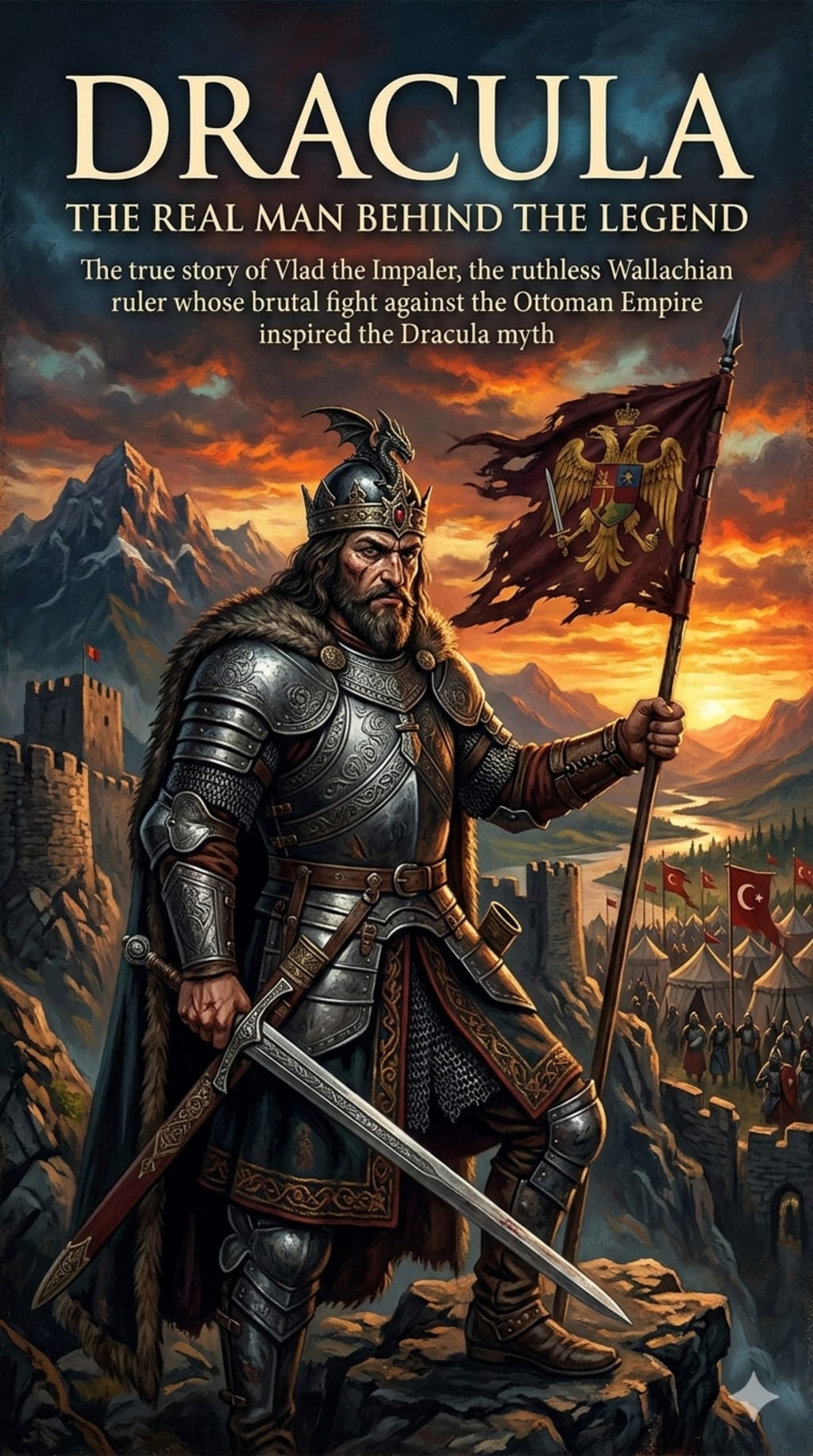
Vlad III was born in 1431 in the region of Transylvania, which is now part of modern-day Romania. He belonged to a noble family and was the son of Vlad II Dracul, a member of the Order of the Dragon, a Christian military order created to defend Europe against the Ottoman Turks. The name Dracul meant “dragon,” and Vlad III later became known as Dracula, meaning “son of Dracul” or “son of the dragon.”
During the 15th century, the Ottoman Empire was expanding rapidly across southeastern Europe. Many small kingdoms and principalities in the region, including Wallachia, were forced to pay tribute to the Ottoman sultan. Wallachia was strategically located between the Ottoman Empire and the Kingdom of Hungary, making it an important buffer state.
As a young boy, Vlad and his younger brother Radu were taken hostage by the Ottoman Empire. This was a common political practice at the time. Their father, Vlad II Dracul, had agreed to send his sons to the Ottoman court as a guarantee of loyalty to Sultan Murad II. Vlad spent several years in the Ottoman court, where he received education and military training. However, this experience deeply affected him and may have contributed to the intense hatred he later developed toward the Ottomans.
In 1447, Vlad’s father was assassinated during a political conflict, and Wallachia fell into chaos. After years of struggle and shifting alliances, Vlad III finally became the ruler of Wallachia in 1456. Once in power, he began strengthening his control and punishing enemies with extreme cruelty. His most infamous method of execution was impalement, where victims were placed on long wooden stakes. This brutal punishment earned him the nickname “Vlad the Impaler.”
Vlad’s rule soon brought him into direct conflict with the Ottoman Empire. At first, Wallachia had to pay tribute to the Ottomans, but Vlad refused to continue this practice. Around 1461, he stopped paying taxes to Sultan Mehmed II, the same Ottoman ruler who had conquered Constantinople in 1453.
Instead of submitting, Vlad launched a series of raids across the Danube River into Ottoman territory. His attacks were extremely violent. According to historical records, he destroyed villages and killed thousands of Ottoman soldiers and civilians. These actions were both military strategy and psychological warfare.
The conflict reached its peak in 1462 when Sultan Mehmed II personally led a large Ottoman army into Wallachia to defeat Vlad. Despite being heavily outnumbered, Vlad used clever tactics to resist the invasion. One of his most famous actions was the “Night Attack at Târgoviște.” During this daring raid, Vlad and his soldiers secretly entered the Ottoman camp at night in an attempt to assassinate the sultan.
Although the assassination attempt failed, the attack created chaos among the Ottoman troops. When Mehmed II advanced further into Wallachia, he encountered a horrifying sight known as the “Forest of the Impaled.” Thousands of captured Ottoman soldiers had been impaled on stakes outside the capital city. This gruesome display was meant to frighten the Ottoman army and demonstrate Vlad’s ruthless determination.
Even the powerful Ottoman army was shocked by this scene. Historical accounts say that Sultan Mehmed II eventually withdrew his forces, although the Ottomans later supported Vlad’s brother Radu in taking control of Wallachia.
Vlad III was eventually captured by Hungarian forces and spent many years in imprisonment. Later he regained the throne briefly in 1476 but was killed in battle soon afterward. His exact burial place remains uncertain.
Although Vlad the Impaler died centuries ago, his reputation for cruelty became legendary across Europe. Stories about his brutal punishments spread widely and were often exaggerated. When Irish author Bram Stoker wrote his famous novel in the 19th century, he borrowed the name “Dracula” from Vlad’s historical identity, transforming the ruthless prince into the world’s most famous vampire.
Today, Vlad III remains one of the most controversial figures in European history. Some people see him as a cruel tyrant, while others view him as a national hero who defended his land against the expansion of the Ottoman Empire.
The legend of Dracula may belong to fiction, but the real story of Vlad the Impaler is far more complex—and perhaps even more terrifying.
About the Creator
Irshad Abbasi
Ali ibn Abi Talib (RA) said 📚
“Knowledge is better than wealth, because knowledge protects you, while you have to protect wealth.
Keep reading
More stories from Irshad Abbasi and writers in History and other communities.
The King’s Highway: The Ancient Road That Witnessed Saladin’s March to War
For thousands of years, a legendary road has cut through the rugged mountains and deserts of the Middle East, linking civilizations, armies, and cultures. Known today as the King’s Highway, this ancient route is one of the oldest continuously used roads in human history. Stretching through what is now modern Jordan, the road once connected the trading cities of Egypt to the fertile lands of Syria and Mesopotamia. Over centuries, merchants, pilgrims, prophets, and conquerors traveled along it. Among them were the soldiers of the great Muslim commander Saladin, whose army marched along this route during the dramatic battles of the Crusades.
By Irshad Abbasi about 19 hours ago in History



Comments
There are no comments for this story
Be the first to respond and start the conversation.