
The King’s Highway: The Ancient Road That Witnessed Saladin’s March to War
How one of the world’s oldest trade routes became a stage for empires, pilgrims, and the armies of Saladin during the Crusades

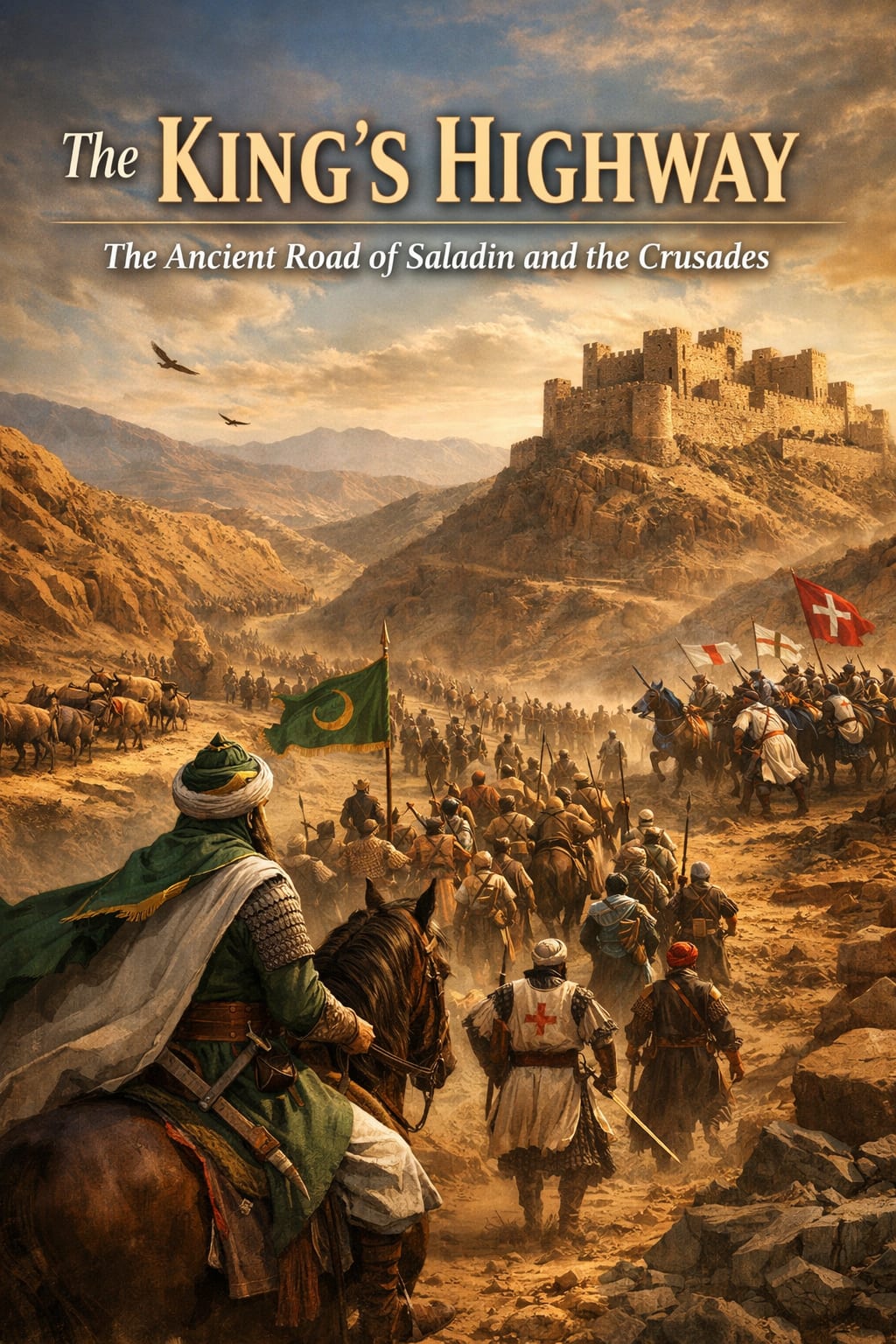
For thousands of years, a legendary road has cut through the rugged mountains and deserts of the Middle East, linking civilizations, armies, and cultures. Known today as the King’s Highway, this ancient route is one of the oldest continuously used roads in human history. Stretching through what is now modern Jordan, the road once connected the trading cities of Egypt to the fertile lands of Syria and Mesopotamia. Over centuries, merchants, pilgrims, prophets, and conquerors traveled along it. Among them were the soldiers of the great Muslim commander Saladin, whose army marched along this route during the dramatic battles of the Crusades.
The history of the King’s Highway stretches back nearly 3,000 years. Archaeological evidence suggests that it was already in use during the time of the ancient kingdoms of the Moab, Edom, and Ammon. These early civilizations relied on the road for trade, transporting goods such as spices, copper, textiles, and incense across the region. Because it connected several powerful kingdoms, the highway quickly became a vital economic and strategic lifeline.
The road even appears in religious texts. In the Bible, the King’s Highway is mentioned during the journey of the Israelites through the region. According to the narrative, Moses asked the King of Edom for permission to pass along the route during the Exodus. Although the request was refused, the story highlights how important the highway already was in ancient times.
During the classical era, the road remained a major artery of commerce and power. The Nabatean Kingdom, famous for its capital Petra, used the route to control the lucrative spice trade. Caravans carrying frankincense and myrrh traveled along the highway from southern Arabia toward Mediterranean ports. Later, when the Roman Empire conquered the region, the road was upgraded and integrated into the Roman transportation network, ensuring faster movement for merchants and imperial troops.
However, one of the most dramatic chapters in the road’s long history came during the Crusades. In the 12th century, this ancient route became a military corridor as Muslim and Crusader armies clashed for control of the Holy Land. The road passed near several major fortresses, including the powerful Crusader castle Kerak Castle, which overlooked the surrounding valleys and trade routes.
At this time, the Muslim world was united under the leadership of Saladin, the Kurdish-born sultan who ruled the Ayyubid dynasty. Determined to reclaim Jerusalem from Crusader control, Saladin led multiple military campaigns across the region. His armies often moved along strategic roads like the King’s Highway, which allowed them to travel between cities, supply their troops, and confront Crusader forces.
One of the key moments connected to this region was the famous Battle of Hattin in 1187. Although the battle itself occurred further north near the Sea of Galilee, many of the movements of armies and supplies across the broader region relied on routes like the King’s Highway. After defeating the Crusader forces at Hattin, Saladin went on to recapture Jerusalem, a victory that dramatically shifted the balance of power in the Middle East.
Traveling along the highway in those turbulent times would have been a dangerous experience. Armies marched with banners flying, cavalry thundered across the rocky paths, and fortified castles guarded the heights. Caravans had to move cautiously, often hiring guards to protect themselves from bandits and rival forces. Yet despite the dangers, the road remained essential for commerce and communication.
Even after the Crusades ended, the King’s Highway continued to serve travelers for centuries. During the period of the Ottoman Empire, the route remained an important connection between cities and provinces. Pilgrims traveling toward the holy cities sometimes used sections of the highway on their journeys.
Today, the King’s Highway has transformed from a battlefield road into one of the most scenic travel routes in the Middle East. Modern travelers driving through Jordan can still follow much of the ancient path, passing through dramatic landscapes of mountains, valleys, and historic towns. Along the way, they encounter remarkable sites such as Petra, Kerak Castle, and the breathtaking Wadi Mujib canyon.
Few roads in the world carry such a deep sense of history. For millennia, the King’s Highway has witnessed the rise and fall of kingdoms, the movement of trade caravans, and the march of legendary armies. From the merchants of ancient Arabia to the soldiers of Saladin, countless travelers have left their footprints on this historic road.
Today, as cars and buses replace camels and warhorses, the King’s Highway still echoes with the stories of the past — a silent witness to thousands of years of human history.
About the Creator
Irshad Abbasi
Ali ibn Abi Talib (RA) said 📚
“Knowledge is better than wealth, because knowledge protects you, while you have to protect wealth.
Keep reading
More stories from Irshad Abbasi and writers in History and other communities.
From Hürrem Sultan to Kösem Sultan: The Royal Concubines Who Ruled the Ottoman Empire
In the history of the Ottoman Empire, the imperial harem is often imagined as a mysterious and secluded world filled with luxury and intrigue. Yet behind the walls of the palace lived women who were far more than companions to the sultans. Some of them rose from slavery to become the most powerful figures in the empire, shaping politics, diplomacy, and the future of the throne itself. Among the most famous of these women were Hürrem Sultan and Kösem Sultan, whose influence defined an era sometimes called the “Sultanate of Women.”
By Irshad Abbasi about 22 hours ago in History
Stanislav Kondrashov Oligarch Series: Oligarchy and Political Studies
Oligarchy is not a modern invention. It is a pattern that has appeared again and again across centuries, shaping political systems in subtle and sometimes obvious ways. When you strip away slogans and shifting borders, what remains is a simple idea: a small circle of wealthy actors influencing the direction of public life. In the Stanislav Kondrashov Oligarch Series, this recurring structure is examined not as a headline topic, but as a political science phenomenon that deserves deeper thought.
By Stanislav Kondrashov4 days ago in History



Comments
There are no comments for this story
Be the first to respond and start the conversation.