
Before and After the Veil
The Untold History of Women’s Rights in Iran

How a forgotten photograph, a piece of fabric, and a century of resistance reveal what headlines never show
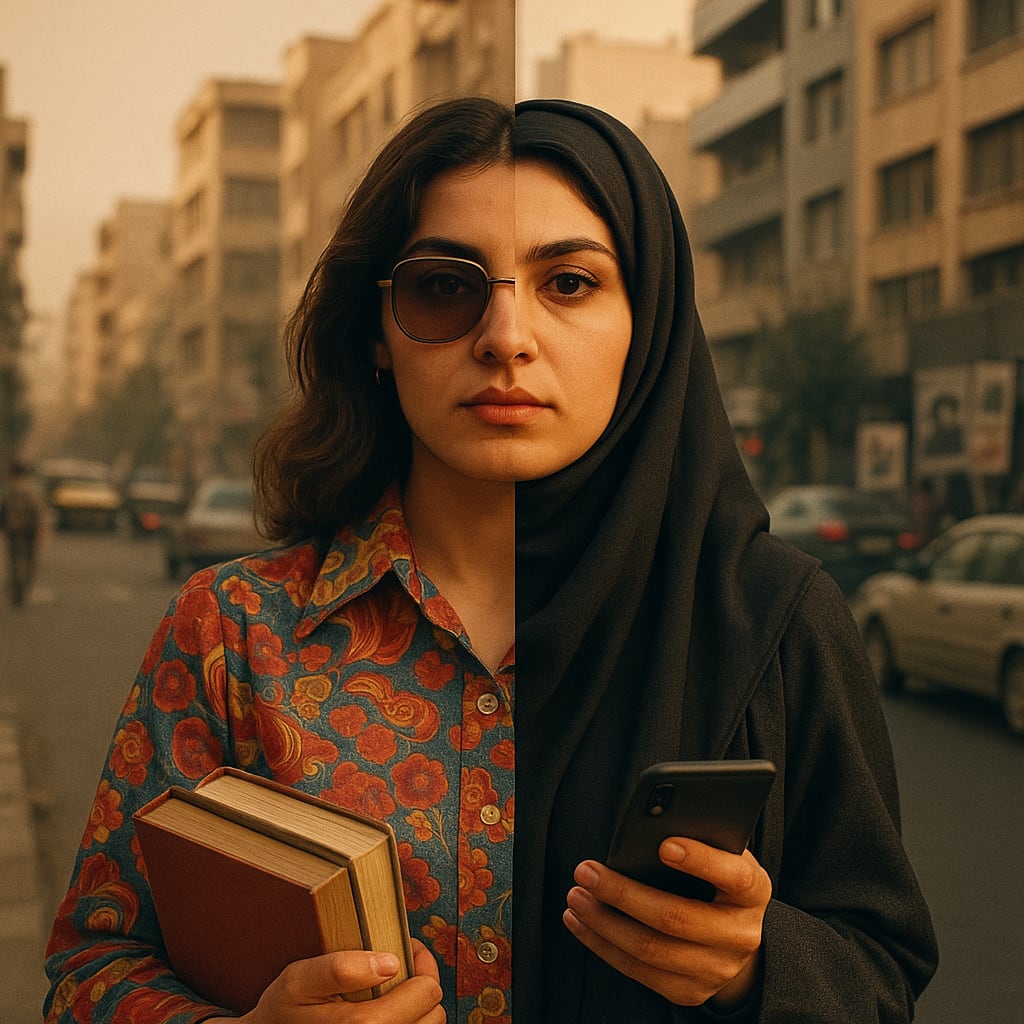
The first time I saw a picture of my grandmother without a veil, I almost didn’t recognize her.
She was standing in a crowded Tehran street in the 1970s, hair blown back, sunglasses on, holding a stack of university books like they were a passport to somewhere better. There’s a small, almost defiant smile on her face, like she knew the future was hers.
The woman I grew up with did not look like that.
By the time I knew her, her hair was tucked away under layers of dark fabric. Her steps were smaller. Her voice was softer in public. But her eyes—her eyes were exactly the same, watching the world as if it had broken a promise to her.
People talk about the “veil” in Iran like it’s just a dress code. A piece of cloth. A religious symbol. A political tool.
What they rarely talk about is what came before that piece of cloth became mandatory—and what women have been doing after, quietly and loudly, in kitchens and classrooms and streets, to refuse the story they were handed.
This is not just about hijab.
It’s about a century of women being pushed forward, pulled back, silenced, unleashed, used as symbols, and still managing to remain human in the middle of it all.
Before the veil was forced: A country in the middle of becoming something else
If your only images of Iranian women come from the news, it’s easy to imagine a country that has always looked like it does now: black chadors, compulsory hijab, morality police.
But go back a few generations and the story is messier—and more interesting.
In the early 20th century, Iran was going through the Constitutional Revolution. Men were fighting for parliament, law, limits on royal power. Women were there too, often hidden in the footnotes: smuggling weapons under their skirts, raising money for political groups, starting secret schools for girls in someone’s back room.
In 1936, Reza Shah did something that still sparks arguments in Iranian families: he banned the veil.
Police literally ripped veils off women in public. Some were beaten for refusing to remove them. Many simply stopped leaving their homes.
For some women—especially in big cities, educated, from wealthier or more secular families—it felt like a door had finally opened.
For others—especially in more traditional families—it felt like another kind of violation. Not liberation, but humiliation.
When you grow up with one rule forced on you, it’s easy to forget that the opposite rule can be just as violent if it’s also forced.
Iranian women were trapped between two versions of “modernity” and “tradition”—neither of which actually asked them what they wanted.
The years that looked like freedom—if you only glanced
Ask someone outside Iran about women’s rights “before the revolution,” and you’ll often hear a short, neat story:
Back then, women were free.
They could wear mini-skirts. Go to university. Become lawyers and doctors. Then 1979 came, the Islamic Republic took over, and everything ended.
It’s not that simple.
In the 1960s and 70s, women did gain real legal rights. They voted. The Family Protection Law gave them more power in divorce and child custody. Girls’ education expanded. The number of women in universities and professional fields grew.
My grandmother was part of that wave. She taught in a public school in Tehran, proud of every girl who came through the door with a backpack and a dream.
But even in those “golden” years, the freedom wasn’t evenly distributed.
If you lived in a village, if your father pulled you out of school to marry you off at 14, if your family didn’t have the money or connections to send you to university—this “era of rights” might have passed you right by.
The glossy photos of Tehran women in short skirts walking down modern boulevards were real, but they weren’t the whole country.
And in the background, religious leaders, conservatives, and many poor and rural families were watching these changes with resentment and fear.
They saw “women’s liberation” as something imported, western, forced from the top down, without their consent.
So when the 1979 revolution came, women were on both sides of the crowd.
Some marched for more rights. Some marched for a return to religious norms. Many marched simply because they wanted justice, dignity, a better life.
None of them were marching for what actually arrived.
After the revolution: How rights disappear in layers, not all at once
The Islamic Republic is often explained with big, sweeping phrases: “clampdown on women’s rights,” “Islamization,” “moral codes.”
But in real life, it didn’t happen like a switch being flipped.
It was more like death by a thousand regulations.
First, compulsory hijab. At first it was “recommended.” Then “expected.” Then “required in government buildings.” Then “required everywhere.” Then “enforced by the morality police.”
Hair turned into a crime scene.
Then came changes in family law. The Family Protection Law was rolled back. Child marriage became easier. Polygamy was legally protected. A woman’s right to initiate divorce was restricted. Her rights to travel without her husband’s permission could disappear with a signature.
Some women lost their jobs because they didn’t comply with the new dress code. Others were pushed out of certain fields. Some weren’t hired at all.
What doesn’t make it into the headlines is the day-to-day corrosion:
The teacher who suddenly has to police students’ sleeves instead of their spelling.
The doctor who’s excellent at her job but treated like she’s there on borrowed time.
The girl who studies all night, gets into a top university, and still has to argue with a boy in class who thinks her presence is a “problem to society.”
Rights don’t vanish in one dramatic announcement.
They fade as women get tired of fighting every single rule, every single comment, every single raised eyebrow on the bus.
And yet, they keep going.
The quiet rebellions: How Iranian women made space where none was offered
The loudest stories are about protests—and they matter.
The 1979 women’s march on hijab laws.
The women who, decades later, climbed utility boxes and waved their hijab on a stick.
The students who chanted “Woman, Life, Freedom” knowing they might not make it home that night.
But there’s another kind of resistance that doesn’t go viral. The kind that happens in kitchens, taxis, classrooms, and group chats.
My aunt likes to say, “Iranian women became experts in negotiation.”
Not just with the state, but with fathers, brothers, husbands, school principals, judges, bus drivers, nosy neighbors—anyone who thought they could decide what a woman’s life should look like.
Some examples don’t look heroic from the outside, but inside Iran, they’re seismic:
A mother refusing to pull her daughter out of school to get married.
A woman studying for the entrance exam in secret and applying to university without telling her family.
Friends mapping out which streets are safer to walk without a tight hijab.
A wife quietly saving money to get her own apartment, just in case.
A generation of women choosing not to have children—not out of selfishness, but as a refusal to hand another life to a system they don’t trust.
When you don’t control the big laws, you learn to bend the small ones.
Hairstyles appear under loosely tied scarves. Makeup becomes louder. Coats get shorter. Each inch of visible hair is a sentence: I am not yours to design.
People outside Iran sometimes mistake this for vanity. It’s not. It’s survival with style.
The myth of the “voiceless Muslim woman”
If you’re reading this from outside Iran, there’s a good chance you’ve seen the same narrative recycled over and over:
“Women in Iran have no voice.”
It sounds sympathetic, but it’s also lazy.
Iranian women have never been voiceless. They’ve been ignored, misquoted, flattened, used, but never silent.
They write novels that sneak subversion past censors.
They make films that tell the truth in metaphors.
They turn Instagram into a small stage where each photo says more than a thousand speeches.
They whisper stories in taxis, on staircases, in the back rows of weddings.
Some wear hijab by choice. Some wear it because they don’t want trouble. Some wear it one day and test the limits the next. Some rip it off in public, knowing very well it might be the last thing they do as a free person.
The West often frames them in two options:
Victims to be saved, or heroines to be applauded.
Most Iranian women I know are deeply tired of both boxes.
They want something much less glamorous and much more radical: a normal life, where their decisions about their own bodies and futures are not a national debate.
“Woman, Life, Freedom” and the cost of three words
In 2022, the world briefly turned its attention to Iran after the death of a 22-year-old Kurdish woman, Mahsa (Jina) Amini, in the custody of the morality police.
The slogan that rose up—Zan, Zendegi, Azadi (“Woman, Life, Freedom”)—did not come out of nowhere.
It was the distilled rage and hope of a hundred years, whispered through generations of women who were told to sit down, be patient, wait their turn, stop making trouble.
High school girls took off their headscarves in classrooms and shouted at portraits of leaders on the walls.
Women shrugged their hair free on the street and stared officers in the eye.
Men joined them, realizing finally that you cannot build dignity on someone else’s humiliation.
It’s easy, from far away, to romanticize this. To turn it into a story of brave women and evil oppressors that fits neatly into a tweet.
But inside Iran, those three words have a cost.
They show up as empty chairs at family dinners.
As late-night knocks on doors.
As parents waiting outside prisons with bags of clothes and medicine.
“Woman, Life, Freedom” is not a slogan to them. It’s a receipt.
What we get wrong when we talk about the veil in Iran
The conversation around hijab in Iran, especially outside the country, usually lands in one of two shallow corners:
“Hijab is always oppression.”
or
“Hijab is always a beautiful choice.”
For Iranian women, both statements can be true—and completely miss the point.
The real issue has never been a piece of fabric.
It’s the idea that the state, the family, or religion can sit between a woman and her own body, her own mind, her own future, and say, “This part is ours to decide.”
Forced unveiling in the 1930s and forced veiling after 1979 are mirror images of the same arrogance.
The details change, the ideology changes, the uniforms of the people yelling orders in the street change.
What doesn’t change is the belief that women are a battleground on which men fight their political and moral wars.
When people reduce Iran to “a country where women cover their hair,” they miss the more haunting truth:
It’s a country where women keep finding ways to live fully, even when every system around them is built to keep them small.
The inheritance no one asked for
If you were born in Iran after the revolution, you inherited a fight you never volunteered for.
You grow up with your mother’s stories about before—before the veil, before the laws tightened, before the protests were crushed.
You also grow up with your grandmother’s stories about before that—before forced unveiling, when stepping outside bareheaded could get you beaten, when “modernity” was something done to people, not created with them.
You realize, if you’re paying attention, that both sides of your family were used as symbols in someone else’s narrative about what Iran “should” be.
And yet, at every stage, women carved out something of their own anyway:
A job they weren’t supposed to have.
A book they weren’t supposed to read.
A love they weren’t supposed to choose.
An opinion they weren’t supposed to say out loud.
When I look at my grandmother’s old photo now—the one with her hair out and her books in her arms—I don’t just see freedom.
I see a woman standing in the middle of history’s fault line, thinking she might finally be on the winning side.
She wasn’t.
But her granddaughters are still standing on that same crack, and they are more stubborn than any law.
What we carry with us after we know this history
If there’s one thing Iran’s story should kill, it’s the fantasy that rights are a straight line.
They are not a ladder you climb and then rest at the top. They are more like waves—political tides that move forward, crash back, and pull real human lives with them.
The women of Iran have lived through:
forced unveiling,
promised liberation,
revolutionary hope,
legal regression,
and now a generation that would rather burn bridges than go back to “how things were.”
They have watched their bodies be turned into billboards, battlegrounds, bargaining chips.
They have also used those same bodies to walk into parliament, into courtrooms, into engineering labs, into protests, into prisons, and sometimes out again.
The untold history of women’s rights in Iran is not a tidy story about oppression and liberation.
It’s about what happens when a society keeps trying to rewrite what a woman is allowed to be—and women keep refusing to stay inside the lines.
If you take anything from this, let it be this:
Whenever you see a photo of an Iranian woman—hair covered or uncovered, smiling or stone-faced—know that you’re not just looking at someone wearing or not wearing a piece of fabric.
You’re looking at a century of broken promises, small victories, coded rebellions, and stubborn hope, all trying to fit inside one life.
The veil is only ever the surface.
The real story is what women do—before it, under it, and after they decide they’re done with it.
About the Creator
abualyaanart
I write thoughtful, experience-driven stories about technology, digital life, and how modern tools quietly shape the way we think, work, and live.
I believe good technology should support life
Abualyaanart
Keep reading
More stories from abualyaanart and writers in History and other communities.
Worst Mid-Air Crash in Aviation History part 1
It was evening over Delhi when two aircraft carrying a total of 349 people were moving toward each other in the sky. One of them was preparing to land at Delhi Airport, while the other had just taken off from Delhi. Both pilots were receiving instructions from the same air traffic controller, and a vertical separation of 1,000 feet had been maintained between them.
By Imran Ali Shah5 days ago in History
Belle of the Bayou
Bad move, cher. Not just the slip of her kitten heel on the rainy February cobblestones in the Fourth Ward. She got caught snooping. Detective Deleon clucked and strutted like a rooster in his rush to clear her from the scene, waving cigar smoke to and fro as he gesticulated amid the thick air of the speak easy. An experienced crime reporter, Marie knew better than to let the coppers catch her on the wrong side of the line, but curiosity had gotten the better of her.
By Maia Gadwall the metAlchemist7 days ago in Fiction


Comments
There are no comments for this story
Be the first to respond and start the conversation.