
6 Ancient Legends That Were Surprisingly Real
From Celestial Explosions to Flooded Seas: When Myths Meet History

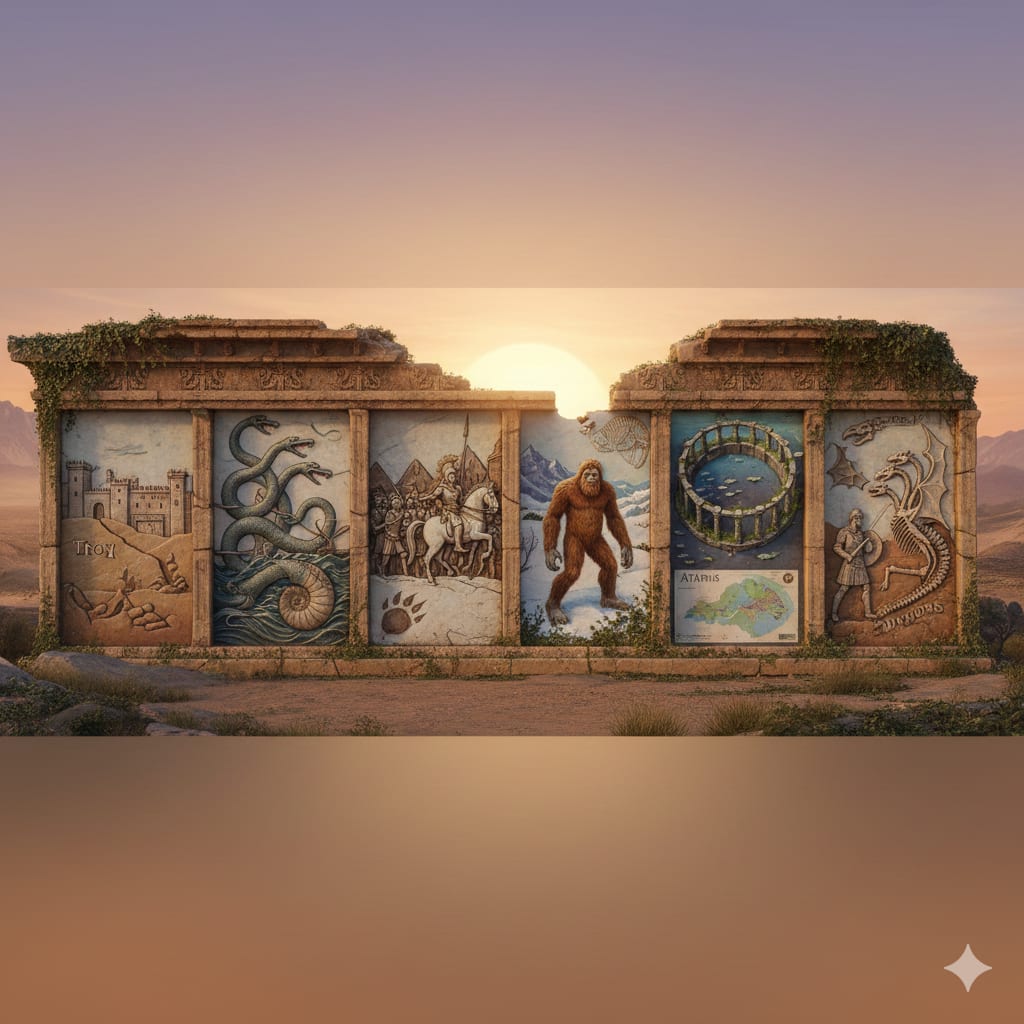
Humans are natural storytellers. For thousands of years, myths and legends have ignited our imagination, fed our souls, and passed wisdom from one generation to the next. While many of these tales are just that, stories, some are rooted in real events, revealing fascinating truths about our planet and the universe.
Here are six ancient legends from around the world that were more than just myths; they have a kernel of truth backed by science and history.
1. The Ancient Story of “The Guest Star.”
In April A.D. 1006, people across Asia, the Middle East, Europe, and possibly North America witnessed a dazzling “guest star” in the sky.
Persian scientist Ibn Sina (Avicenna) documented it in his “Book of Healing,” noting its greenish-yellow glow, sparks, and shifting colors before vanishing.
For centuries, it was mistaken for a comet. Today, astronomers know it was a supernova, a massive cosmic explosion that happened 7,200 years ago, whose light only reached Earth at the start of the first millennium. At its peak, it was brighter than Venus and even visible during the daytime. High-energy remnants of this stellar explosion are still observable today via NASA’s Chandra X-ray Observatory.
2. The Legend of Crater Lake
The Klamath tribe of Oregon believed Crater Lake was formed during a battle between Skell, lord of the Above-world, and Llao, god of the Under-world. Fire and brimstone rained between Mount Mazama and Mount Shasta until Llao was defeated and trapped beneath the mountain, which later became a beautiful blue lake.
Science tells us the truth is just as dramatic. Around 7,700 years ago, Mount Mazama erupted, expelling so much molten rock that the summit collapsed, forming a massive volcanic caldera. Over time, rain and snow filled the depression, creating the deepest lake in the United States.
3. The Myth of Rama’s Bridge
In the Hindu epic Ramayana, Rama’s wife is kidnapped and taken to Lanka, prompting him to build a floating bridge of stones with his army of monkeys to rescue her.
While the story sounds fantastical, Rama’s Bridge (Adam’s Bridge) exists. Satellite images show a 48-kilometer chain of limestone shoals and sand connecting India and Sri Lanka. Some sandbanks were walkable until the 15th century, when storms submerged parts of the bridge beneath shallow waters.
4. Atlantis: Myth or Reality?
Plato’s Atlantis tells of a utopian civilization that sank beneath the waves. While Atlantis itself is debated, many scholars point to a real-world inspiration: the Minoan civilization on Santorini (ancient Thera).
Around 3,650 years ago, a catastrophic volcanic eruption obliterated the island, triggered massive tsunamis, and spewed sulfur dioxide into the atmosphere, causing long-term climate effects. The disaster likely led to the rapid decline of the Minoans, inspiring the enduring legend of Atlantis.
5. Noah’s Ark and the Great Flood
Stories of a massive flood saving one family and all animals appear in many cultures, from the Bible to the Epic of Gilgamesh.
While a global flood is impossible, geological evidence suggests a catastrophic flooding event in the Black Sea around 5,000 B.C. Mediterranean waters broke through a natural barrier, creating a waterfall 200 times the volume of Niagara Falls and flooding nearby lands. Those who witnessed it may have inspired the flood myths we know today.
6. Why These Myths Matter
Myths are more than beautiful stories; they are windows into history, science, and human perception.
These ancient tales, whether about supernovas, volcanic eruptions, or cataclysmic floods, provide clues to our distant past, helping scientists and historians reconstruct the events that shaped our world.
So next time you hear a myth, remember: some stories passed through generations may be stranger than fiction, and perhaps, true.
.
.
.
.
.
.
.
.
.
.
“ancient legends,” “true myths,” “historical myths,” “Rama’s Bridge,” “Crater Lake legend,” “Atlantis,” “Noah’s Ark.”
About the Creator
Areeba Umair
Writing stories that blend fiction and history, exploring the past with a touch of imagination.
Keep reading
More stories from Areeba Umair and writers in History and other communities.
6 Bizarre Taxes From History That Will Make You Thank Modern Life
Throughout history, taxes haven’t always been about income or property. Some levies were downright bizarre, targeting everyday life, personal habits, and even your body. From medieval England to ancient Rome, here are six of the strangest taxes ever recorded.
By Areeba Umairabout 23 hours ago in History
The Titanic and the Titan had much in common.
Two unsinkable ships that sank It's regrettable that 5 lives were lost on the Titan submersible that now lies at the bottom of the ocean near the Titanic. Not only are these two vessels in the same ocean but they have other similarities.
By Cheryl E Preston6 days ago in History
No Other Choice (2025)
It is only February, so other films may well surpass “No Other Choice”, but I think this is the best film I’ve seen so far this year. And that surprises me, because, it is a subtitled film and while I am pretentious enough to choose to watch foreign-language films, I was also very tired and that was an extra commitment from me. But more importantly, let me warn you, this film is gruesome and violent. There were times I had to turn away from the screen to avoid the worst of it (including some self-inflicted dentistry).
By Rachel Robbins4 days ago in Geeks



Comments
There are no comments for this story
Be the first to respond and start the conversation.